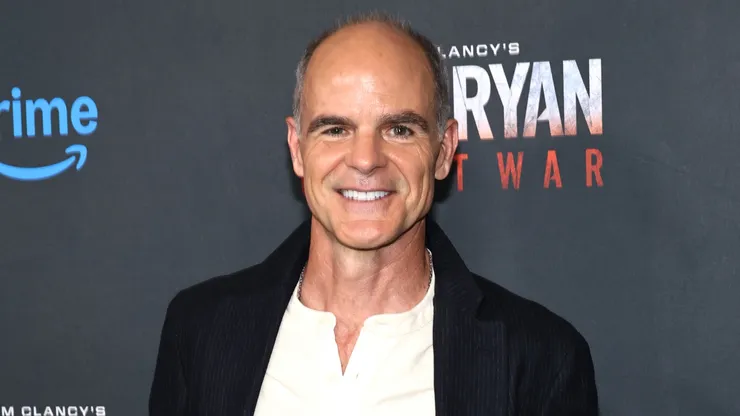
Born on May 22, 1969 in Philadelphia, Michael Kelly has built a television career defined less by celebrity spotlight and more by the weight of the characters he inhabits. He eventually carved out a steady presence in film and television, often portraying figures of authority—CIA officers, military commanders, and political operatives—whose influence is felt more in decisions than in dialogue.
Each performance reinforced a consistent screen identity: controlled, grounded and often operating in morally complex environments where tension builds in silence rather than spectacle. As he turns 56, attention naturally returns to a body of work that has shaped ensemble storytelling in contemporary television.
Doug Stamper – House of Cards (2013–2018)
Few characters define Michael Kelly’s career like Doug Stamper, the deeply loyal and psychologically fractured right hand of Frank Underwood in House of Cards. Across six seasons, the role evolves from cold political operator to a man increasingly consumed by obsession, survival, and emotional dependency inside the brutal machinery of Washington power.
What made Stamper resonate was not volume, but restraint. Kelly’s performance leaned into silence, stillness, and controlled volatility, turning every pause into tension. The character became one of the most recognizable figures in Netflix’s early prestige era, earning Kelly critical acclaim and multiple award nominations for supporting actor performances.
Mike November – Jack Ryan (2018–2023)
In Tom Clancy’s Jack Ryan, Kelly shifts into a more grounded intelligence-world presence as Mike November, a CIA field operative whose instincts often balance pragmatism with moral clarity. Appearing alongside John Krasinski’s Jack Ryan, he brings a veteran energy that helps anchor the series’ global missions.
Over multiple seasons, November becomes more than a supporting player—he functions as a stabilizing force within chaotic geopolitical operations. Kelly’s portrayal emphasizes calm authority under pressure, especially in sequences involving field extraction, covert planning, and shifting alliances.
Captain Bryan Patterson – Generation Kill (2008)
One of Kelly’s earliest standout television roles came in HBO’s Generation Kill, where he portrayed Captain Bryan Patterson during the U.S. invasion of Iraq. Based on real events, the miniseries captures the exhaustion, confusion, and bureaucracy of modern warfare.
Kelly’s performance stands out for its subtle authority. Rather than dramatizing command, he plays Patterson as a man constrained by structure, constantly navigating between leadership responsibility and military absurdity in a rapidly evolving battlefield environment.
Mark Snow – Person of Interest (2011–2013)
In Person of Interest, Kelly appears as Mark Snow, a corrupt detective entangled in the show’s broader surveillance-driven world. Though not a main character, his presence reinforces the series’ central theme: systems of power quietly shaping moral outcomes.
His arc unfolds through tension-filled episodes where loyalty, corruption, and survival collide. Kelly’s interpretation leans into ambiguity—Snow is neither fully villain nor victim, but a man shaped by institutional decay.
Dr. Edgar Dumbarton – Taboo (2017)
In Taboo, set in a dark, fog-drenched early 19th-century London, Kelly plays Dr. Edgar Dumbarton, a figure tied to political and medical corruption within the story’s layered conspiracy. The series, led by Tom Hardy, thrives on atmosphere, and Kelly fits seamlessly into its grim tone.
His performance is restrained but unsettling, adding intellectual weight to a world driven by greed, empire, and secrecy. Dumbarton operates in the background of power structures, reflecting the show’s fascination with hidden influence.
Gary Volesky – The Long Road Home (2017)
Based on true military events, The Long Road Home depicts the 2004 Sadr City ambush in Iraq. Kelly portrays General Gary Volesky, a real-life military figure involved in the chain of command during the crisis.
Rather than focusing on battlefield action, Kelly’s role highlights decision-making under extreme pressure. His scenes often revolve around communication breakdowns, strategic hesitation, and the emotional toll of command during unfolding tragedy.
Andrew McCabe – The Comey Rule (2020)
In The Comey Rule, Kelly steps into real-world political drama as Andrew McCabe, former Deputy Director of the FBI. The miniseries explores internal conflicts within the bureau during the early years of the Trump administration.
Kelly’s portrayal is measured and procedural, reflecting the institutional tone of the FBI itself. His performance adds texture to the show’s broader examination of loyalty, law enforcement ethics, and political pressure.
Johnny Viti – The Penguin (2024)
In HBO’s The Penguin, part of the Batman universe, Kelly plays Johnny Viti, a figure embedded in Gotham’s criminal ecosystem. The series expands the world introduced in The Batman film, focusing on power struggles within organized crime.
Kelly brings a grounded criminal realism to the role, portraying Viti as someone navigating shifting alliances in a city where loyalty is temporary and survival depends on adaptability.
Agent Jonathan “Prophet” Sims – Criminal Minds: Suspect Behavior (2011)
In this short-lived spin-off of Criminal Minds, Kelly appears as Agent Jonathan Sims, nicknamed “Prophet,” a member of an elite FBI team dealing with high-risk behavioral analysis cases.
His character adds a darker psychological edge to the procedural format, reflecting the show’s focus on profiling violent offenders. Kelly’s performance is tightly controlled, emphasizing intelligence and internal tension.
Mickey Gunn – The Good Wife (2011–2012)
In The Good Wife, Michael Kelly appears as Mickey Gunn, a sharp political strategist introduced during Season 3. His character operates within the show’s dense political ecosystem, often engaging in verbal and tactical clashes that reflect the series’ signature blend of legal drama and behind-the-scenes power negotiation.
He appears across two episodes, quickly fitting into the show’s rhythm of fast dialogue and high-stakes maneuvering. Although limited in screen time, the role reinforces Kelly’s consistent strength in portraying politically aware figures who navigate institutional pressure with calculated restraint.
Mickey Gunn functions less as a central figure and more as a catalyst within the narrative machinery of The Good Wife, contributing to the layered political tension that defines the series’ world.