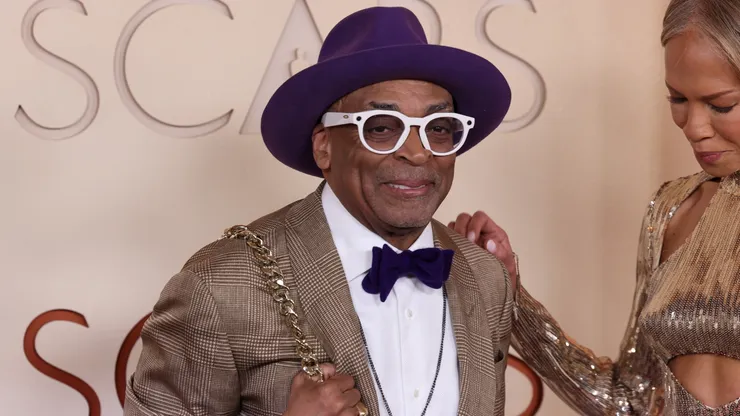
At 69, Spike Lee remains one of the most influential voices in American filmmaking, with a career defined by stories that challenge, provoke, and document the complexities of social life in the United States.
He first gained attention in the late 1980s with She’s Gotta Have It, but it was Do the Right Thing that firmly established his reputation, capturing racial tensions in Brooklyn with a style that was both visually bold and deeply grounded in reality.
His work has earned critical recognition, including Academy Award honors, while several of his films have been preserved for their cultural impact. Taken together, his filmography reflects not just an evolution in storytelling, but a consistent effort to engage with the social and political climate of each era.
Do the Right Thing (1989)
Do the Right Thing stands as Spike Lee’s defining film, a layered portrait of a Brooklyn neighborhood where racial tensions simmer throughout the hottest day of the summer.
The story unfolds through an ensemble cast, capturing everyday interactions that gradually escalate into conflict, culminating in a tragic and controversial climax involving police violence. The film was inspired in part by real-life incidents of racial injustice in New York, grounding its narrative in lived social realities.
What makes the film enduring is its refusal to offer easy answers. Through stylized cinematography, direct-to-camera monologues, and the recurring presence of Public Enemy’s “Fight the Power,” Lee constructs a world that feels both heightened and deeply authentic. Its ambiguous ending sparked debate upon release and continues to invite discussion about responsibility, protest, and systemic inequality decades later.
Malcolm X (1992)
With Malcolm X, Spike Lee took on one of the most ambitious projects of his career, delivering a sweeping biographical epic centered on the influential civil rights leader.
The film traces Malcolm X’s transformation from a troubled youth into a powerful voice for Black empowerment, with Denzel Washington delivering a performance widely regarded as one of the finest in modern cinema.
Rather than presenting a simplified narrative, Lee explores the contradictions and evolution of Malcolm X’s ideology, emphasizing his shifting views on race, religion, and identity.
The film’s scale — from prison sequences to international travels — reflects a commitment to historical authenticity, making it both an educational and cinematic milestone in Lee’s filmography.
BlacKkKlansman (2018)
BlacKkKlansman revisits a real-life story from the 1970s, following a Black detective who infiltrates the Ku Klux Klan through a combination of phone deception and undercover work.
The film blends satire with tension, using humor as a vehicle to expose the absurdity and danger of organized racism while maintaining a gripping narrative structure. What elevates the film is its deliberate connection between past and present.
Lee closes the story by referencing modern events, reinforcing the idea that the issues depicted are far from historical relics. This approach earned him his first competitive Academy Award and reasserted his relevance in contemporary political cinema.
25th Hour (2002)
Set in the aftermath of 9/11, 25th Hour follows a man spending his final day of freedom before beginning a prison sentence. Unlike many of Lee’s more outwardly political films, this story is intimate, focusing on regret, friendship, and the weight of irreversible decisions. The city itself plays a central role, portrayed as wounded yet resilient.
The film’s emotional core lies in its introspective tone, particularly in its exploration of identity and consequence. Through carefully structured dialogue and reflective pacing, Lee crafts a narrative that feels personal while subtly capturing a broader sense of uncertainty in early-2000s America.
Inside Man (2006)
With Inside Man, Spike Lee stepped into mainstream thriller territory without abandoning his thematic concerns. The film revolves around a meticulously planned bank heist that quickly evolves into a psychological battle between a detective and a mastermind criminal. Its structure relies on layered storytelling, gradually revealing key details.
Despite its commercial appeal, the film quietly incorporates social commentary, touching on issues such as power, wealth, and institutional secrecy. Lee balances suspense with sharp dialogue, proving his ability to operate within genre conventions while still imprinting his distinct voice.
Da 5 Bloods (2020)
Da 5 Bloods follows a group of Vietnam War veterans returning to the country decades later, seeking both closure and a buried treasure. The narrative shifts between past and present, blending war sequences with reflections on memory, trauma, and loyalty among soldiers who were often overlooked upon returning home.
Rather than focusing solely on action, the film delves into the psychological scars of war and the historical treatment of Black soldiers. Its structure, which interweaves personal grief with political context, highlights Lee’s ongoing interest in revisiting history through a contemporary lens.
She’s Gotta Have It (1986)
Spike Lee’s debut feature, She’s Gotta Have It, introduced audiences to a fresh and unapologetically independent voice. The film centers on a young woman navigating relationships on her own terms, challenging traditional portrayals of gender and sexuality in cinema at the time.
Shot on a modest budget, the film’s success helped redefine the possibilities of independent filmmaking in the United States. Its conversational style, direct address, and character-driven narrative signaled the arrival of a filmmaker willing to push boundaries both thematically and stylistically.
He Got Game (1998)
In He Got Game, Lee explores the intersection of sports, family, and ambition through the story of a high school basketball prodigy and his estranged father. The film uses the world of basketball not just as a backdrop, but as a lens through which to examine pressure, opportunity, and systemic exploitation.
The dynamic between the two central characters drives the narrative, adding emotional weight to the sports drama framework. Lee’s direction emphasizes both the spectacle of the game and the personal struggles behind it, creating a film that resonates beyond athletics.
School Daze (1988)
School Daze takes place on a historically Black college campus, addressing themes such as colorism, identity, and internal divisions within the community. By combining elements of musical, comedy, and drama, Lee experiments with tone while tackling serious social issues.
The film’s structure allows for multiple perspectives, presenting conflicts that are both personal and cultural. Though less widely discussed than his later works, it serves as an important step in Lee’s development, introducing ideas that would become central to his later films.
Jungle Fever (1991)
Jungle Fever examines the complexities of interracial relationships in New York City, focusing on how personal choices intersect with societal expectations. The film does not shy away from uncomfortable truths, portraying tensions within both families and communities.
One of its most notable aspects is its raw depiction of addiction and emotional conflict, particularly through supporting characters. Lee approaches the subject with honesty rather than simplification, reinforcing his reputation for confronting difficult topics head-on without offering easy resolutions.