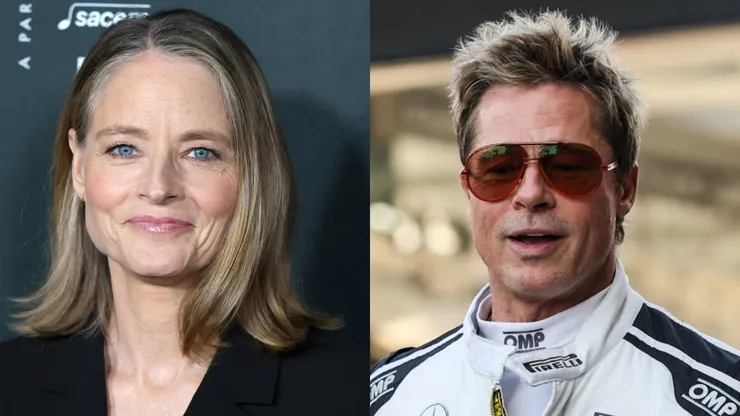
According to Variety, Jodie Foster pointed to Brad Pitt’s “F1” during a panel at the Aspen Festival of Ideas, arguing that the film’s storytelling felt so formulaic it resembled something generated by AI, despite acknowledging its enormous commercial success.
Jodie Foster Says ‘F1’ Felt Like an AI-Generated Movie
During the discussion, titled Who Owns the Future of Hollywood, Foster reflected on the industry’s technological evolution and cited “F1” as an example of where she believes filmmaking could be heading. While making it clear she was not dismissing the picture’s achievements, she remarked, “I don’t say this disparagingly… This movie went on to make millions of dollars. But I look at a movie like ‘F1’ and I’m like, ‘F1’ was made by AI.”
She went on to explain what led her to that conclusion, pointing to the film’s narrative structure and dialogue. “The structure was exactly the structure that you would learn in school. The actors say the lines exactly the way it would be written if a computer was writing exactly what would be the right thing for that time.” Foster added that those behind it “were able to dominate the technology to make something big and beautiful and potentially where a lot of the information comes from other places.”
Her comments come as “F1” continues to stand as one of the biggest theatrical successes of the past year. Directed by Joseph Kosinski and starring Brad Pitt as veteran driver Sonny Hayes, the racing drama became Apple’s highest-grossing movie to date and earned more than $634 million at the worldwide box office. Following that success, a sequel was officially greenlit.
The conversation later shifted to AI’s broader impact on Hollywood. Foster acknowledged that the technology is already changing production and could continue replacing jobs across the industry, particularly in areas such as background performances.
At the same time, she expressed support for using AI as a filmmaking tool rather than a creative substitute, saying, “What we all would love is that filmmakers would be able to dominate AI, and never lose sight of that.” She also noted that AI-assisted imagery proved useful for a dream sequence in her latest picture, provided the technology remained in service of the director’s vision rather than the other way around.