Awards season tends to freeze a moment in time, but the story of a year in acting is rarely that contained. Throughout 2025, a handful of performers didn’t just collect nominations—they shaped the conversation across genres and platforms, moving between prestige films, streaming hits and unexpected box office runs.
It became a year defined less by a single breakout and more by sustained presence, where visibility was built project by project, performance by performance, until certain names felt impossible to avoid.
What makes this transition into 2026 particularly compelling is how momentum now functions as its own currency. The industry no longer resets in January; it carries forward, with casting decisions, festival buzz and early releases already reflecting the aftershocks of the previous year.
Josh Brolin | Weapons, Wake Up Dead Man, The Running Man
Josh Brolin built one of the most eclectic résumés of 2025 by moving across radically different genres without losing cohesion as a screen presence. In Weapons, he stepped into a dark, psychological horror framework, portraying a father caught in a disturbing mass disappearance, a role that leaned heavily on emotional desperation and unease rather than action-driven beats.
At the same time, his participation in Wake Up Dead Man: A Knives Out Mystery placed him inside one of the decade’s most recognizable ensemble franchises, where he played a powerful religious figure entangled in a murder case set within a gothic church.
Complementing that, The Running Man cast him as a manipulative TV producer in a dystopian spectacle, reinforcing how 2025 wasn’t about a single defining role for Brolin—but about range, scale, and the ability to dominate wildly different cinematic spaces within the same year.
Benicio del Toro | One Battle After Another, The Phoenician Scheme
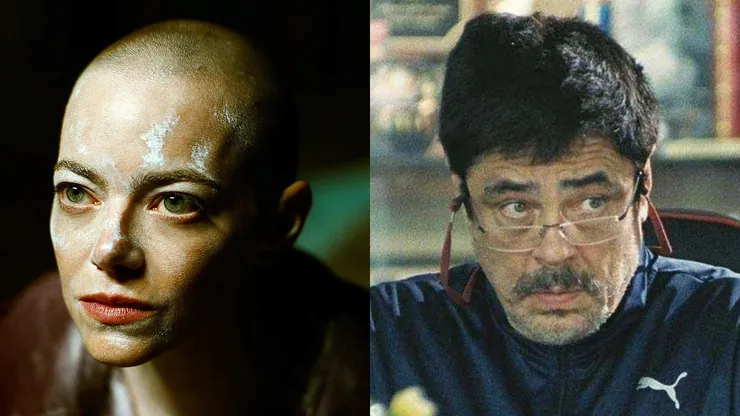
Benicio del Toro found himself at the center of one of 2025’s most anticipated auteur-driven projects with One Battle After Another, directed by Paul Thomas Anderson.
The film—loosely inspired by Thomas Pynchon’s work—brought together a high-profile ensemble and leaned into a mix of political satire and action, giving del Toro space to operate within a layered, tonally complex narrative.
What elevated his presence that year wasn’t just the scale of the production, but the kind of material he gravitated toward. His performances continue to thrive in ambiguity—characters that don’t fully reveal themselves, shaped as much by silence as by dialogue.
Within a landscape increasingly driven by clear archetypes, del Toro’s 2025 work stood out precisely because it resisted clarity, reinforcing his reputation as an actor who brings texture rather than resolution.
Robert Pattinson | Mickey 17, Die My Love
Robert Pattinson continued to deepen his collaboration with visionary filmmakers in 2025, most notably through Mickey 17, a sci-fi project directed by Bong Joon-ho that blends existential themes with large-scale storytelling.
The film’s premise—centered on a disposable worker repeatedly regenerated—allowed Pattinson to explore identity in a fragmented, almost cyclical way, pushing further into conceptual acting territory.
Running parallel to that, Die, My Love placed him in a much more intimate and emotionally volatile setting, adapting a psychologically intense narrative that contrasts sharply with the controlled structure of his sci-fi work.
That duality is what defined Pattinson’s 2025: not just visibility, but a deliberate tension between scale and intimacy, between spectacle and emotional rawness—an approach that continues to set him apart from more conventional leading actors.
Paul Mescal | Hamnet, The History of Sound
Paul Mescal consolidated his position in 2025 not through volume, but through carefully selected, emotionally resonant material. In Hamnet, the adaptation of Maggie O’Farrell’s novel, he stepped into a narrative shaped by grief, memory, and absence, where the emotional weight rests as much on what is unspoken as on what is expressed.
His performance leaned into restraint, allowing the story’s intimacy to dictate rhythm rather than forcing dramatic peaks. That same sensibility carried into The History of Sound, a project built around connection and quiet longing, where Mescal once again operated in a register that prioritizes interiority over spectacle.
Across both films, his 2025 wasn’t defined by transformation or scale, but by consistency—an actor refining a language of performance rooted in subtle shifts, silences, and emotional precision.
Jessie Buckley | Hamnet, How to Shoot a Ghost
Jessie Buckley delivered one of the most emotionally elastic performances of 2025 in Hamnet, where her portrayal carried the narrative’s emotional core. The role demanded a balance between fragility and force, often within the same scene, and Buckley approached it with a rawness that never tipped into excess. Her ability to hold tension internally gave the film much of its lingering impact.
In contrast, How to Shoot a Ghost allowed her to move into more experimental territory, embracing a story less bound by traditional structure. That shift highlighted her versatility—not just in tone, but in rhythm, adapting her performance style to match the film’s more abstract language.
Joel Edgerton | Train Dreams, The Plague
Joel Edgerton anchored two markedly different narratives in 2025, both rooted in atmosphere and character rather than plot-driven urgency. Train Dreams, based on Denis Johnson’s novella, required a performance built on isolation and the passage of time, where Edgerton’s physical presence—quiet, contained, almost weathered—became central to the storytelling.
Meanwhile, The Plague pushed him into darker territory, exploring moral tension within a more oppressive, uneasy setting. What ties both performances together is Edgerton’s refusal to overstate emotion; instead, he allows it to surface gradually, often through gesture and pacing rather than dialogue.
Mark Ruffalo | Mickey 17, Hal & Harper, Task
Mark Ruffalo had one of the most varied presences of 2025, navigating between large-scale cinema and more intimate, character-driven storytelling. In Mickey 17, his collaboration within Bong Joon-ho’s layered sci-fi world positioned him inside a narrative that blends satire, identity, and existential repetition, requiring a performance that could shift tone without losing coherence.
At the same time, projects like Hal & Harper and Task allowed him to operate on a smaller, more introspective scale. These roles leaned into Ruffalo’s long-established strength: portraying flawed, deeply human characters with a sense of vulnerability that never feels performative.
Dakota Johnson | Materialists, Splitsville
Dakota Johnson sharpened her screen identity in 2025 through performances built on restraint and observational detail. In Materialists, directed by Celine Song, she plays within a narrative centered on relationships and emotional economics, where much of the performance unfolds through subtext rather than direct expression.
Her control over tone—knowing when to withhold rather than reveal—became one of the film’s defining elements. With Splitsville, she explored a more contemporary and potentially satirical edge, yet maintained that same understated approach.
Across both projects, Johnson avoided dramatic excess, instead building characters that feel lived-in and quietly complex. Her 2025 stands out for its precision—proof that minimalism, when executed with intent, can be just as commanding as transformation-heavy roles.
Ralph Fiennes | The Choral, 28 Years Later
Ralph Fiennes once again demonstrated why he remains a reference point for controlled, technically precise acting. In The Choral, his performance is rooted in discipline and structure, likely tied to a character shaped by hierarchy, tradition, or artistic rigor. Fiennes excels in these spaces, where authority is conveyed not through volume, but through posture, cadence, and restraint.
In contrast, 28 Years Later places him within a far more volatile environment, part of a franchise known for tension and urgency. That shift allows him to apply the same precision under pressure, adapting his performance to a world driven by chaos rather than control.
Josh O’Connor | Rebulding, The History of Sound, The Mastermind, Wake Up Dead Man
Josh O’Connor arguably had one of the most expansive years in terms of range. Moving between projects like The Mastermind and Wake Up Dead Man, he demonstrated an ability to adapt to both tightly constructed ensemble pieces and more character-focused narratives.
His performances often hinge on internal tension, creating characters that feel unsettled even in stillness. That same quality carries through Rebuilding and The History of Sound, where emotional nuance becomes central.
Rather than relying on overt transformation, O’Connor builds from within, allowing contradictions to shape his characters. His 2025 wasn’t defined by a single standout role, but by accumulation—a body of work that, taken together, positions him as one of the most versatile actors of his generation.
Emma Stone | Bugonia, Eddington
Emma Stone continued her creative partnership with auteur-driven cinema in 2025, particularly through Bugonia, directed by Yorgos Lanthimos. The project, a remake of a South Korean film, leans into absurdity and controlled chaos—territory where Stone has increasingly thrived.
Her performance operates within a stylized framework, requiring precision in tone to balance the film’s surreal edge. Meanwhile, Eddington, under Ari Aster’s direction, placed her in a completely different environment—one shaped by psychological tension and ensemble interplay.
The contrast between both films highlights Stone’s adaptability, not just in genre but in performance rhythm. Her 2025 work reinforces a trajectory defined by bold collaborations rather than safe choices.
Austin Butler | Caught Stealing, Eddington
Austin Butler leaned further into physically and psychologically demanding roles in 2025. In Caught Stealing, directed by Darren Aronofsky, he takes on a character caught in a chaotic underworld, a role that emphasizes tension, unpredictability, and sustained intensity. The film’s kinetic energy aligns with Butler’s ability to fully inhabit characters under pressure.
In Eddington, however, he becomes part of a broader ensemble, adjusting his performance to fit within a more layered narrative structure. This contrast reveals an actor increasingly aware of scale—when to dominate a scene and when to recede into it. His 2025 reflects a continued commitment to transformation, but with growing control over how that transformation is deployed.
Elle Fanning | Sentimental Value, Predator: Badlands
Elle Fanning navigated two very different cinematic worlds in 2025. In Sentimental Value, directed by Joachim Trier, she operates within an introspective, emotionally layered narrative that plays to her strengths in subtle, character-driven storytelling. Her performance is built on clarity and sensitivity, allowing emotional shifts to emerge gradually.
On the other end of the spectrum, Predator: Badlands introduces her into a high-concept franchise environment, where scale and physical stakes take precedence. What stands out is her ability to adapt without losing her core screen identity. Rather than being overwhelmed by spectacle, she brings a grounded presence that anchors the film’s more intense elements.
Stellan Skarsgard | Andor, Sentimental Value
Stellan Skarsgard carried over one of the most commanding performances in recent television into 2025 through Andor, where his portrayal of Luthen Rael continues to resonate.
The role is defined by controlled intensity, particularly in moments where ideology and personal cost collide. His ability to convey layered motivations within tightly written scenes remains a standout element of the series.
In Sentimental Value, he shifts into a more reflective register, trading political urgency for emotional introspection. The contrast between both projects underscores his range, but also his consistency—an actor who brings gravitas regardless of scale.
Kerry Condon | F1: The Movie, Train Dreams
Kerry Condon approached 2025 from two very different cinematic registers, each demanding a distinct kind of presence. In F1: The Movie, she steps into a high-pressure, large-scale production alongside Brad Pitt, where her role reportedly centers on the technical and strategic side of the racing world.
Rather than being overshadowed by spectacle, her performance works as a stabilizing force—grounded, precise, and essential to the film’s internal logic. With Train Dreams, the scale shifts dramatically.
The film’s meditative tone places emphasis on isolation and memory, allowing Condon to explore a quieter, more reflective performance style. The contrast between both roles highlights her control as an actor—equally effective in expansive, fast-paced environments and in stories that unfold through stillness and emotional residue.
Ethan Hawke | Blue Moon, The Lowdon, The Black Phone 2
Ethan Hawke structured his 2025 around a mix of long-standing creative partnerships and genre revisits. Blue Moon, directed by Richard Linklater, sees him returning to a collaborative dynamic that has historically produced some of his most nuanced work, often centered on dialogue, rhythm, and character introspection.
The project leans into that familiarity, allowing Hawke to operate in a space where subtlety carries narrative weight. In contrast, The Black Phone 2 reintroduces him to a darker, more unsettling tone, following the impact of his original performance as a masked antagonist.
The return to that role adds a layer of continuity, but also raises the stakes in terms of intensity and psychological presence. Across the year, Hawke’s work reflects an actor comfortable moving between intimacy and menace without diluting either.
David Jonsson | The Long Walk, Wasteman
David Jonsson emerged in 2025 through projects that place characters under sustained pressure. The Long Walk, adapted from Stephen King’s novel, situates him within a brutal, endurance-based narrative where psychological strain becomes the defining element.
Performances in that setting require a gradual unraveling rather than sudden shifts, and Jonsson leans into that progression with control. Wasteman, on the other hand, offers a more grounded, character-focused environment, allowing him to explore identity and vulnerability in a contemporary setting.
What connects both roles is a sense of internal tension—his characters often appear composed on the surface while carrying something unsettled underneath. That duality makes his 2025 feel like a breakout built on substance rather than visibility alone.
Pedro Pascal | The Last of Us, Materialists, Eddington, The Fantastic Four
Pedro Pascal maintained one of the most visible and wide-ranging presences of 2025, spanning television, auteur cinema, and blockbuster territory. The Last of Us continued to anchor his year, with his portrayal of Joel remaining central to the series’ emotional core—particularly as the narrative deepens its exploration of consequence and moral ambiguity.
Beyond television, his involvement in Materialists and Eddington places him within filmmaker-driven projects that emphasize tone and character interplay, while The Fantastic Four introduces him into one of Marvel’s most anticipated reboots as Reed Richards.
Timothee Chamalet | Marty Supreme
Timothee Chalamet centered his 2025 around Marty Supreme, a project that departs from his more introspective roles by placing him in a sports-driven narrative inspired by the world of professional table tennis.
Directed by Josh Safdie, the film introduces a kinetic, high-energy environment that contrasts with the controlled emotional landscapes he has often inhabited. What makes this performance particularly notable is its physical dimension—rhythm, movement, and competitive intensity become just as important as dialogue.
Chalamet adapts to that shift by leaning into pace and presence, demonstrating an ability to recalibrate his acting style without losing his defining sensitivity. His 2025 stands as a reminder that reinvention doesn’t always require abandoning identity—it can emerge through context alone.