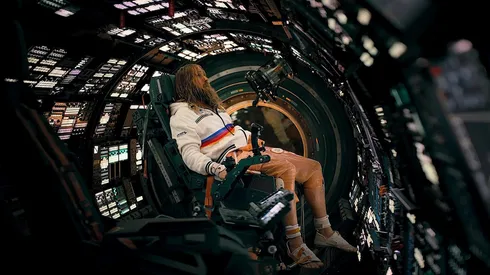
In a recent interview with Comic Book, Christopher Miller revealed that he and directing partner Phil Lord made an unusually bold choice for their adaptation of Project Hail Mary: they shot it without relying on green screens. The cosmic adventure, starring Ryan Gosling, was built on physical sets and practical creature work, a strategy that reframes how a modern space film can look and feel.
Building Space the Hard Way
In an era when even modest productions lean heavily on digital environments, Miller’s approach feels almost contrarian. “There is no green screen in the movie whatsoever. Not a single green or blue screen was used,” he said, emphasizing that the interior of the Hail Mary spacecraft was constructed in full. The team also built a substantial section of the ship’s exterior, turning what might have been a visual effects playground into a tactile working environment.
That commitment extended to Rocky, the alien companion at the heart of the story. Instead of performing opposite a marker destined to be replaced in post production, the cast interacted with a fully realized on set presence. “Rocky was really with us at all times,” Miller explained. For Gosling’s Ryland Grace, a man waking up alone in deep space, that physical interaction lends weight to a relationship that carries much of the film’s emotional charge.
Cinematographer Greig Fraser capitalized on that realism. With practical lights embedded into the set, his team could move fluidly and respond to performances as they unfolded. Miller described how they were able to shift the camera toward Gosling’s reactions to “what was really happening,” rather than “guessing and pointing out where Rocky might be some day.” The effect, he suggested, is a sense that scenes were captured in the moment, not assembled later.
Adapted from Andy Weir’s novel by Drew Goddard, the picture follows an amnesiac astronaut who discovers he may be humanity’s last hope. It is a premise that practically begs for digital spectacle. Instead, Lord and Miller appear to have bet on craftsmanship and proximity, wagering that audiences can feel the difference between a void imagined in post production and one built, lit and inhabited in real time.