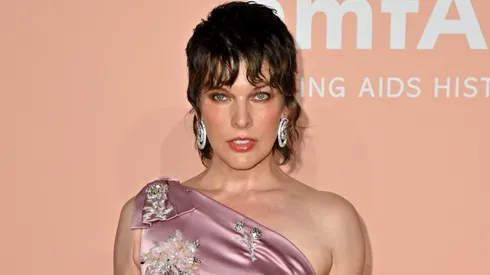
Milla Jovovich entered cinema as an unconventional presence, one that resisted easy categorization. Breaking through in the late 1990s, she became synonymous with characters built on instinct, physicality, and quiet defiance, shaping a career that unfolded largely outside traditional Hollywood paths.
Turning 50, she stands as a figure whose work mirrors the evolution of genre filmmaking itself. Her most enduring performances blended action with atmosphere, often placing strength and vulnerability side by side. Rather than chase reinvention, her career has been defined by consistency, commitment and a distinctive screen identity that endured.
The Fifth Element (1997)

More than a cult favorite, The Fifth Element stands as the film that permanently defined Milla Jovovich’s screen persona. As Leeloo, she constructed a character almost entirely through physical expression, movement, and emotion, relying on a fragmented language that paradoxically made her more human. Jovovich’s performance balanced innocence and strength, turning a high-concept sci-fi spectacle into something intimate and character-driven. Decades later, Leeloo remains one of the most recognizable figures in modern science fiction, and the role set the template for Jovovich’s future as a physical, presence-first actor.
Resident Evil (2002)
Resident Evil marked a turning point not just in Jovovich’s career, but in early-2000s action cinema. As Alice, she introduced a new kind of franchise heroine—controlled, resilient, and emotionally restrained. The film’s minimalist horror approach allowed her to establish authority without relying on exposition, using silence and movement to build tension. What began as a video game adaptation became a global franchise largely because of Jovovich’s ability to anchor increasingly ambitious sequels with consistency and physical credibility.
Resident Evil: Apocalypse (2004)
Expanding the scope of the original, Apocalypse pushed Jovovich further into action icon territory. Alice evolved from survivor into weapon, and Jovovich adjusted her performance accordingly, embracing a colder, more confrontational presence. The film leaned heavily on spectacle, yet her grounded physicality kept the chaos coherent. This installment solidified her reputation as a reliable franchise lead at a time when female-driven action films were still rare.
The Messenger: The Story of Joan of Arc (1999)
This was one of the most demanding roles of Jovovich’s career. As Joan of Arc, she carried spiritual conviction, psychological torment, and physical exhaustion across a sweeping historical epic. Her performance was raw and polarizing, oscillating between divine certainty and human doubt. While the film divided critics, it showcased Jovovich’s fearlessness as an actor willing to inhabit extremity, making it a crucial entry in understanding her range beyond genre cinema.
Dazed and Confused (1993)
Appearing early in her career, Dazed and Confused revealed a different side of Jovovich—natural, unguarded, and deeply rooted in ensemble storytelling. Her role may not dominate the film, but her presence felt effortless, blending seamlessly into Linklater’s portrait of youth culture. In hindsight, the film stands as a reminder that Jovovich’s foundation was built on character work long before action franchises defined her image.
Zoolander (2001)
Jovovich’s performance in Zoolander demonstrated her sharp comedic instincts. As Katinka, she delivered exaggerated dialogue with deliberate seriousness, enhancing the film’s absurdist tone. The role worked because she committed fully to the satire without undercutting it. It remains one of her most surprising performances, showing her ability to pivot away from intensity and embrace playful irony.
Ultraviolet (2006)
Though critically maligned upon release, Ultraviolet has grown into a cult object defined by its visual ambition. Jovovich leaned fully into the film’s stylized reality, delivering a performance built almost entirely on movement and presence. Rather than grounding the film in realism, she amplified its heightened tone, reinforcing her status as an actor comfortable operating in abstract, design-driven worlds.
The Three Musketeers (2011)
As Milady de Winter, Jovovich reimagined a classic literary antagonist through a modern lens. Her performance blended elegance, menace, and athleticism, allowing the character to function as both strategist and fighter. While the film itself was uneven, Jovovich’s turn stood out for its confidence and physicality, proving her adaptability within historical adventure frameworks.
Faces in the Crowd (2011)
This psychological thriller gave Jovovich room to explore vulnerability rather than dominance. Playing a woman suffering from prosopagnosia after trauma, she focused on internal tension and emotional disorientation. The performance relied less on action and more on sustained unease, offering a quieter but effective reminder of her dramatic range.
Monster Hunter (2020)
Monster Hunter reinforced Jovovich’s long-standing partnership with genre-driven storytelling. As a soldier thrust into an unfamiliar world, she leaned once again on endurance and physical authority to carry the film. While divisive, the movie underscored her consistency as an action lead and her willingness to commit fully to demanding, effects-heavy productions even decades into her career.