
In a new series of interviews conducted by Variety, however, leading Homer scholars and historians offered a different perspective, arguing that historical precision has never been the defining measure of the ancient epic that inspired the film.
ChristopherNolan’s adaptation, starring Matt Damon as Odysseus, follows the Greek king’s perilous journey home after the Trojan War and has received widespread acclaim since its release.
Scholars Argue There Has Never Been a Single Correct Version of ‘The Odyssey’
Much of the online conversation has focused on the film’s production design, with some viewers questioning details such as the polished Trojan Horse or comparing Benny Safdie’s Agamemnon armor to a modern superhero suit rather than Bronze Age equipment.
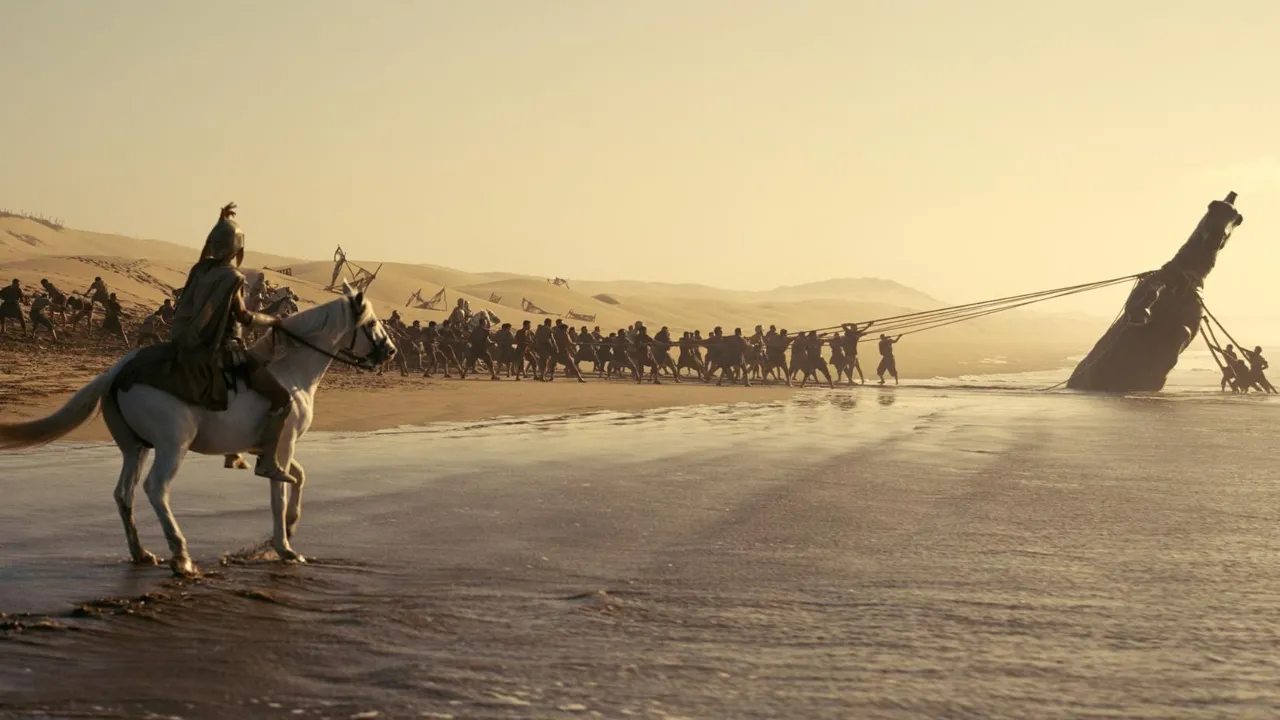
Source: IMDb
Among the experts interviewed by Variety, those concerns were far less significant. Joel P. Christensen, editor of The Oxford Critical Guide to Homer’s Odyssey, summed up the reaction from many academics with a laugh: “Nobody cared. Even the head archaeologist didn’t care.” He added that Homer’s poem itself is “filled with anachronisms” because it combines different historical layers, making historical inconsistencies part of the tradition rather than a departure from it.
The conversation became more nuanced when it turned to Nolan’s adaptation of the text itself. Harvard classicist Gregory Nagy noted there is no single “original” version of “The Odyssey” in the modern sense because the poem developed through centuries of oral storytelling before it was written down.
That idea was echoed by Richard P. Martin, professor of Greek and Latin literature at Stanford, who described Homer’s work as “already historical fiction, reimagining an ancient past when it was first composed.” For Martin, Nolan’s blockbuster belongs to a long tradition of reinterpretations. “There is no ‘correct’ treatment, because every generation makes its own version of the poem, either by retranslation or revisualization in various media.” He concluded with a sentiment many classicists appear to share: “All publicity about Homer is good publicity.”