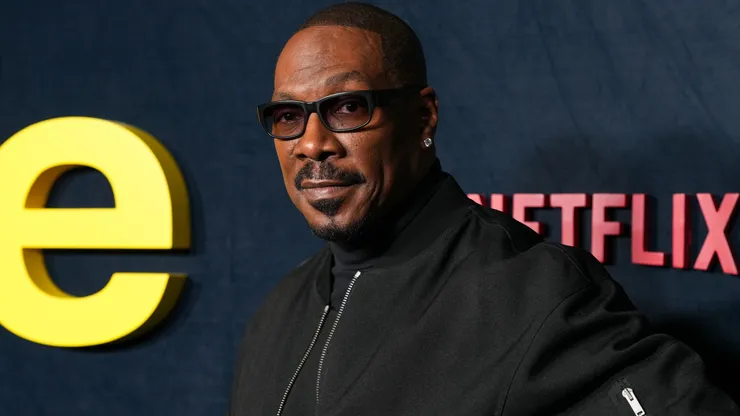
There are comedians who make audiences laugh, and then there is Eddie Murphy—a performer who, at his peak, seemed to bend the rhythm of comedy to his will. Emerging from the fast-talking energy of Saturday Night Live in the early 1980s, herewired the possibilities of mainstream humor.
Turning 65 becomes less a milestone than a marker of influence: a reminder of how one voice, sharpened in stand-up clubs and amplified on screen, helped set the tempo for an entire generation of laughs.
Beverly Hills Cop (1984)
The film that didn’t just launch a career—it detonated it. Playing Axel Foley, a Detroit detective chasing a personal case into the polished excess of California, Eddie Murphy reshaped what an action-comedy protagonist could look like: irreverent, fast-thinking, and constantly one step ahead.
Produced on a relatively modest budget, the movie exploded into a global hit, grossing over $300 million and becoming the highest-grossing U.S. release of 1984.
What made it endure wasn’t just the box office. The character of Foley—equal parts trickster and outsider—became a blueprint replicated across decades of Hollywood storytelling.
The film’s mix of street humor and slick production turned Murphy into an international star almost overnight, cementing a persona that studios would spend years trying to bottle again.
Coming to America (1988)
A royal fairy tale flipped inside out, this comedy follows Prince Akeem’s journey from a fictional African kingdom to Queens, New York, in search of something money can’t buy.
Built from an original story by Murphy himself, the film allowed him to stretch beyond a single role, portraying multiple characters with distinct voices, rhythms, and physicalities.
The result was more than a hit—it became a cultural staple. With a worldwide gross approaching $300 million and endlessly quoted dialogue, the film balanced romance, satire, and identity in a way that felt both extravagant and grounded. Beneath the humor, it offered a rare look at Black wealth and self-determination on screen, wrapped in a story that never lost its comedic pulse.
Trading Places (1983)
Before superstardom fully crystallized, Murphy delivered a performance that cut through class satire with razor precision. Cast opposite Dan Aykroyd, he plays a street hustler suddenly inserted into high society as part of a cruel social experiment. The premise could have leaned heavy; instead, it moves with speed, wit, and biting irony.
Rather than simply playing for laughs, Murphy injects the film with urgency. His performance exposes the absurdity of privilege without losing the rhythm of mainstream comedy. The film’s influence lingers in how it merges social commentary with commercial appeal—a formula that many would attempt, but few would balance as cleanly.
The Nutty Professor (1996)
Here, Murphy disappears entirely—then reappears as an entire family. Using groundbreaking prosthetics and performance shifts, he transforms into multiple members of the Klump household, each with distinct personalities and comedic timing. The technical ambition alone made it remarkable; the execution made it iconic.
Yet beneath the exaggerated humor sits something more reflective. The film explores self-image, insecurity, and transformation, giving Murphy space to blend vulnerability with spectacle. It marked a reinvention phase, proving that his comedic instincts could evolve alongside changing audiences.
48 Hrs. (1982)
Raw, fast, and unpolished in the best sense, this film introduced Murphy to mainstream audiences with a jolt of energy. Paired with Nick Nolte, he plays a wisecracking convict temporarily released to help solve a case—an unlikely partnership that became the foundation for countless future duos.
The chemistry isn’t smooth; it’s abrasive, which is precisely why it works. Murphy’s performance carries a sharp edge, reflecting both the tone of early ’80s cinema and his own stand-up roots. In many ways, this was the prototype—the moment when his voice first collided with Hollywood structure and reshaped it.
Dr. Dolittle (1998)
A pivot toward family audiences didn’t dilute Murphy’s presence—it reframed it. Playing a doctor who suddenly gains the ability to communicate with animals, he anchors a film built on absurdity with surprising sincerity. The concept leans whimsical, but his performance keeps it grounded.
Commercial success followed, opening a new chapter in his career. The film introduced Murphy to younger viewers, extending his influence beyond the audiences that had grown up with his earlier, edgier work. It’s less about punchlines and more about accessibility—without losing comedic identity.
Norbit (2007)
Few films in Murphy’s career divide opinion as sharply as this one. Playing multiple roles once again, he leans fully into exaggerated, almost cartoonish territory. The humor is loud, physical, and intentionally excessive—pushing boundaries rather than refining them.
Despite critical pushback, the film found a massive audience. Its success underscores a recurring truth in Murphy’s career: his connection with viewers often operates independently of critical consensus. Even at its most polarizing, his comedic instincts remain unmistakably his own.
Coming 2 America (2021)
Decades later, Murphy returns to Zamunda with a different rhythm. The sequel leans into nostalgia while introducing a new generation of characters, revisiting familiar faces and settings with a softer, more reflective tone.
Rather than attempting to recreate the original’s energy, the film acknowledges time. The humor shifts, the stakes evolve, and Murphy’s performance carries a sense of legacy—less explosive, more measured. It’s a continuation shaped by distance, not repetition.
Boomerang (1992)
Style defines this film as much as its humor. Set within the world of high-powered advertising, Murphy plays a charismatic executive whose confidence begins to unravel when he encounters someone equally self-assured.
The comedy here is smoother, more restrained. Dialogue replaces spectacle, and charisma replaces chaos. It reveals another dimension of Murphy’s screen presence—one that relies less on transformation and more on control, timing, and subtle shifts in tone.
Bowfinger (1999)
A satire of Hollywood that feels almost too sharp to be accidental. Murphy takes on dual roles: a paranoid movie star and his oblivious lookalike, allowing him to explore fame from both sides of the mirror.
The brilliance lies in its restraint. Instead of overwhelming the screen, Murphy calibrates each performance with precision, creating a contrast that drives the film’s humor. It’s one of his most self-aware works—an industry joke that understands exactly where the line between absurdity and reality begins to blur.
Shrek (2001)
Animation didn’t dilute Eddie Murphy’ presence—it amplified it. As Donkey, he delivered a voice performance that felt as physical and kinetic as any live-action role, turning a sidekick into the emotional engine of the story.
The film itself became a cultural reset for animated comedies, winning the first-ever Academy Award for Best Animated Feature and redefining how humor could coexist with fairy-tale subversion.
Beyond the accolades, Donkey became one of Murphy’s most beloved creations. The rapid-fire dialogue, improvised energy, and relentless optimism gave the character a life far beyond the screen, anchoring multiple sequels and embedding itself into pop culture. It proved that even without appearing on camera, Murphy could dominate a film’s rhythm.
The Haunted Mansion (2003)
Inspired by the iconic Disney theme park attraction, this film placed Murphy at the center of a supernatural comedy designed for family audiences. As a workaholic real estate agent trapped in a mysterious mansion, he balances skepticism and fear with comedic timing that keeps the tone accessible rather than dark.
Although the film received mixed critical reception, it found steady popularity over time, particularly among younger viewers and Disney fans. Murphy’s performance carries the narrative through shifting moods—moving from light humor to eerie spectacle—showing once again his ability to adapt to different genres while maintaining a recognizable comedic voice.