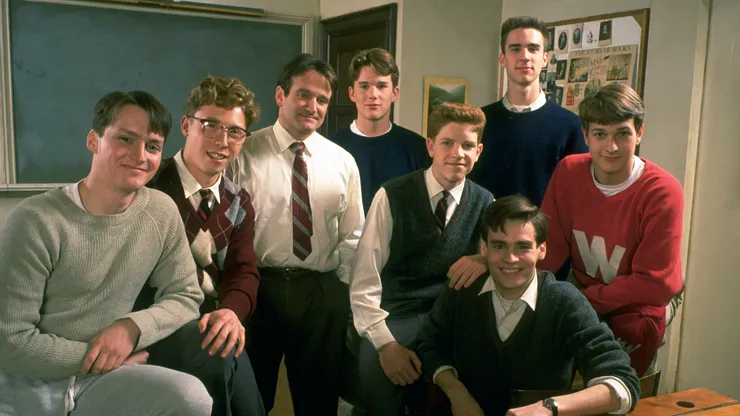
On a day like today back in 1989, audiences were first invited to take a seat in the deeply traditional, fiercely strict English classroom of Welton Academy. They expected a standard coming-of-age prep school drama; instead, they were handed an emotional cinematic grenade.
Directed by Peter Weir and written by Tom Schulman (who won an Academy Award for the screenplay), Dead Poets Society became a massive critical and commercial success. It grossed over $235 million worldwide, turning phrases like “Carpe Diem” into global mantras and redefining Robin Williams’s career.
But in an ever-changing cinematic landscape, how does a quiet, 37-year-old film about teenage boys reading 19th-century poetry still hold such immense cultural weight in 2026? The answer lies in its perfect storm of casting, universal themes, and an unapologetic emotional rawness.
The Robin Williams Factor
Before Dead Poets Society, Robin Williams was globally recognized as a kinetic, lightning-fast comedic genius. Audiences knew him from Mork & Mindy and Good Morning, Vietnam. However, as John Keating, Williams delivered a masterclass in dramatic restraint.
- A Quiet Rebellion: Keating wasn’t loud or cartoonish; he was deeply empathetic, warmly rebellious, and fiercely intelligent. He didn’t just teach his students poetry; he taught them how to think for themselves.
- The Legacy: Following Williams’s tragic passing in 2014, the film took on a profoundly new layer of emotional resonance. Watching Keating urge his students to find their voice and savor life carries a bittersweet weight that continues to bring modern audiences to tears.
A Timeless Battle: Individuality vs. Conformity
The true genius of Dead Poets Society is that it takes the universal teenage experience and treats it with the utmost respect. The boys of Welton Academy are buckling under the immense, suffocating weight of parental and societal expectations.
The tragic arc of Neil Perry (Robert Sean Leonard) and the quiet, painful awakening of Todd Anderson (Ethan Hawke) remain devastatingly relatable. The film accurately portrays the terrifying transition between childhood obedience and adult independence. Whether it is 1959 (when the film is set), 1989 (when it was released), or today, the pressure to conform to a path chosen by someone else is an eternal struggle.
The Enduring Power of Poetry
Ultimately, Dead Poets Society succeeds today for the exact same reason it succeeded 37 years ago: it is a fierce defense of the arts.
In a modern world that often prioritizes relentless productivity, algorithms, and rigid career paths, Keating’s central thesis remains an incredibly necessary reminder. As he passionately tells his students: “Medicine, law, business, engineering, these are noble pursuits and necessary to sustain life. But poetry, beauty, romance, love, these are what we stay alive for.
Decades after its release, Dead Poets Society continues to invite new generations to step up onto their desks, rip out the introductory pages of the rulebook, and figure out what their verse in the powerful play of life will be.