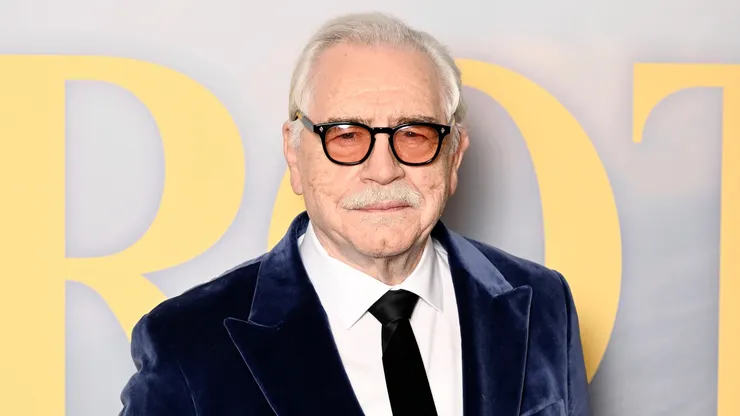
Brian Cox built his reputation long before global fame arrived, beginning his career on British theatre stages after training at the London Academy of Music and Dramatic Art. His early years were shaped by classical work with Shakespearean companies, where he developed the commanding stage presence that later became a signature of his screen performances.
By the 1980s, he was already gaining critical attention in both theatre and television, establishing himself as a versatile actor capable of shifting between historical drama, psychological intensity and contemporary storytelling.
Logan Roy – Succession (2018–2023)
Cox’s portrayal of Logan Roy in HBO’s Succession is widely considered the peak of his career in television. As the ruthless patriarch of the Roy family and CEO of Waystar RoyCo, Logan embodies modern corporate dynastic power, often compared to real-world media moguls such as Rupert Murdoch. The character drives the emotional and narrative tension of the entire series, even in episodes where he appears briefly.
What made the performance stand out globally was Cox’s ability to project dominance without theatrical excess. His delivery is controlled, often minimal, relying on timing, silence, and sudden emotional shifts. This earned him major accolades, including a Golden Globe, and helped define Succession as one of the most critically acclaimed dramas of the streaming era.
Dr. Hannibal Lecktor – Manhunter (1986)
In Michael Mann’s Manhunter, Cox plays Dr. Hannibal Lecktor (spelled differently from later adaptations), marking the character’s first appearance on screen. His version predates Anthony Hopkins’ iconic interpretation and presents a far more restrained and psychological approach to the character.
Rather than theatrical menace, Cox’s Lecktor is cold, analytical, and disturbingly calm. Even with limited screen time, the performance is remembered for its realism and subtle tension, influencing later reinterpretations of the character in cinema and television.
Agamemnon – Troy (2004)
In Wolfgang Petersen’s Troy, Cox plays King Agamemnon, leader of the Greek forces during the Trojan War. The character is driven by political expansion and control over the Greek coalition, often clashing with figures like Achilles over authority and recognition.
Cox’s performance adds a strategic and political layer to the film’s epic structure. Rather than heroic idealism, his Agamemnon is calculating and imperial, reinforcing the idea that the Trojan War is as much about power as it is about mythology and honor.
Ward Abbott – The Bourne Identity (2002)
In The Bourne Identity, Cox plays Ward Abbott, a senior CIA official involved in covert intelligence operations connected to Jason Bourne’s origins. The character represents institutional decision-making behind black-ops programs.
His performance is defined by bureaucratic authority rather than action-driven presence. Cox portrays Abbott as controlled, pragmatic, and morally detached, emphasizing how intelligence systems operate through layers of secrecy and consequence rather than direct confrontation.
Colonel William Stryker – X2: X-Men United (2003)
Cox’s Colonel William Stryker is one of the most iconic villains in early superhero cinema. As the architect of anti-mutant military operations, he embodies ideological extremism rooted in discipline and strategic planning.
Instead of exaggerated villainy, Cox plays Stryker with calm conviction, making him more unsettling. His belief system feels rational within his worldview, which adds complexity to the character and elevates him beyond typical genre antagonists.
Melvin Belli – Zodiac (2007)
In David Fincher’s Zodiac, Cox portrays real-life attorney Melvin Belli, who becomes involved in the media-fueled investigation of the Zodiac Killer case. The film itself is based on the unsolved murders that terrorized Northern California in the late 1960s and 1970s, and Cox’s character appears during a key moment when public attention and legal figures intersect with the investigation.
Although his screen time is limited, Cox brings eccentric authority and public charisma to the role, reflecting Belli’s real-life reputation as a high-profile lawyer. His performance contributes to the film’s broader tone of obsession, uncertainty, and the psychological toll of unresolved truth, reinforcing Fincher’s meticulous approach to procedural storytelling.
Robert McKee – Adaptation. (2002)
In Spike Jonze’s Adaptation., Cox plays Robert McKee, the influential real-life screenwriting teacher, reimagined within Charlie Kaufman’s meta-narrative about storytelling and creative paralysis. The film itself blends fiction and self-referential commentary, making McKee’s presence a structural turning point in the story.
Cox’s performance transforms what could have been a simple lecture into one of the film’s most intense sequences. His delivery is firm, intellectual, and confrontational, pushing the protagonist toward a breakthrough while simultaneously deconstructing Hollywood storytelling conventions.
Captain O’Hagan – Super Troopers (2001)
In the cult comedy Super Troopers, Cox plays Captain John O’Hagan, a strict and disciplined authority figure overseeing a group of undisciplined highway patrol officers. The film, created by the comedy troupe Broken Lizard, relies heavily on absurdist humor and improvisational energy.
Cox’s role is played entirely straight, which is what makes it effective. His serious tone contrasts sharply with the chaotic behavior of the main characters, creating a comedic tension that has helped the film maintain strong cult status years after its release.
Killearn – Rob Roy (1995)
In Rob Roy, Cox portrays Killearn, a manipulative and opportunistic figure operating within the unstable political landscape of 18th-century Scotland. The film, directed by Michael Caton-Jones, focuses on clan conflict, honor, and survival in a harsh historical environment.
Cox’s performance is subtle and grounded, emphasizing intelligence over aggression. Rather than playing a traditional villain, he presents Killearn as a pragmatic survivor, navigating shifting alliances in a world defined by betrayal and political calculation.
Argyle Wallace – Braveheart (1995)
In Mel Gibson’s Braveheart, Cox appears as Argyle Wallace, a nobleman who plays a key role in shaping William Wallace’s early ideological development. The film, which dramatizes the First War of Scottish Independence, became a global success and won multiple Academy Awards.
Though not a central character, Cox’s presence adds emotional and narrative grounding to the story. His portrayal reinforces the political and strategic foundations of the rebellion, offering a measured counterpoint to the film’s more romanticized heroic elements.