One of the most ambitious mythological stories ever created is returning to the big screen with The Odyssey, a cinematic adaptation of Homer’s ancient epic directed by Christopher Nolan.
The film brings the legendary journey of Odysseus back into the spotlight, following the Greek king’s dangerous voyage home after the Trojan War while exploring a world filled with gods, mythical creatures and battles of both physical and psychological endurance.
Set to feature a major ensemble cast, including Matt Damon as Odysseus, the movie has generated attention for its scale, practical filmmaking approach and the challenge of adapting one of literature’s most influential works for a modern audience.
Christopher Nolan Built The Odyssey Around Practical Effects Instead of Digital Illusions
Christopher Nolan’s The Odyssey follows one of the director’s most recognizable filmmaking philosophies: creating as much as possible in front of the camera instead of relying entirely on digital effects.
The production used real locations, physical sets, prosthetics, animatronics and forced perspective techniques to recreate Homer’s mythical world, adding CGI only as a finishing tool rather than the foundation of the scenes.
That approach became especially important for the film’s monsters and supernatural moments. Instead of making creatures exist only on a computer screen, Nolan’s team built physical elements that allowed actors such as Matt Damon and the rest of the cast to interact with their surroundings, giving the epic a more realistic and tangible feeling.
Circe’s Transformation Scene Was Created Without CGI
One of the most talked-about moments in The Odyssey is Circe’s horrifying transformation sequence, and its biggest secret is that the scene was created without relying on CGI.
The production used practical effects, animatronics and traditional filmmaking techniques to show Odysseus’ men being transformed by the sorceress, creating a disturbing visual effect directly on camera.
Instead of digitally replacing the actors, the team worked with physical elements, including prosthetic pieces and makeup effects that altered the appearance of their faces and bodies.
The transformations were enhanced through carefully designed lighting, sound effects and camera work, allowing the scene to feel more like a practical horror sequence than a computer-generated fantasy moment.
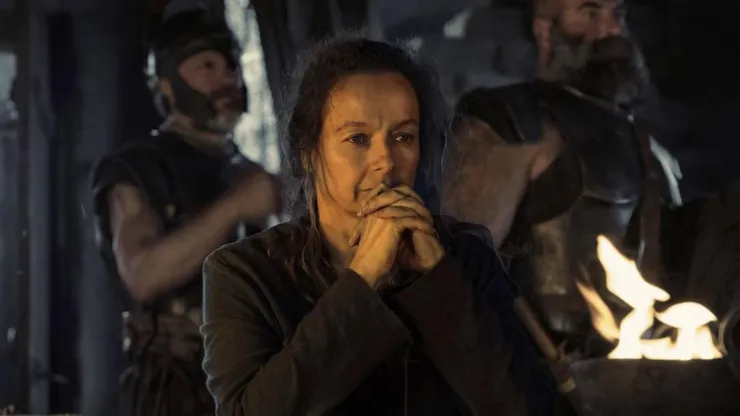
The decision matched Christopher Nolan’s vision for the film’s mythical world: making impossible events feel real. Samantha Morton, who plays Circe, explained that the sequence avoided digital effects and relied on performers, physical effects and the creativity of the filmmaking team to achieve its unsettling result.
Ithaca Was Built Around a Real Italian Castle That Required a Daily Hike
One of the most impressive details behind The Odyssey is that Odysseus’ home of Ithaca was not created entirely on a soundstage. Christopher Nolan’s team used the real Castello di Santa Caterina, a historic fortress located on top of Monte Santa Caterina on the island of Favignana, off the coast of Sicily, to represent the palace where Penelope and Telemachus wait for Odysseus’ return.
However, choosing such an authentic location came with a major challenge: the castle was extremely difficult to access. The cast and crew had to make a steep walk of around 45 minutes every day to reach the set during filming, a demanding routine that became part of the physical experience of the production.
Because the location could not easily accommodate the amount of equipment required for a large-scale Hollywood production, Nolan’s team had to create alternative solutions.
A funicular system was used to help transport materials, while helicopters assisted with moving equipment and supplies to the remote castle location. The decision reflected the filmmaker’s commitment to using real environments, even when they created logistical problems behind the scenes.
The result was a setting that gave Ithaca a sense of history and isolation that would have been difficult to recreate digitally. Instead of building a fantasy kingdom from scratch, Nolan placed the actors inside a real fortress overlooking the Mediterranean, turning the location itself into part of Odysseus’ legendary journey.
Ithaca’s Interior Castle Was Recreated Inside a Huge Los Angeles Set
While the exterior of Odysseus’ home was filmed at the real Castello di Santa Caterina in Sicily, Christopher Nolan’s team took a completely different approach for the interior of Ithaca.
The palace halls and the central megaron — the great hall where Penelope faces the pressure of the suitors — were constructed inside a huge Los Angeles soundstage.
The scale of the set was one of the production’s most impressive achievements. The interior palace was built across three floors and stretched roughly the length of two football fields, creating a complete environment where actors could move naturally without relying on green screens or digital extensions.
Production designer Ruth De Jong explained that the goal was not simply to create a spectacular palace, but to make Ithaca feel different from the richer and more extravagant kingdoms shown in the story.
The design used simpler materials, lower ceilings and more intimate spaces to reflect Odysseus’ home as a place of warmth and identity rather than pure power.
The Cyclops Scene Was Shot Inside a Real Cave With Thousands of Years of History
One of the most challenging sequences in The Odyssey was Odysseus’ encounter with Polyphemus, and Christopher Nolan chose not to recreate the Cyclops’ lair entirely on a studio set.
The scene was filmed inside Nestor’s Cave, a real cavern located in the Peloponnese region of Greece, near Voidokilia Beach, a location with human presence dating back to prehistoric times.
Filming inside the cave created a unique set of difficulties for the production. Unlike a controlled soundstage, the crew had to work within a natural environment where access, space and equipment transportation became major challenges.
According to behind-the-scenes details from the production, reaching the filming area required a long walk of approximately 50 minutes, while specialized equipment had to be brought into the location under difficult conditions.
The production also had to carefully adapt the ancient cave into a functional film set. Installing the necessary structures for practical effects required additional planning and authorization because parts of the setup involved placing anchors into the rock.
Rather than recreating Polyphemus’ home digitally, Nolan’s team transformed a real mythological landscape into one of the film’s most demanding locations. The decision was consistent with Nolan’s approach throughout The Odyssey: placing actors inside real environments whenever possible.
Polyphemus Was Created With a Massive Practical Creature and Bill Irwin’s Performance
The Cyclops Polyphemus became one of the biggest examples of Christopher Nolan’s commitment to practical filmmaking in The Odyssey. Instead of creating the legendary creature entirely through CGI, the production built a massive physical structure that combined puppetry, animatronics, robotics and visual effects to give the monster a real presence on screen.
The scale of the creation was one of the production’s biggest challenges. Nolan’s team built a towering contraption of around 60 feet (approximately 18 meters) inside Nestor’s Cave, allowing Matt Damon and the rest of the cast to react to an actual physical object rather than an imaginary creature that would be added later.
The director explained that the goal was to imagine the encounter from Odysseus’ perspective: not as a fantasy illustration, but as something terrifying that could exist in real life.
Bringing Polyphemus to life also involved the unique talents of Bill Irwin, the performer known for physically controlling and voicing TARS in Nolan’s Interstellar.
For The Odyssey, Irwin helped shape the Cyclops’ movements, voice and physical performance, using his background in mime and puppetry to make the creature feel like a living being rather than just a visual effect. The sound design was another key part of making Polyphemus intimidating.
By recording Irwin’s performance within the cave environment and using the natural acoustics of the location, the production created a deeper sense of scale and fear around the Cyclops.
The combination of the enormous practical creation, the real cave setting and Irwin’s performance turned one of Homer’s most famous monsters into one of the film’s most ambitious technical achievements.
The Laestrygonians Were Created Using Forced Perspective, Not Giant CGI Characters
The Laestrygonians sequence became another example of Christopher Nolan’s decision to create The Odyssey’s mythical world through practical filmmaking techniques.
Rather than turning the giant cannibals into entirely CGI creations, the production used a combination of forced perspective, camera angles, physical performances and carefully designed staging to make the creatures appear enormous on screen.
To create the illusion of scale, Nolan’s team worked with performers of different sizes. The Laestrygonians were portrayed by very tall actors and stunt performers, around 2 meters tall, while smaller doubles represented Odysseus’ soldiers.
By combining differences in height, perspective tricks and precise camera positioning, the filmmakers were able to make the giants look far larger than the human characters without relying entirely on digital effects.
Matt Damon also used a stunt double during the sequence to help maintain the visual illusion. The performer’s different physical proportions allowed the production to manipulate the contrast between Odysseus and the giant enemies, reinforcing the feeling that the hero was facing beings from another world.
The approach followed one of the main ideas behind Nolan’s adaptation: making Homer’s mythology feel like something that could exist in a physical environment. By using real performers, practical staging and old-school cinematic techniques, the Laestrygonians sequence became less about creating fantasy through computers and more about using filmmaking itself to create the illusion of impossible creatures.
Robert Downey Jr. Was Reportedly Considered for the Role of Poseidon
One of the biggest casting stories surrounding The Odyssey involved one of the most powerful figures in Greek mythology: Poseidon, the god of the sea and one of Odysseus’ greatest obstacles during his journey home.
According to reports, Christopher Nolan wanted Robert Downey Jr. for the role, which would have reunited the actor with the director after their Oscar-winning collaboration on Oppenheimer.
However, the potential casting reportedly never moved forward because of scheduling conflicts with Marvel Studios’ Avengers: Doomsday, where Downey Jr. was set to return to the Marvel Cinematic Universe in the role of Victor von Doom.
Neither Nolan nor Downey Jr. has publicly confirmed the details of the offer, making the story one of the most intriguing behind-the-scenes rumors connected to the film. The possibility of Downey portraying Poseidon generated significant attention because the character represents one of the most important forces in Homer’s original epic.
In The Odyssey, the god’s anger toward Odysseus becomes one of the main reasons the hero’s return to Ithaca becomes a decade-long struggle filled with storms, monsters and impossible challenges.
The Underworld Scenes Were Filmed in Iceland’s Extreme Conditions
One of the most unusual filming choices in The Odyssey was Christopher Nolan’s decision to portray the Underworld of Hades through Iceland’s cold and isolated landscapes.
Instead of creating the realm of the dead with artificial sets or digital environments, the director used the country’s volcanic terrain, black sands and remote locations to create a world that felt completely disconnected from Odysseus’ Mediterranean origins.
The Underworld sequences were filmed in Iceland during June, when the country experiences the phenomenon known as the midnight sun, creating an eerie atmosphere with almost continuous daylight.
The production captured the scenes under difficult conditions, with strong winds, rain and desolate landscapes that helped establish the feeling of a mysterious and unforgiving realm beyond the living world.
Nolan specifically selected Iceland because its environment represented the opposite of Ithaca and the warm Mediterranean setting associated with Homer’s epic.
The freezing temperatures, empty terrain and otherworldly scenery allowed the filmmaker to visually separate Odysseus’ journey into Hades from every other part of his voyage, turning the Underworld into one of the film’s most distinctive locations.
Odysseus’ “A Couple of Stops” Line Becomes a Dark Foreshadowing Moment
One of the most ironic moments in The Odyssey comes from a seemingly innocent comment made at the beginning of Odysseus’ journey home. After leaving Troy, the Greek hero tells his men that they have already taken enough from the war and that making “a couple of stops” along the way will not be a problem.
The line quickly becomes one of the film’s most tragic examples of dramatic irony. Those extra stops become the events that slowly destroy Odysseus’ crew, as the survivors encounter some of the most dangerous challenges of the journey, including mythical creatures, hostile forces and situations that leave Odysseus as the only man who reaches Ithaca alive.
Beyond being a dark joke, the moment captures one of the central ideas behind Homer’s epic: Odysseus’ greatest enemy is not only the monsters and gods he faces, but also the consequences of his own decisions. A casual remark about a shorter journey home becomes the beginning of a decade-long struggle filled with loss, temptation and survival.