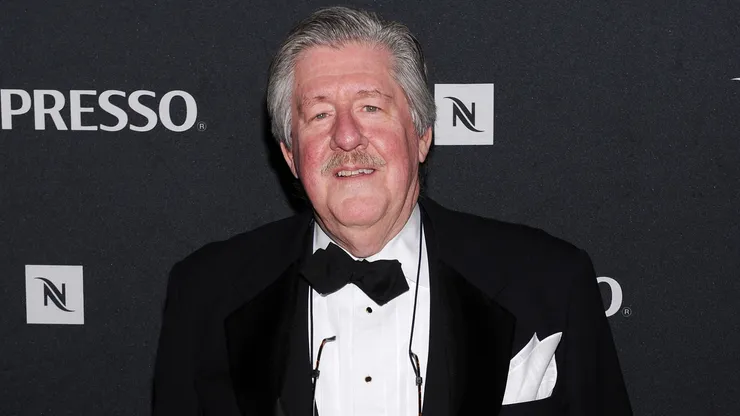
Edward Herrmann never needed to dominate the screen to command it. With his unmistakable voice, refined presence and effortless authority, the Emmy and Tony winner built a career that stretched across Broadway, Hollywood and television, becoming equally convincing as historical figures, corporate tycoons and beloved family patriarchs.
While millions came to know him as Richard Gilmore in Gilmore Girls, his résumé had already been shaped by decades of acclaimed performances in productions ranging from Reds and The Purple Rose of Cairo to The Lost Boys and The Aviator. On what would have been his 83rd birthday, his legacy reaches far beyond a single iconic role.
Gilmore Girls (2000–2007)
No role became more closely associated with Edward Herrmann than Richard Gilmore, the Yale-educated businessman whose love for his family often hid behind impeccable manners and old-fashioned discipline.
Across seven seasons, Herrmann transformed Richard into one of television’s most beloved fathers and grandfathers, balancing humor, vulnerability and quiet emotional depth. His chemistry with Kelly Bishop, Lauren Graham and Alexis Bledel became one of the emotional foundations of Gilmore Girls.
Even after Herrmann’s death in 2014, the series continued to honor his legacy, with the revival Gilmore Girls: A Year in the Life building much of its emotional story around Richard’s absence. Few television performances have remained as cherished by audiences, ensuring that Herrmann’s legacy continues to resonate with each new generation of viewers.
Eleanor and Franklin (1976)
Long before audiences knew him as Richard Gilmore, Edward Herrmann earned widespread acclaim by portraying Franklin D. Roosevelt in the acclaimed television miniseries Eleanor and Franklin.
The performance captured both Roosevelt’s political determination and personal vulnerability, earning praise from critics and opening the door to future portrayals of the president. The success of the miniseries became a turning point in Herrmann’s career.
His interpretation of FDR was considered so convincing that filmmakers repeatedly returned to him whenever the president appeared on screen, creating one of the most enduring actor-historical figure associations in modern television.
Reds (1981)
Warren Beatty’s epic Reds remains one of the defining historical dramas of American cinema, earning 12 Academy Award nominations and winning three Oscars. Herrmann portrayed writer and political activist Max Eastman, joining an ensemble that included Beatty, Diane Keaton and Jack Nicholson.
Rather than competing for attention, Herrmann blended seamlessly into the ambitious production, reinforcing the authenticity of a film that sought to recreate one of the most turbulent political periods of the early twentieth century. His work in Reds further established him as one of Hollywood’s most dependable character actors.
The Aviator (2004)
Martin Scorsese assembled an extraordinary cast for The Aviator, and Herrmann fit naturally among them as Joseph Breen, the influential head of Hollywood’s Production Code Administration. His scenes opposite Leonardo DiCaprio’s Howard Hughes highlighted one of the film’s central conflicts between artistic ambition and industry censorship.
Although Breen appears only periodically, Herrmann gave the historical figure a quiet authority that reflected his enormous influence over American filmmaking during the studio era. The role showcased yet another example of Herrmann’s gift for portraying real-life figures with intelligence and credibility.
The Purple Rose of Cairo (1985)
Woody Allen’s The Purple Rose of Cairo is frequently cited among the greatest fantasy films ever made, and Herrmann played an important supporting role as Henry, the wealthy husband whose marriage is quietly falling apart. Surrounded by a story that blurs fantasy and reality, he grounded the emotional conflicts with a believable, understated performance.
The film has only grown in reputation over the years thanks to its inventive storytelling and emotional depth. Herrmann’s contribution may not have been its most prominent, but it reflected the quality that defined much of his career: making supporting characters feel fully realized, regardless of their screen time.
The Practice (1998–2004)
Edward Herrmann proved that a guest appearance could leave a lasting impression when he joined David E. Kelley’s legal drama The Practice. As attorney Anderson Pearson, he delivered a nuanced performance that combined courtroom confidence with emotional complexity, earning the Primetime Emmy Award for Outstanding Guest Actor in a Drama Series in 1999.
The award reflected a career built on consistency rather than celebrity. Herrmann often elevated television dramas through performances that never overshadowed the story but instead strengthened every scene he entered. His Emmy-winning role remains one of the finest examples of that remarkable ability.
The Lost Boys (1987)
Among horror fans, Edward Herrmann is forever linked to one of the genre’s most unforgettable twists. In Joel Schumacher’s The Lost Boys, he portrayed Max, the friendly owner of a Santa Carla video store whose polite demeanor cleverly disguises his true identity until the film’s dramatic conclusion.
What makes Herrmann’s performance especially effective is its restraint. Rather than relying on theatrical menace, he plays Max with quiet confidence, making the final revelation even more surprising.
Decades later, The Lost Boys remains one of the most influential vampire films ever made, and Herrmann’s subtle portrayal continues to be one of its greatest strengths.
Annie (1982)
By the time Annie reached theaters, Edward Herrmann had already developed a reputation for portraying Franklin D. Roosevelt with remarkable authenticity. His appearance as the 32nd U.S. president in John Huston’s adaptation of the Broadway musical introduced his version of FDR to a global audience, balancing presidential confidence with warmth during one of America’s most difficult historical moments.
The role became much more than a one-time performance. Throughout his career, Herrmann returned to Roosevelt several times in television productions and documentaries, becoming one of the actors most closely associated with the former president. Few performers have embodied a historical figure so consistently across different decades and mediums.
Overboard (1987)
Released in 1987, Overboard paired Goldie Hawn and Kurt Russell in what would become one of the era’s defining romantic comedies. Herrmann played Grant Stayton III, Joanna Stayton’s wealthy and unfaithful husband, whose indifference toward his wife sets the story’s central events in motion.
Rather than portraying him as an exaggerated villain, Herrmann infused the character with effortless charm and understated humor. Although the film received mixed reviews upon release, it gradually found a second life through home video and television broadcasts, eventually becoming a cult favorite.
Herrmann’s polished performance fit perfectly within the film’s satirical look at privilege, adding another memorable wealthy patriarch to a career filled with sophisticated authority figures.
The Paper Chase (1973)
Edward Herrmann’s feature film career began with a memorable supporting role in The Paper Chase, the acclaimed legal drama directed by James Bridges. He played Thomas Craig Anderson, a Harvard Law student navigating the intense academic environment dominated by the legendary Professor Kingsfield, portrayed by John Houseman.
Although he was part of a talented ensemble, Herrmann immediately stood out thanks to the calm authority and intelligence that would become defining traits throughout his career.
The film earned widespread critical acclaim and won Houseman the Academy Award for Best Supporting Actor, while also becoming one of the most respected legal dramas ever produced.
For Herrmann, it served as an ideal introduction to Hollywood, demonstrating that he could bring depth and sophistication to supporting roles long before becoming a familiar face on television and in major films.
Grey’s Anatomy (2007)
Even in a brief guest role, Edward Herrmann managed to leave a lasting impression on Grey’s Anatomy. During Season 4, he portrayed Dr. Norman Shales, a former pharmacist who decided to pursue his lifelong dream of becoming a surgeon later in life.
As the oldest intern at Seattle Grace Hospital, Norman brought kindness, humility and an unconventional perspective to a highly competitive residency program, quickly becoming a fan favorite despite appearing in only three episodes.
What made the character memorable was the contrast he provided to the show’s usual intensity. Rather than competing with younger interns through arrogance, Norman relied on experience, empathy and optimism, often reminding his colleagues that medicine was about more than ambition.
His story ultimately ended with a minor stroke that led him to switch to psychiatry, leaving the series with one of its most heartfelt exits and another example of Herrmann’s remarkable ability to make supporting characters unforgettable.