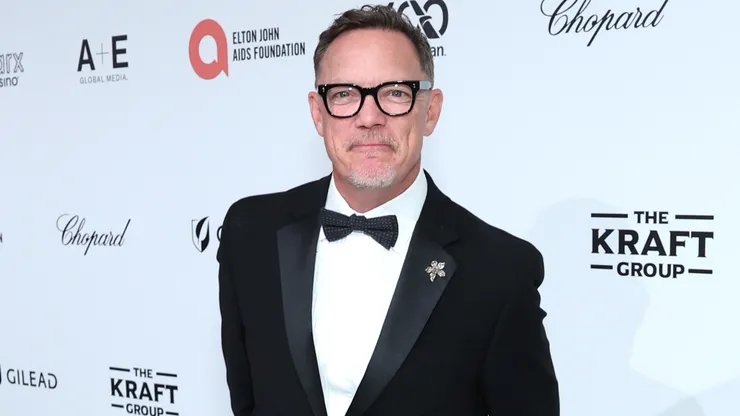
Matthew Lillard’s career has never followed the traditional Hollywood blueprint. Instead, his filmography unfolded like a collection of cult transmissions passed from one generation to the next: a chaotic horror villain in Scream, a cyberpunk troublemaker in Hackers, a punk rebel in SLC Punk! and eventually the live-action face of Shaggy in Scooby-Doo. Over the years, many of the projects that once felt niche or wildly eccentric quietly evolved into enduring pop culture landmarks.
Stu Macher — Scream (1996)
When Matthew Lillard appeared as Stu Macher in Scream, he helped redefine what horror villains could look and sound like in the late ‘90s. Rather than portraying a cold, silent killer, Lillard injected Stu with frantic humor, nervous energy, and unpredictable emotional swings that made the character simultaneously absurd and terrifying.
Directed by Wes Craven, the film became a massive critical and commercial success, revitalizing the slasher genre at a time when horror had begun to lose cultural momentum. What made the performance endure was how chaotic it felt.
Stu’s final scenes, filled with screaming laughter and sudden tonal shifts, became some of the most quoted moments in the franchise. Over the decades, fans continued theorizing about the character’s possible survival, turning Stu into one of the most discussed figures in the entire Scream universe.
Even now, Lillard’s performance remains central to the film’s identity, proof that horror icons do not always need masks to leave a permanent mark.
Shaggy Rogers — Scooby-Doo (2002)
Playing Shaggy in the live-action Scooby-Doo adaptation carried unusual pressure because the character already existed in the imagination of multiple generations. Yet Lillard approached the role with almost obsessive commitment, studying the original animated series and intentionally mirroring the voice patterns and physical mannerisms that made Shaggy recognizable.
The result surprised audiences and critics alike, quickly becoming one of the most praised elements of the film. The role eventually became much larger than a single movie. After the success of Scooby-Doo and its sequel, Lillard inherited the official animated voice role for Shaggy following Casey Kasem’s retirement.
That transition allowed him to remain tied to the franchise for years, turning what initially seemed like a comedic casting experiment into one of the defining chapters of his career. For many younger viewers, Lillard did not simply play Shaggy—he became inseparable from the character itself.
Stevo — SLC Punk! (1998)
Few performances in Lillard’s career captured emotional contradiction quite like Stevo in SLC Punk!. Set against the underground punk scene of 1980s Salt Lake City, the film followed a young man trying to reject conformity while quietly fearing adulthood and isolation.
Lillard balanced sarcasm, rebellion, and vulnerability with unusual intensity, giving the movie a restless emotional pulse that later helped it become a cult classic. Unlike many teen films from the era, SLC Punk! aged into something more reflective over time.
Audiences revisiting the movie years later often connected less with its punk chaos and more with the existential exhaustion beneath Stevo’s humor. Lillard’s performance evolved alongside that reinterpretation, increasingly recognized as one of the strongest dramatic turns of his career. The film’s final monologue in particular remains one of the most referenced scenes among fans of late-‘90s independent cinema.
Emmanuel “Cereal Killer” Goldstein — Hackers (1995)
Long before digital culture became fully mainstream, Hackers imagined cyberspace as a neon-colored underground rebellion. Lillard’s “Cereal Killer” embodied that energy perfectly, delivering a performance full of twitchy confidence, absurd humor, and exaggerated coolness.
At the time of release, the film received mixed reviews, but its stylized version of internet culture gradually transformed it into a beloved cult favorite. Part of the movie’s staying power came from how openly theatrical it was.
Lillard leaned into that exaggerated tone without restraint, making “Cereal Killer” one of the film’s most memorable personalities despite sharing the screen with stars like Angelina Jolie and Jonny Lee Miller. Years later, Hackers became a nostalgic symbol of early internet-era cinema, and Lillard’s eccentric performance remains deeply attached to its identity.
William Afton — Five Nights at Freddy’s (2023)
By the time Lillard joined Five Nights at Freddy’s, he was already closely associated with cult horror fandoms. Casting him as William Afton felt almost symbolic: a veteran of ‘90s horror stepping into one of the internet generation’s most influential horror franchises.
The film itself became a massive commercial success despite mixed reviews, proving how powerful the fanbase surrounding the video game series had become.
Lillard approached Afton with calculated restraint rather than overt theatricality. That choice created a colder, more unsettling villain whose presence lingered beneath the film’s animatronic spectacle.
The role also introduced him to a much younger audience unfamiliar with his earlier work, effectively connecting two different eras of horror culture. In many ways, the casting represented a full-circle moment for an actor whose career had quietly become intertwined with genre fandom across decades.
Dennis Rafkin — Thirteen Ghosts (2001)
In a film overflowing with elaborate ghost designs and supernatural chaos, Lillard somehow managed to stand out as Dennis Rafkin in Thir13en Ghosts. Playing a psychic dragged into an increasingly violent haunted-house nightmare, he delivered a performance that constantly oscillated between panic, sarcasm, and genuine fear.
His nervous comedic rhythm helped ground a movie that otherwise embraced full horror excess. Although Thirteen Ghosts initially divided critics, it later developed a dedicated cult following online, particularly among horror fans fascinated by the film’s elaborate ghost mythology.
Lillard’s frantic performance became part of that rediscovery. Rather than treating the role with detached irony, he committed fully to the film’s bizarre energy, which ultimately made Dennis one of the movie’s most memorable characters.
Jerry Conlaine — Without a Paddle (2004)
At first glance, Without a Paddle looked like a fairly standard early-2000s comedy built around chaos and physical humor. Yet the chemistry between Lillard, Seth Green, and Dax Shepard gave the film a surprisingly emotional center beneath its absurd adventures.
As Jerry Conlaine, Lillard brought warmth and emotional openness to a movie that could easily have become one-dimensional. Over time, the film gained a second life through cable television reruns and streaming rediscovery.
Audiences connected not only with the comedy, but also with its nostalgic themes about friendship, aging, and unfinished dreams. Lillard’s performance contributed heavily to that emotional undercurrent, reminding viewers that even broad comedies often depend on sincerity to remain memorable years later.
Brock Hudson — She’s All That (1999)
In She’s All That, Lillard appeared in a smaller but unforgettable role as Brock Hudson, an aggressively obnoxious reality-TV personality whose exaggerated confidence perfectly matched the heightened tone of late-‘90s teen cinema.
Even with limited screen time, he managed to create one of the film’s most quotable supporting characters through sheer energy and comic timing. The performance reflected an important pattern throughout Lillard’s career: his ability to dominate scenes without necessarily being the lead actor.
During an era filled with polished teen heartthrobs, Brock Hudson felt intentionally messy and loud, almost parodying celebrity culture before reality television fully exploded in the 2000s. That self-aware absurdity helped the role age better than many expected.
Chip Sutphin — Serial Mom (1994)
One of Lillard’s earliest notable performances came in Serial Mom, directed by cult filmmaker John Waters. The dark comedy centered on a seemingly perfect suburban mother secretly living as a serial killer, and Lillard’s role as Chip Sutphin allowed him to introduce the eccentric screen presence that would later define much of his career.
Working within Waters’ exaggerated satirical style required performers willing to embrace absurdity without hesitation, something Lillard handled naturally even early in his career.
Although Serial Mom was not a major box-office hit, the film eventually became a cult favorite, especially among fans of dark comedy. Looking back, the role now feels like an early glimpse of the unpredictable charisma that would later become his trademark.
Dean Boland — Good Girls (2018–2021)
Years after becoming associated primarily with cult films and genre projects, Lillard surprised many viewers with his performance as Dean Boland in Good Girls. The role demanded something very different from the exaggerated energy of his earlier work.
Dean was insecure, selfish, vulnerable, and occasionally sympathetic all at once, allowing Lillard to explore a more restrained dramatic style. What made the performance compelling was its instability.
Dean constantly shifted between comedic awkwardness and emotional collapse, often forcing audiences to reconsider whether they should empathize with him at all. Across multiple seasons, Lillard turned the character into far more than a simple sitcom husband archetype, proving that his range extended well beyond the cult personas that initially made him famous.