Hollywood has spent staggering amounts of money on pictures that seemed destined to become major events. While some blockbusters justify their enormous costs with cultural impact and long-term popularity, others quickly fade from public memory despite lavish productions and ambitious marketing campaigns.
In many cases, these movies earned decent box office returns but failed to leave a lasting impression on audiences. Here are 10 of the most expensive films ever made that are rarely talked about today.
How Do You Know (2010)

It is rare for a contemporary romantic comedy to command a nine-figure price tag, yet this James L. Brooks production managed to burn through $120 million. Despite featuring an A-list ensemble of Reese Witherspoon, Owen Wilson, Paul Rudd, and Jack Nicholson, the film’s massive costs were primarily driven by high talent salaries and a meticulous, slow-paced production schedule. Today, it is largely viewed as a footnote in its stars’ careers, lacking the quotability or staying power of the genre’s more modest classics.
Mortal Engines (2018)
Produced by Peter Jackson with a staggering budget estimated between $100 million and $150 million, this steampunk epic was designed to launch a sprawling new franchise based on Philip Reeve’s novels. The film boasted breathtaking visual effects of traction cities roaming a post-apocalyptic wasteland, but the spectacle failed to resonate with audiences, leading to one of the biggest box office losses in history. While the technical craftsmanship is undeniable, the characters and plot have almost entirely faded from the collective memory of sci-fi fans.
The 13th Warrior (1999)
This Viking-era action film, starring Antonio Banderas, is a textbook case of a production spiraling out of control, with its final costs reportedly ballooning toward $160 million after extensive reshoots and marketing. Directed by John McTiernan and based on a Michael Crichton novel, the movie suffered from a troubled post-production phase that saw the original score replaced and the tone heavily altered. Despite its gritty atmosphere and impressive practical sets, it failed to secure a foothold in the cultural landscape of the late ’90s.
Battleship (2012)
Universal Pictures spent an eye-watering $209 million to turn a simple board game into a sci-fi blockbuster involving alien invaders and the U.S. Navy. While the film was clearly aiming for the same toy-to-titan success as the Transformers series, it arrived to middling reviews and a lukewarm audience reception. Even with Rihanna making her theatrical debut and Peter Berg at the helm, the movie’s generic CGI mayhem has left it adrift in the sea of forgotten 2010s blockbusters.
Mars Needs Moms (2011)
Disney’s foray into performance-capture animation cost $150 million to produce, yet it resulted in one of the most significant financial disasters in the studio’s history. The film’s uncanny valley visual style was often cited as a deterrent for families, and its story failed to capture the imagination of its target demographic. The studio’s image-mo-cap division was shuttered shortly after, and the film is now almost never mentioned alongside Disney’s legendary animated catalog.
King Arthur: Legend of the Sword (2017)
Guy Ritchie attempted to give the Arthurian legend a kinetic, modern makeover with a $175 million budget that was intended to kickstart a six-film cinematic universe. Starring Charlie Hunnam and Jude Law, the movie featured high-octane editing and massive magical creatures, but it was crushed at the box office by heavy competition. Because the planned sequels were immediately scrapped, this expensive reimagining exists as a solitary, largely forgotten curiosity of mid-2010s studio ambition.
Transcendence (2014)
Marking the directorial debut of Christopher Nolan’s longtime cinematographer Wally Pfister, this cerebral sci-fi thriller cost $100 million and starred Johnny Depp as an AI-uploaded consciousness. Despite its high-concept premise and an impressive supporting cast including Morgan Freeman and Rebecca Hall, the film was criticized for being emotionally cold and narratively sluggish. It vanished from theaters quickly and has since failed to develop the cult following often enjoyed by similar high-budget genre experiments.
John Carter (2012)
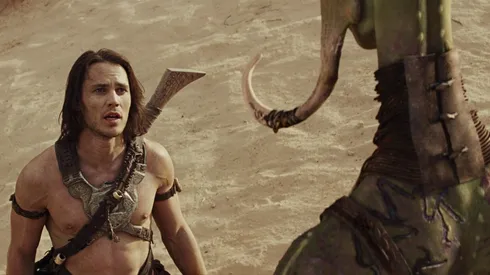
Though it is often cited in industry circles as a cautionary tale of marketing failure, the actual content of this $264 million Martian epic has largely slipped from public consciousness. Director Andrew Stanton brought Edgar Rice Burroughs’ seminal sci-fi world to life with incredible detail, but the film struggled to distinguish itself from the many franchises it had originally inspired. Despite a dedicated small circle of defenders, the general public has mostly forgotten the sweeping landscapes and creature designs of Barsoom.
Stealth (2005)
At the time of its release, this high-tech thriller about a sentient, rogue fighter jet was one of the most expensive movies ever made, with a budget of roughly $135 million. Directed by Rob Cohen, the film relied heavily on early-2000s CGI and an MTV-style aesthetic that aged almost instantly. While it was intended to be a summer tentpole, it was panned by critics and ignored by audiences, leaving it to gather dust as a relic of an era obsessed with military-themed techno-thrillers.
Chaos Walking (2021)
Even with the star power of Tom Holland and Daisy Ridley at the height of their respective Spider-Man and Star Wars fame, this YA adaptation struggled through years of delays and reshoots. The production costs climbed to $100 million as the studio tried to fix the unfilmable concept of characters’ thoughts being audible to everyone. By the time it finally hit theaters during a difficult release window, the hype had evaporated, and the film left no lasting mark on the genre it hoped to redefine.