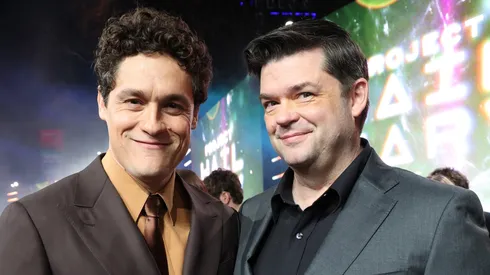
“Project Hail Mary” may take audiences to the edge of the cosmos, but its directors are also thinking about a much more immediate question facing Hollywood.
In a recent conversation with The Hollywood Reporter that touched on filmmaking and emerging technology, Phil Lord and Christopher Miller weighed in on the growing fascination with artificial intelligence in film.
Why Lord and Miller Believe Creativity Still Belongs to Humans
The debate surfaced after a widely circulated AI-generated clip imagining actors Brad Pitt and Tom Cruise in a fight scene caught the internet’s attention. The interviewer recalled a famous screenwriter who, in response to the video, suggested that future filmmakers might harness similar tools to create groundbreaking work, perhaps even rivaling the inventive sensibilities of directors like Christopher Nolan. Miller, however, was unconvinced by that optimistic outlook.
“I don’t think that’s true,” he said, arguing that generative systems are fundamentally backward-looking. “AI can only regurgitate the average of things that have come before it.” For Miller, the real hallmark of influential filmmakers is the ability to produce something audiences have never quite encountered before, an instinct that cannot easily be distilled into data patterns.
That philosophy also shapes how Lord and Miller think about their own projects. Pointing to the groundbreaking visual language of “Spider-Man: Into the Spider-Verse,” Miller noted that the film’s originality came from venturing into territory that had little precedent. “I don’t think AI could have made that first Spider-Verse movie because there was nothing like it to have taken from,” he explained.
For the directors, creativity is often found in the smallest details. Miller offered an example from “Project Hail Mary,” the upcoming science fiction adventure starring Ryan Gosling as astronaut Ryland Grace. Even something as simple as a character’s wardrobe emerged from personal associations rather than a calculated formula. Gosling, he said, drew on memories of a fox encounter when suggesting a cardigan decorated with foxes, while some of the character’s science themed shirts were inspired by jokes from Miller’s own family.
Lord expanded on the idea by describing filmmaking as a collaborative accumulation of individual tastes rather than a single guiding algorithm. “What you really experience are the stacking of individual artists’ hands and idiosyncratic taste, piling on top of each other and becoming a virtuous cycle, compounding one another,” he said. The result, in their view, is something that grows richer precisely because it carries the fingerprints of many different creators.
Their comments arrive as anticipation builds for “Project Hail Mary,” which premiered in London on March 9 and is scheduled to open in U.S. theaters on March 20 through Amazon MGM Studios. The film follows a lone astronaut who wakes aboard an interstellar mission with no memory of how he got there and gradually pieces together a desperate plan to save Earth. If Lord and Miller are right, the kind of imaginative leaps required for stories like that may remain firmly in human hands for the foreseeable future.