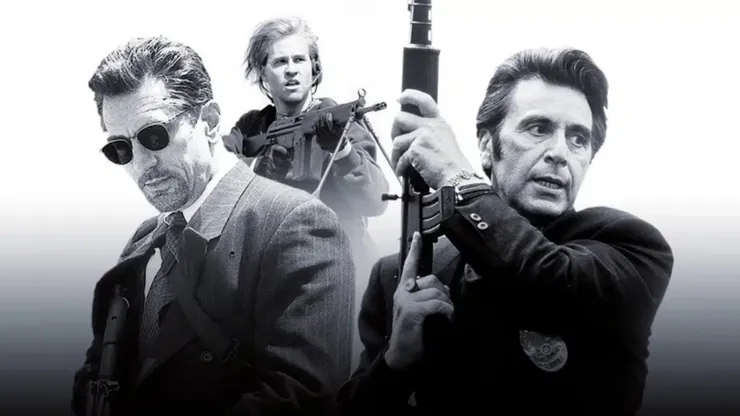
There are films that succeed because of a single standout performance, and then there are those rare productions where nearly every name in the credits carries weight. Hollywood has long treated ensemble casting as both a creative gamble and a commercial strategy, bringing together established stars to create events that extend beyond the story itself.
From sprawling crime sagas to sharp-tongued comedies, these 10 projects often reflect specific moments in the industry, when studios were willing to bet on the chemistry and the draw of multiple A-list actors sharing the screen.
Pulp Fiction (1994)
- Starring Samuel L. Jackson, John Travolta, Uma Thurman, Bruce Willis, Ving Rhames, Harvey Keitel, Christopher Walken and Tim Roth
When Pulp Fiction premiered at the 1994 Cannes Film Festival, it not only won the Palme d’Or but also redefined what an ensemble cast could achieve in a nonlinear narrative. Quentin Tarantino strategically blended established names with actors in career transition—most notably John Travolta, whose casting was considered a risk at the time but ultimately reignited his career.
Each actor delivers a performance that feels self-contained yet essential to the film’s structure. Samuel L. Jackson’s Jules became one of the most quoted characters in modern cinema, while Uma Thurman’s Mia Wallace turned into a cultural icon. The film’s success—grossing over $200 million worldwide—proved that a bold ensemble could drive both critical acclaim and commercial appeal.
The Lord of the Rings Trilogy (2001–2003)
- Starring Elijah Wood, Ian McKellen, Viggo Mortensen, Cate Blanchett, Orlando Bloom, Sean Bean and Christopher Lee
Peter Jackson’s trilogy stands as one of the most ambitious ensemble efforts ever attempted, with all three films shot simultaneously over 438 days in New Zealand. The casting process prioritized commitment over star power, yet it ultimately assembled a group that blended respected veterans like Ian McKellen with actors who would become global stars.
The scale of the project demanded long-term cohesion, and that continuity translated into performances that felt lived-in across the trilogy. The Return of the King alone won 11 Academy Awards, tying the record for most Oscars, while the ensemble itself became inseparable from the cultural identity of the franchise.
Little Women (2019)
- Starring Saoirse Ronan, Emma Watson, Florence Pugh, Laura Dern and Timothée Chalamet
Greta Gerwig’s adaptation of Little Women brought together a cast deeply embedded in the awards circuit. Saoirse Ronan received an Academy Award nomination for Best Actress, while Florence Pugh earned a nomination for Best Supporting Actress, underscoring the strength of the ensemble rather than a single standout performance.
The film grossed over $200 million worldwide, an impressive feat for a period drama, and much of that success can be attributed to its cast chemistry. Timothée Chalamet and Ronan, reuniting after Lady Bird, anchor the emotional core, while Laura Dern’s performance adds generational depth that elevates the narrative beyond a traditional adaptation.
Magnolia (1999)
- Starring Julianne Moore, Tom Cruise, John C. Reilly, William H. Macy and Philip Seymour Hoffman
Paul Thomas Anderson’s Magnolia is built entirely on the strength of its ensemble, weaving together multiple storylines over a single day in Los Angeles. Tom Cruise’s performance earned him a Golden Globe win and an Academy Award nomination, marking one of the most critically acclaimed roles of his career.
At the same time, the film relies heavily on its supporting cast to maintain emotional continuity. Philip Seymour Hoffman’s restrained performance contrasts with Julianne Moore’s volatility, while John C. Reilly provides a grounded perspective. The result is a film where no single storyline dominates, reinforcing the importance of every actor involved.
The Royal Tenenbaums (2001)
- Starring Gene Hackman, Anjelica Huston, Ben Stiller, Owen Wilson, Luke Wilson, Bill Murray and Gwyneth Paltrow
Wes Anderson’s breakthrough film assembled a cast that blended Hollywood veterans with contemporary stars. Gene Hackman’s performance earned him a Golden Globe for Best Actor, and his portrayal of Royal Tenenbaum remains one of the most celebrated roles of his late career.
The film’s structure allows each character to occupy a distinct emotional space, from Gwyneth Paltrow’s subdued performance to Ben Stiller’s tightly controlled portrayal of Chas. This balance between comedic timing and dramatic weight is what elevates the ensemble beyond a typical cast-driven film.
One Battle After Another (2025)
- Starring Leonardo DiCaprio, Benicio del Toro, Sean Penn, Regina Hall and Teyana Taylor
Paul Thomas Anderson’s One Battle After Another arrived in 2025 as the most ambitious project of his career, both in scale and reception. Inspired by Thomas Pynchon’s Vineland, the film blends political satire, action, and dark comedy, following a former revolutionary (DiCaprio) pulled back into conflict when his past resurfaces.
It premiered in September 2025 and quickly became a major awards contender, eventually winning multiple Oscars, including Best Picture and Best Director. What elevates the film into this list is how its ensemble operates across tonal extremes.
Sean Penn’s performance as the antagonist earned him an Academy Award, while Benicio del Toro and Regina Hall add layers to a narrative that shifts between absurdity and tension.
With a budget estimated between $130 and $175 million and a global gross surpassing $200 million, the film stands as both Anderson’s biggest commercial success and a rare example of a large-scale auteur-driven ensemble piece resonating with both critics and audiences.
The Thin Red Line (1998)
- Starring Jim Caviezel, Sean Penn, Nick Nolte, George Clooney, John Cusack and Woody Harrelson
Terrence Malick’s war epic became known for its unusually expansive cast, with several major actors—including George Clooney and John Travolta—appearing only briefly after extensive editing. The production attracted top-tier talent eager to work with Malick after his two-decade absence from filmmaking.
The film received seven Academy Award nominations, including Best Picture, and stands out for how it distributes its performances across multiple perspectives. Rather than centering on a single protagonist, it uses its ensemble to create a fragmented, philosophical view of war.
Knives Out (2019)
- Starring Daniel Craig, Ana de Armas, Chris Evans, Jamie Lee Curtis, Michael Shannon, Lakeith Stanfield, Christopher Plummer and Toni Collette
Rian Johnson’s Knives Out revitalized the whodunit genre with a cast that blends multiple generations of actors. Daniel Craig’s Benoit Blanc introduced a new detective figure to modern audiences, while Ana de Armas received a Golden Globe nomination for her performance.
The film grossed over $300 million worldwide, significantly outperforming expectations for an original mystery film. Its success demonstrated how a carefully balanced ensemble—where each character serves the plot—can drive both audience engagement and franchise potential.
The Grand Budapest Hotel (2014)
- Starring Ralph Fiennes, Saoirse Ronan, Adrien Brody, Willem Dafoe, Jeff Goldblum, Jude Law and Tilda Swinton
Wes Anderson’s film is notable for assembling one of the most densely packed casts in recent cinema, with many actors appearing in brief but memorable roles. Ralph Fiennes leads the film in a rare comedic performance that earned him a BAFTA nomination.
The film won four Academy Awards and became one of Anderson’s most commercially successful projects. Its ensemble structure—featuring both frequent collaborators and new additions—creates a layered narrative where each appearance contributes to the film’s distinctive tone.