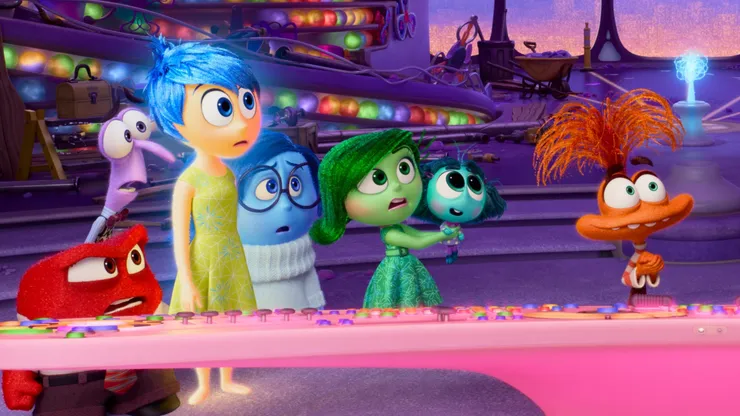
When Disney and Pixar first announced that they were heading back into the mind of Riley Andersen for a sequel to 2015’s Academy Award-winning Inside Out, the film community was understandably defensive. The original film was a pristine, self-contained masterpiece that perfectly explained emotional intelligence to children and adults alike. A sequel risked being a cynical, cash-grabbing retread of an already completed emotional arc.
Instead, director Kelsey Mann and screenwriter Meg LeFauve did the unthinkable. They caught lightning in a bottle for a second time.
Inside Out 2 stormed into theaters and shattered box-office records on its way to a staggering $1.69 billion global haul. Two years later, the film has aged beautifully, settling into the cultural landscape not as a lesser spin-off, but as the essential, deeply profound second chapter of a unified masterpiece.
The Masterclass on Mental Health: The Anatomy of an Attack
While the original film famously taught us that sadness is a necessary component of joy, Inside Out 2 pivoted its focus to a vastly more complex, modern, and clinical antagonist: Anxiety.
Voiced with a brilliant, frantic velocity by Maya Hawke, Anxiety wasn’t framed as a cackling villain out to ruin Riley’s life. Instead, she was depicted as an aggressive, well-meaning projectionist who loved Riley so much that she tried to micromanage every single future catastrophe to keep her safe. It was a stunningly accurate, highly empathetic metaphor for how generalized anxiety operating inside a teenager’s brain actually functions.
The emotional peak of the film—and arguably one of the greatest sequences in animation history—is Riley’s mid-game panic attack in the penalty box. Pixar captured the visceral, suffocating reality of a panic attack with flawless visual storytelling:
- The control console spinning into a blinding, orange whirlwind.
- Anxiety freezing in place, paralyzed by the sheer velocity of her own overthinking.
- The physical manifestation of Riley’s racing heart, heavy breathing, and sensory overload.
By having Joy step in not to fight Anxiety, but to gently remove her hands from the console and hold her, Pixar delivered a beautiful message to a generation of viewers navigating an unprecedented mental health crisis: You cannot control your anxiety by fighting it; you have to learn to coexist with it.
The Rarity of the Equal Sequel: Standing Tall with the 2015 Classic
What makes Inside Out 2 a definitive classic alongside the 2015 original is its refusal to take the easy way out. A lesser sequel would have simply sent Joy and a new emotion on a journey through a different part of the brain to retrieve lost memories.
Instead, the sequel completely evolved the franchise’s internal architecture by introducing the Sense of Self. The film bravely explored how puberty forces us to shed the simple, curated identities of childhood (“I am a good person”) and inherit the messy, conflicting, and contradictory anxieties of adulthood.
“I don’t know how to stop Anxiety. Maybe that’s what happens when you grow up… you feel less joy.” — Joy
By the time the climax hits, the film delivers its ultimate thesis: a healthy identity isn’t built exclusively on our best moments. To truly grow up, we have to embrace our flaws, our mistakes, and our embarrassments. Joy’s realization that she has to let Riley’s system accept all of her memories is what elevates the sequel into the exact same artistic tier as the original.