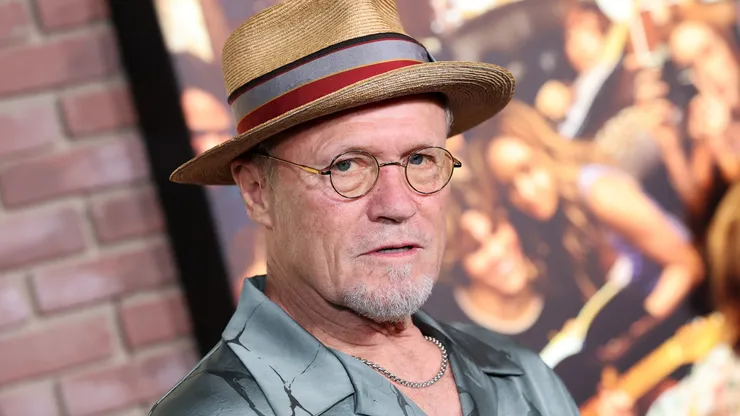
The face of Michael Rooker rarely arrives quietly on screen. It emerges—weathered, watchful, often dangerous—carrying with it decades of roles that resist easy categorization.
Born in 1955 and trained at DePaul University, he built his career not through conventional stardom, but through a steady accumulation of characters that feel lived-in and unsettlingly real.
His film debut in Henry: Portrait of a Serial Killer set the tone early: a performance so stark and unvarnished that it blurred the line between actor and subject, earning critical attention and opening the door to a career defined by risk rather than comfort.
Henry – Henry: Portrait of a Serial Killer
Rooker’s film debut didn’t just introduce him—it unsettled audiences in a way few performances manage. Portraying a loosely real-life-inspired drifter, he stripped the character of theatrics, opting instead for a quiet, almost documentary-like realism that made the violence feel disturbingly ordinary. The film itself faced distribution challenges due to its graphic content, which only amplified its reputation over time.
What makes the performance endure is its restraint. There’s no attempt to justify or dramatize Henry’s actions; instead, Rooker leans into stillness, letting silences carry as much weight as dialogue. It became a blueprint for the kind of roles he would gravitate toward—men who don’t ask for understanding, yet linger long after the screen fades.
Yondu Udonta – Guardians of the Galaxy
Decades into his career, Rooker found unexpected mainstream resonance in the Marvel universe. As Yondu, a Ravager leader with a whistle-controlled arrow, he initially appears as a rugged antagonist. Yet across the films, particularly in the sequel, the character evolves into something far more emotionally layered.
That transformation is where Rooker excels. Beneath the blue skin and bravado lies a deeply conflicted father figure, culminating in one of the saga’s most memorable emotional beats. His collaboration with James Gunn once again proved how effectively the actor can balance grit with vulnerability, even within a blockbuster framework.
Merle Dixon – The Walking Dead
When Rooker stepped into the role of Merle Dixon, he brought with him a volatility that instantly set the tone. Introduced as abrasive and deeply flawed, Merle could have easily been a one-note antagonist. Instead, Rooker infused him with an unpredictability that kept viewers constantly on edge.
Over time, the character’s layers began to emerge, revealing a complicated mix of loyalty, resentment, and survival instinct. His arc, though not long-lived compared to others in the series, remains one of its most impactful—largely because Rooker refused to simplify him into something easily digestible.
Rowdy Burns – Days of Thunder
In the high-speed world of NASCAR drama, Rooker’s Rowdy Burns stands out as more than just a rival. Opposite Tom Cruise, he embodies the seasoned competitor—aggressive, confident, and unwilling to yield an inch on the track. The role demanded both physical presence and emotional control, something Rooker delivered with precision.
Yet beneath the rivalry lies a subtle professionalism. Burns isn’t portrayed as reckless, but rather as someone shaped by the same obsession that drives the film’s protagonist. It’s a quieter performance compared to his more explosive roles, but one that underscores his ability to anchor tension without overstatement.
Bill Broussard – Mississippi Burning
In a film charged with historical weight, Rooker takes on a different kind of intensity. As an FBI agent investigating civil rights-era crimes, his character operates within a moral framework that contrasts sharply with many of his other roles. The performance is measured, grounded, and deliberately restrained.
Working alongside Gene Hackman and Willem Dafoe, Rooker holds his own by avoiding excess. Instead of commanding attention through volume, he builds credibility through presence—adding to the film’s realism and emotional gravity.
Chick Gandil – Eight Men Out
Portraying one of the central figures in baseball’s infamous Black Sox scandal, Rooker steps into a narrative steeped in moral ambiguity. Chick Gandil is neither fully villain nor victim, and that gray area is where the performance finds its strength.
Rather than leaning into melodrama, Rooker plays Gandil with a quiet calculation, emphasizing the pressures and motivations behind the conspiracy. The result is a portrayal that feels historically grounded, contributing to the film’s reputation as one of the more nuanced sports dramas of its era.
Jared Svenning – Mallrats
A sharp departure from his darker roles, Rooker’s turn in Kevin Smith’s comedy reveals a different facet of his screen presence. As a scheming real estate developer, he taps into a more exaggerated, almost satirical energy without losing his signature edge.
The performance works precisely because it doesn’t abandon his intensity—it repurposes it. Even in a comedic setting, there’s a sense of underlying menace, which adds an extra layer to the film’s offbeat tone and proves his versatility beyond gritty drama.
Frank Bailey – JFK
In Oliver Stone’s sprawling political drama, Rooker takes on a supporting role that contributes to the film’s intricate narrative web. Though not at the forefront, his presence adds texture to a story driven by conflicting accounts and interpretations.
The film itself thrives on detail, and Rooker adapts accordingly. His performance is subtle, almost observational, fitting seamlessly into a larger ensemble that prioritizes atmosphere over individual spotlight.
Savoy – Sea of Love
Sharing the screen with Al Pacino, Rooker delivers a supporting role that still carries weight. In a film driven by tension and suspicion, his character adds to the uneasy atmosphere that defines the narrative.
What stands out is how naturally he fits into the film’s noir sensibility. Without demanding attention, he reinforces the story’s tone—another example of how his presence alone can shape the mood of a scene.
Buddy Revell – The Dark Half
Adapting Stephen King’s psychological horror brings its own challenges, and Rooker meets them head-on. The film leans into themes of duality and identity, giving him space to explore darker, more surreal territory.
His performance amplifies the film’s unsettling atmosphere, balancing grounded realism with the story’s more fantastical elements. It’s a reminder that even within genre storytelling, Rooker’s approach remains consistent: direct, unflinching, and impossible to ignore.