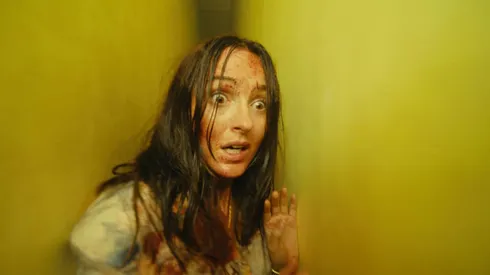
The release of Backrooms, inspired by the viral liminal-space myth that evolved from internet creepypasta culture, has pushed a very specific kind of horror back into the spotlight—one built not on traditional monsters, but on architecture, repetition and silence.
Its endless corridors and fluorescent haze belong to a growing cinematic language often associated with “liminal horror”, a style that critics and audiences frequently link to films like Cube, where environments feel artificially infinite and emotionally disorienting rather than overtly dangerous.
Skinamarink
If there’s a film that feels like it could exist inside the Backrooms universe, it’s Skinamarink. The story is deceptively simple—two children wake up to find their home altered in subtle but terrifying ways—but the execution transforms that premise into something deeply unsettling.
The house becomes an unfamiliar maze, where doors vanish, hallways feel endless, and nothing behaves as expected. What truly elevates it is how the film is shot.
The camera lingers on ceilings, dark corners, and empty stretches of carpet, rarely showing complete actions or faces. That fragmented perspective mirrors the disorientation of wandering through the Backrooms: you’re always looking, never fully seeing, and constantly questioning what’s just out of frame.
Cube
Cube strips its characters of context and drops them into a structure that feels algorithmic rather than human. Identical rooms extend in every direction, each one potentially lethal, creating a closed system where movement doesn’t guarantee escape. The lack of explanation becomes part of the horror.
This is where it strongly connects to Backrooms. The environment isn’t just a setting—it’s a puzzle with no clear solution, governed by rules that are never fully revealed. The repetition of spaces and the impossibility of mapping them accurately create that same existential dread: you’re trapped somewhere that shouldn’t exist, and it doesn’t care about you.
The Blair Witch Project
At first glance, a forest might seem far removed from fluorescent hallways, but The Blair Witch Project taps into the same fear of spatial breakdown. The characters walk for hours only to return to the same locations, as if the environment itself is looping.
The film’s raw, handheld footage intensifies that confusion. There’s no stable perspective, no reliable orientation—just fragments of movement and panic. Like in Backrooms, the real terror isn’t what’s chasing you, but the realization that you can’t trust the space around you to behave logically.
Session 9
Set in an abandoned mental institution, Session 9 thrives on the unease of empty, decaying spaces. The building feels vast yet suffocating, filled with long corridors and forgotten rooms that seem disconnected from time.
As the film progresses, the environment begins to influence the characters psychologically. The silence becomes oppressive, and the lack of activity makes every small sound feel amplified. This slow, creeping dread mirrors the Backrooms experience, where emptiness itself becomes the source of fear.
The Shining
The Overlook Hotel in The Shining is one of cinema’s most iconic examples of a space that feels wrong without obvious reason. Its endless hallways, geometric patterns, and unnatural symmetry create a sense of artificial order that borders on uncanny.
Kubrick’s precise camerawork enhances that effect, guiding viewers through spaces that feel both familiar and impossible. The hotel seems to stretch beyond its physical limits, much like the infinite corridors of the Backrooms. It’s not just a haunted place—it’s a place that doesn’t quite obey reality.

Pulse (Kairo)
Kairo approaches horror through absence rather than presence. Its world gradually empties, leaving behind quiet rooms and abandoned urban spaces that feel disconnected from life.
The film’s slow pacing and static compositions emphasize that emptiness. Characters often appear small within large, silent environments, reinforcing a sense of isolation. That emotional and spatial void is central to the Backrooms aesthetic, where the fear comes from being alone in a place that feels endless.
Vivarium
In Vivarium, repetition becomes the horror. A suburban neighborhood made of identical houses stretches infinitely, trapping its inhabitants in a loop with no variation or escape.
This artificial uniformity closely mirrors the visual identity of the Backrooms. The environment feels constructed rather than organic, designed with purpose but devoid of meaning. The longer the characters remain, the more the space erodes their sense of identity, much like the psychological toll of being stuck in an endless liminal environment.
As Above, So Below
Descending into the catacombs beneath Paris, the characters in As Above, So Below quickly lose any sense of direction. The tunnels become a labyrinth where paths repeat and logic begins to collapse.
The found footage style enhances this descent into disorientation. Limited visibility, shaky camerawork, and confined spaces create a constant sense of unease. Much like the Backrooms, the deeper you go, the less the environment makes sense—and the harder it becomes to believe there’s a way out.
It Follows
While It Follows isn’t about a maze-like environment, it captures a similar sense of unease through space. Suburban streets and interiors feel strangely empty, as if something is missing or out of place.
The film’s slow camera movements and wide framing force viewers to constantly scan the background, anticipating something that may or may not appear. That lingering tension—where the environment itself feels off—is deeply connected to the Backrooms experience.
Annihilation
Annihilation presents a different kind of liminal space, one where reality itself is unstable. Inside “The Shimmer,” landscapes shift, biology mutates, and perception becomes unreliable.
Although more visually dynamic than typical Backrooms settings, the core idea is the same: you’re in a place where the rules don’t apply. The inability to understand or predict the environment creates a constant sense of unease, reinforcing that same fear of being trapped in something incomprehensible.