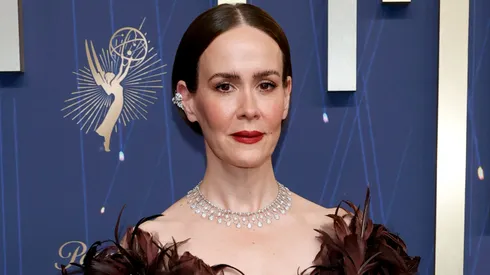
Sarah Paulson’s television career has been built less on longevity in a single role than on an instinct for transformation. From early appearances in network dramas to becoming a defining face of prestige anthology television, her rise reflects how TV itself evolved over the past two decades—bolder stories, riskier characters, and performances that demand attention rather than familiarity.
What sets her apart is the way her most memorable roles linger beyond plotlines. Whether anchored in psychological tension, historical drama or genre storytelling, her characters often feel unsettled, searching, and quietly commanding. Taken together, these performances don’t just mark career milestones; they trace the arc of an actor who helped redefine what leading roles on television could look like.
Marcia Clark — The People v. O.J. Simpson: American Crime Story

This was the performance that reshaped Sarah Paulson’s public profile. As Marcia Clark, she resisted the temptation to dramatize the spectacle and instead leaned into restraint, exhaustion, and quiet resolve. Her portrayal reframed a figure long flattened by headlines, emphasizing professionalism under relentless scrutiny. The role earned widespread acclaim and positioned Paulson as one of television’s most trusted dramatic anchors.
Lana Winters — American Horror Story: Asylum
Lana Winters remains one of the most punishing arcs Paulson has ever carried. Across Asylum, she charted a brutal evolution from ambitious reporter to survivor, navigating institutional cruelty, media ethics, and personal trauma. The performance demanded endurance as much as emotional range, and Paulson delivered with a fearlessness that helped elevate the season into one of the franchise’s most respected chapters.
Linda Tripp — American Crime Story: Impeachment
Paulson’s turn as Linda Tripp was deliberately uncomfortable. Rather than soften the character, she leaned into awkwardness, insecurity, and moral ambiguity. Through careful physicality and a subdued emotional palette, Paulson avoided caricature and offered a study in loneliness and power. It was a performance that sparked debate—fitting for a role rooted in political and cultural fracture.
Ally Mayfair-Richards — American Horror Story: Cult
In Cult, the horror wasn’t supernatural—it was intimate. Paulson’s Ally embodied modern anxiety, paranoia, and the erosion of trust in public and private life. Her portrayal captured the slow collapse of stability, making fear feel psychological rather than theatrical. The role stood out for its immediacy, reflecting the cultural moment with unnerving precision.
Nurse Mildred Ratched — Ratched
Taking on one of television’s most infamous characters was a calculated risk. Paulson’s Nurse Ratched rejected outright villainy in favor of control, repression, and emotional armor. The performance was icy yet layered, grounding the series’ stylized world in a character driven by trauma and ambition. It showcased Paulson’s ability to lead a show built on atmosphere and internal tension.
Bette and Dot Tattler — American Horror Story: Freak Show
Playing conjoined twins with opposing personalities was a technical and emotional challenge few actors attempt. Paulson distinguished Bette and Dot through voice, posture, and rhythm, making each feel fully realized. The role highlighted her craft, proving her ability to carry complex storytelling within a heightened, theatrical setting without losing emotional credibility.
Harriet Hayes — Studio 60 on the Sunset Strip
Before prestige anthologies defined her résumé, Paulson found footing in Aaron Sorkin’s fast-talking drama. As Harriet Hayes, she balanced intellect, faith, and vulnerability within an ensemble packed with dialogue-heavy performances. The role hinted early at Paulson’s ability to hold emotional ground without overpowering a scene—a skill that would become central to her later work.
Nicolle Wallace — Game Change
In this political drama, Paulson played a key behind-the-scenes figure during the 2008 U.S. election. Her performance emphasized competence and emotional containment, offering contrast to the more volatile personalities around her. The role reinforced Paulson’s strength in real-world dramatizations, where credibility and nuance are essential.
Carrington Lane — All’s Fair
In 2025, Sarah Paulson took on one of her most high-profile ensemble roles in All’s Fair, a star-studded legal drama created by Ryan Murphy for Hulu. The show quickly became Hulu’s most-watched scripted debut in three years, and was renewed for a second season shortly after its launch.
She portrays Carrington Lane, a sharp-tongued divorce lawyer whose rivalry with Kardashian’s character, Allura Grant, drives much of the narrative tension. The dynamic between the two is both competitive and flamboyant, with her delivering her trademark intensity amid courtroom battles and biting exchanges.