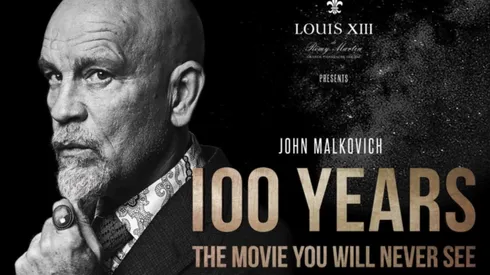
In 2015, a film quietly premiered by not premiering at all. Titled “100 Years“, the John Malkovich–led project was conceived with a radical condition: it would remain sealed from public view until November 18, 2115.
Directed by Robert Rodriguez and featuring a cast that includes Malkovich, Shuya Chang and Marko Zaror, the short film was created as part of a collaboration with Louis XIII cognac, a brand built around time, aging and legacy.
The Origins of 100 Years: Cinema as a Time Capsule
The film known as 100 Years was unveiled to the public in 2015 through an unconventional announcement: it would not be released for another century. Officially titled 100 Years: The Movie You Will Never See, the project was directed by Robert Rodriguez and starred John Malkovich in a mysterious lead role.
Rather than following a traditional production or distribution model, the film was conceived as a conceptual experiment, created in partnership with Louis XIII cognac, a luxury brand whose production cycle itself spans generations.
Louis XIII is made from eaux-de-vie aged between 40 and 100 years, meaning the cognac bottled today was distilled by cellar masters long gone. That philosophy—crafting something for people who do not yet exist—became the conceptual backbone of the film.
Rodriguez and Malkovich were invited to imagine a story meant exclusively for the future, detached from contemporary reception, box office pressure, or critical response.
A Film That Exists But Cannot Be Seen
What makes 100 Years particularly unusual is that it is not theoretical or unfinished. The film was completed, screened privately for a select few involved in the project, and then physically sealed.
The original reels were placed inside a high-tech vault made of bulletproof glass and steel, equipped with biometric locks and set to open automatically on November 18, 2115. The vault has been displayed in cities such as Cannes, Los Angeles and Hong Kong, turning the unseen film into a traveling exhibition.
Three teaser trailers were released to the public at the time of the announcement, each presenting a different possible version of the future—one dystopian, one technologically advanced, and one post-apocalyptic.
None of them revealed the actual plot of the film, leaving its true content deliberately ambiguous. Whether any of these visions reflect the real narrative remains unknown.
John Malkovich and the Appeal of the Unreachable
John Malkovich’s involvement was central to legitimizing the project beyond its promotional roots. Known for choosing unconventional, often cerebral roles, he approached 100 Years as a philosophical exercise rather than a performance aimed at an audience.

In interviews surrounding the announcement, he described the film as a message cast forward in time, detached from ego and reception, free from the need to be understood immediately.
The cast also includes Shuya Chang and Marko Zaror, though their characters and roles remain undisclosed. Even basic details—runtime, genre, narrative structure—have been withheld, reinforcing the idea that the film’s value lies not in anticipation, but in surrendering control over how and when it will be experienced.
Art, Marketing and the Question of Legacy
While 100 Years was undeniably tied to a luxury brand, its impact reached far beyond advertising. The project blurred the line between cinema, performance art and philosophical provocation. It challenged one of the entertainment industry’s core assumptions: that relevance must be immediate.
In an era dominated by streaming, algorithms, and instant feedback, 100 Years proposed the opposite—art that accepts obscurity as its natural state. Critics and cultural commentators have debated whether the film should be considered a genuine artistic work or a high-concept branding exercise.
Yet its endurance as a topic of discussion suggests that it succeeded in reframing how cinema can interact with time. By removing the audience from the present, the project forced attention onto intention, trust and the fragility of cultural preservation.
Waiting for an Audience Not Yet Born
When the vault finally opens in 2115, none of the filmmakers, actors or original collaborators will be alive to witness the reaction. The world that receives 100 Years may not resemble the one that created it—technologically, politically, or culturally. That uncertainty is not a flaw but the film’s defining feature.
In committing a finished work to the future, 100 Years stands as one of cinema’s most radical gestures. It is less a movie than a statement: a belief that stories can outlive their creators, and that art does not always need to be seen to exist.