It featured two guys sitting in a greasy-spoon diner, dissecting the hidden messaging of a woman’s shirt button, and eventually going to a laundromat.
Test audiences absolutely hated it. A notorious network research memo from the time summarized the feedback as “weak,” with one executive famously grumbling, “You can’t get too excited about two guys going to the laundromat.” Yet against all statistical odds, that low-concept pilot about the mundane minutiae of everyday life evolved into Seinfeld—the most influential, fiercely analyzed, and massively popular sitcom in television history.
As we celebrate its anniversary today, let’s look back at how a show explicitly designed to be “about nothing” became an absolute everything to global pop culture.
The Miracle Pick-Up: Saved by a Secret Budget
It is easy to forget that Seinfeld was almost buried before it ever had a chance to walk. NBC’s legendary chief Brandon Tartikoff initially passed on the series, characterizing it as “Too New York, too Jewish” to appeal to a broad Middle-American demographic.
The show was salvaged by a single hero: NBC executive Rick Ludwin. Believing passionately in the unique voice of creators Jerry Seinfeld and Larry David, Ludwin took money out of his own department’s special-specials budget to fund a tiny, four-episode order. That order remains the smallest sitcom pick-up in network television history.
When the show returned in 1990—officially dropping “Chronicles” from its name and adding Julia Louis-Dreyfus as Elaine Benes to balance the dynamic—the underground word-of-mouth began to snowball. By Season 4’s legendary “The Contest” episode, the show wasn’t just a hit; it was a mandatory weekly cultural ritual.
The Secret Formula: “No Hugging, No Learning”
Before Seinfeld, the standard American sitcom template relied heavily on moral resolutions. Shows like The Cosby Show or Family Ties wrapped up each episode with a lesson learned, an emotional embrace, and a return to familial harmony.
Larry David radically dismantled this convention with a strict, baseline mantra for the writers’ room: “No hugging, no learning.”
Jerry, George, Elaine, and Kramer were unapologetically petty, deeply selfish, and pathologically incapable of personal growth. If they did something terrible, they didn’t learn a lesson; they simply got annoyed by the consequences. This refreshing, cynical honesty felt revolutionary to audiences who were tired of overly sentimental television.
The Four Pillars of the Grid
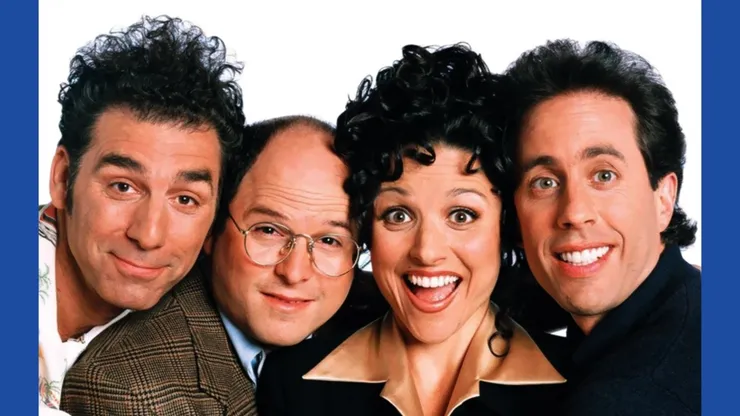
A massive component of Seinfeld‘s dominance was its flawless, lightning-in-a-bottle casting. The show functioned as a perfectly oiled comedic machine where every character brought a distinct flavor of neurosis:
- Jerry Seinfeld: The calm, observant anchor of the madness, acting as the ultimate straight man who viewed his friends’ lives as a giant, ongoing stand-up routine.
- Jason Alexander (George Costanza): The neurotic, self-loathing, and fiercely dishonest id of Larry David. George turned lying into an Olympic sport, providing the show with its most explosive physical comedy.
- Julia Louis-Dreyfus (Elaine Benes): A whirlwind of assertive, fast-talking, and fiercely independent energy who could push a man across a room with a single “Get out!”
- Michael Richards (Cosmo Kramer): The eccentric, sliding-door-crashing hipster doofus whose chaotic physical comedy balanced out the show’s hyper-intellectual banter.
An Endless Lexicon: Dictating the Way We Talk
The ultimate proof of Seinfeld’s unprecedented popularity is how completely it rewrote the English language. Decades after airing its finale to over 76 million viewers, the show’s vocabulary remains permanently embedded in modern vernacular.