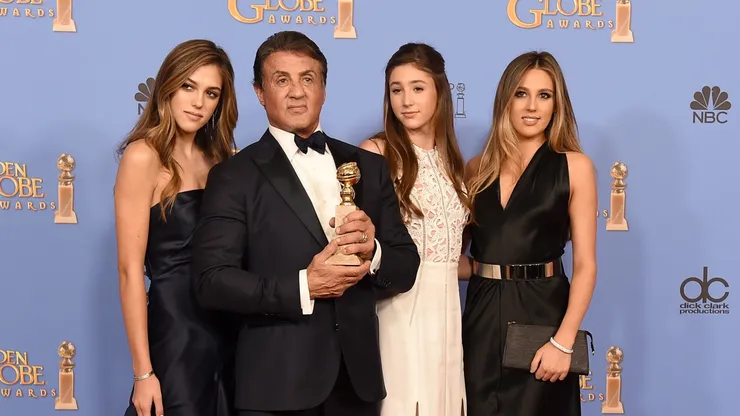
Sylvester Stallone has spent half a century commanding the global cultural zeitgeist, immortalized as a symbol of physical resilience. Yet, if you look closely at the trajectory of his career, the massive shifts in his artistic choices don’t align with studio trends—they align with his family.
Stallone’s filmography is deeply intertwined with the triumphs and deep tragedies of his personal life as a father. From the guilt of balancing 1980s superstardom with his children’s needs to the devastating losses that fueled his late-career creative renaissance, being a dad completely dismantled the cold, unyielding action-star exterior he was forced to wear.
Sage Stallone and the Blurred Lines of ‘Rocky V’
By the late 1980s, Stallone was trapped inside the larger-than-life, untouchable image of his own creation. He broke that mold in 1990 by casting his real-life oldest son, Sage Stallone, to play Rocky Balboa Jr. in Rocky V.
The film focused heavily on a father struggling to notice his own son’s emotional neglect while chasing fame and distraction. The tension on screen was palpable because it mirrored their real life. Stallone later admitted that the movie allowed him to have breakthroughs with Sage that they hadn’t managed in the privacy of their own home.
The tragic, sudden passing of Sage in 2012 from heart disease fundamentally shattered Stallone, casting a long emotional shadow over his work. When he returned to the screen years later as an aging, grieving mentor, the raw, tear-jerking vulnerability he displayed was no longer just acting—it was a father processing real, unyielding grief in front of the lens.
Seargeoh and the Private Fight for Autism Advocacy
In the early 1980s, at the absolute absolute peak of his global fame, Stallone’s second son, Seargeoh, was diagnosed with autism. In an era where the condition was deeply misunderstood and heavily stigmatized by the public, a typical Hollywood leading man might have hidden the diagnosis to protect a carefully curated “perfect” public image.
Instead, Stallone and his then-wife Sasha Czack went public, using their massive platform to raise awareness and establish a research fund under the National Society for Children and Adults with Autism.
This diagnosis fundamentally altered how Stallone viewed his career. He stopped chasing the hollow, playboy lifestyle of a traditional 80s superstar and transformed into a fiercely private, protective patriarch. He began choosing projects that kept him closer to home and started seeking out stories that championed the protection of the vulnerable, laying the thematic groundwork for his later career pivots.
‘Over the Top’ (1987): The Ultimate Manifestation of Dad Guilt
While film critics historically dismissed the arm-wrestling drama Over the Top as high-camp 80s excess, the film is secretly the most transparent look into Stallone’s internal psyche at the time.
Playing a struggling truck driver trying to win back the love and custody of his estranged, military-academy son, the movie functions as a massive piece of cinematic “dad guilt.”
Stallone wrote the script during a period where he was constantly traveling the globe for massive, back-to-back studio shoots, missing crucial milestones in his children’s lives. The film’s core thesis—that a father will literally tear his own muscles apart to prove his worth to his child—was Stallone’s way of communicating his real-life anxieties to his family through the only language he knew perfectly: blockbuster cinema.
The Ultimate Transition into the ‘Girl Dad’ Era
The final, most joyful evolution of Stallone’s career came with his marriage to Jennifer Flavin and the birth of his three daughters: Sophia, Sistine, and Scarlet.
Surrounded entirely by women, the hyper-masculine action star completely softened. He began taking himself significantly less seriously, a shift that translated on screen into a much warmer, self-deprecating presence.
This transformation culminated in his recent pivot to reality television with Paramount+’s smash hit The Family Stallone. Watching the man who single-handedly defeated cinematic armies get completely overwhelmed by his daughters’ dating lives or bickering over fashion choices has turned him into a premier modern icon of the “Girl Dad” movement.
The Passing of the Torch
As Sylvester Stallone enters his ninth decade today, his philosophy on celebrity has completely inverted. He is no longer fighting to keep the spotlight on himself; he is actively using his final years in the industry to build a launchpad for his children’s ambitions.
Eighty years of life have proven that Stallone’s greatest victory wasn’t a box office record or an iconic movie prop—it was learning to drop his guard and let the love for his family define his legacy.