If you are tracking the timeline of Hollywood’s greatest eras, today marks what would have been Shelley Duvall’s 77th birthday. Since we lost her in July 2024 to complications from diabetes, the film world has felt a little less colorful.
Discovered completely by accident at a Houston party by a talent scout, Duvall went on to defy the rigid, sanitized expectations of what a Hollywood leading lady “should” look like. With her wide, expressive eyes, delicate frame, and a voice that could shift from a whisper to a blood-curdling scream, she became the ultimate collaborator for legendary auteurs. To honor her memory today, we are stepping into the archives to look at the five brilliant performances that cemented her immortality.
1. Millie Lammoreaux in 3 Women (1977) — Her Creative Zenith
While mainstream audiences often recognize her for her horror work, 3 Women remains Duvall’s absolute artistic masterpiece. Inspired by a dream director Robert Altman had, the avant-garde psychological drama stars Duvall as Millie, a thoroughly self-deluded, hyper-talkative spa attendant who is utterly obsessed with magazine-ready lifestyles and consumerism. Duvall brought an agonizingly funny, deeply tragic layer to a woman who desperately wants to be noticed by a world that looks right through her. Her brilliant performance earned her the prestigious Best Actress award at the Cannes Film Festival, proving her dramatic weight on the global stage.
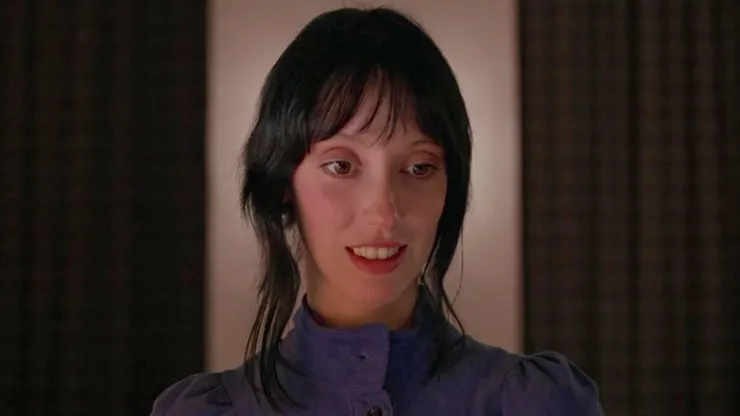
2. Wendy Torrance in The Shining (1980) — The Triumph of Terror
There is no discussing Duvall without acknowledging her grueling, historic turn in Stanley Kubrick’s adaptation of Stephen King’s novel. As Wendy Torrance, a mother trapped inside the haunted, snowbound Overlook Hotel with a homicidal husband, Duvall delivered a performance of raw, uninterrupted panic. While Kubrick’s notorious, relentless directing methods pushed her to the absolute brink of physical and emotional exhaustion, what remains on screen is a masterclass in survival. Wendy isn’t a passive victim; she swings a baseball bat, navigates a snow maze, and fights like hell to protect her son, creating the most iconic scream-queen archetype in history.
3. Olive Oyl in Popeye (1980) — The Fated Casting
“I was born to play Olive Oyl.” — Shelley Duvall
When Altman announced a live-action musical adaptation of the famous comic strip, the entire world collectively pointed at Duvall. Her tall, slender physique, expressive body language, and distinctive voice made her the literal human manifestation of E.C. Segar’s cartoon creation. Starring alongside Robin Williams, Duvall didn’t just play the role; she completely inhabited it. Her performance of the Harry Nilsson-penned ballad “He Needs Me” remains a dizzyingly sweet, whimsical highlight of 1980s cinema, later famously utilized by Paul Thomas Anderson in Punch-Drunk Love.
4. L.A. Joan in Nashville (1975) — The Ultimate Groupie
In Altman’s sprawling, 24-character satirical masterpiece about the American country music scene, Duvall shines brightly in a crowded room. Playing L.A. Joan, a self-absorbed, wig-wearing groupie who travels to Nashville under the guise of visiting her dying aunt, Duvall completely weaponized her comedic timing. She floats through the background of concert halls and political rallies, completely detached from reality and hunting down the next big star. It is a subtle, scene-stealing performance that highlighted her unique capability to anchor an ensemble piece.
5. Keechie in Thieves Like Us (1974) — The Raw Romantic
Before she was an international icon, Duvall proved her dramatic mettle in this beautifully gritty, Depression-era crime romance. Playing Keechie, a simple country girl who falls hard for a escaped convict (Keith Carradine), Duvall delivered a performance entirely stripped of Hollywood glamour. The romance works because it feels unbelievably human—clumsy, tender, and deeply vulnerable. It proved early on that Duvall didn’t need elaborate costumes or stylized sets to command the screen; her raw, naturalistic presence was more than enough to capture the heart of the audience.