The year 1945 gave the world many things, but few have resonated quite as loudly as the birth of a boy from Surrey who would eventually see his name scrawled in graffiti across London’s brick walls with the sacrilegious claim that “Clapton is God“.
Now, as Eric Clapton marks his 81st year on March 30, 2026, the stratospheric highs of his career remain as jagged and beautiful as the riffs that defined them. From the frantic, distorted blues of the Yardbirds and the psychedelic mastery of Cream to the weeping melancholy of “Layla”, his journey has been a masterclass in survival.
“Layla” (Derek and the Dominos, 1970)
Widely regarded as one of the most intense expressions of unrequited love in musical history, “Layla” was Clapton’s desperate plea to Pattie Boyd. The track is famous for its intertwining guitar duel between Clapton and Duane Allman, creating a wall of sound that feels both frantic and meticulously layered. The shift from the fiery opening riff to the haunting, piano-driven coda remains one of the most celebrated transitions in rock.
The song’s enduring power lies in its raw, bleeding-edge emotion. Clapton pushed his vocals and his guitar to the breaking point, capturing a moment of personal obsession that resonated globally. It wasn’t just a radio hit; it was the birth of a masterpiece that proved Clapton could weave the complexity of a symphony into the grit of the blues.
“Tears in Heaven” (1992)
Born from the unimaginable tragedy of losing his young son, Conor, this track saw Clapton trade his electric fire for a devastatingly simple acoustic arrangement. It stripped away the “Guitar God” persona to reveal a grieving father, resulting in one of the most successful and emotionally resonant songs of the 1990s. The song dominated the Grammy Awards and introduced a new generation to his softer, more contemplative side.
Beyond its commercial success, “Tears in Heaven” served as a public catharsis. The delicate fingerpicking and fragile vocals provided a blueprint for the “MTV Unplugged” era, proving that a true legend doesn’t need a wall of amplifiers to command a room. It remains a staple of his live sets, a quiet testament to the healing power of melody.
“Sunshine of Your Love” (Cream, 1967)
If there is a single riff that defined the psychedelic blues movement, it is the heavy, descending hook of this Cream classic. Clapton utilized his famous “woman tone”—a thick, creamy distortion achieved by rolling back the tone knobs on his Gibson SG—to create a sound that felt both ancient and futuristic. The song helped establish the power trio as the dominant force in 1960s rock.
The interplay between Clapton, Jack Bruce, and Ginger Baker on this track pushed the boundaries of what a rock song could be. By blending pop sensibilities with long, improvisational stretches, they laid the groundwork for hard rock and heavy metal. It remains the quintessential example of Clapton’s ability to turn a simple blues motif into a global anthem.
“Wonderful Tonight” (1977)
Written while waiting for Pattie Boyd to get ready for a party hosted by Paul McCartney, this ballad became the definitive “slow dance” of the late 70s. It showcased a softer, more melodic side of Clapton’s songwriting, focusing on the quiet intimacy of a long-term relationship. The gentle, clean guitar hook is instantly recognizable, providing a masterclass in “less is more.”
While some critics initially dismissed it as too sentimental, the song’s longevity has proven its worth. It highlights Clapton’s ability to step away from the blues-rock furnace to deliver a pop-standard that feels timeless. Even 81 years into his journey, the song remains one of his most-streamed tracks, illustrating his reach beyond the traditional guitar enthusiast.
“Cocaine” (1977)
Originally written by J.J. Cale, Clapton’s version of “Cocaine” became a definitive document of the 1970s rock lifestyle. With its insistent, chugging riff and deadpan delivery, the song occupies a strange space in his catalog—both a celebration of the era’s excess and, as he would later claim, a subtle warning against it. It remains one of his most recognizable and requested live tracks.
The brilliance of the song lies in its rhythmic precision. Clapton’s guitar work here is tight and economical, mirroring the “Slowhand” philosophy of making every note count. It helped cement his reputation as a master of the “laid-back” groove, a style he refined after years of playing high-intensity psychedelic blues.
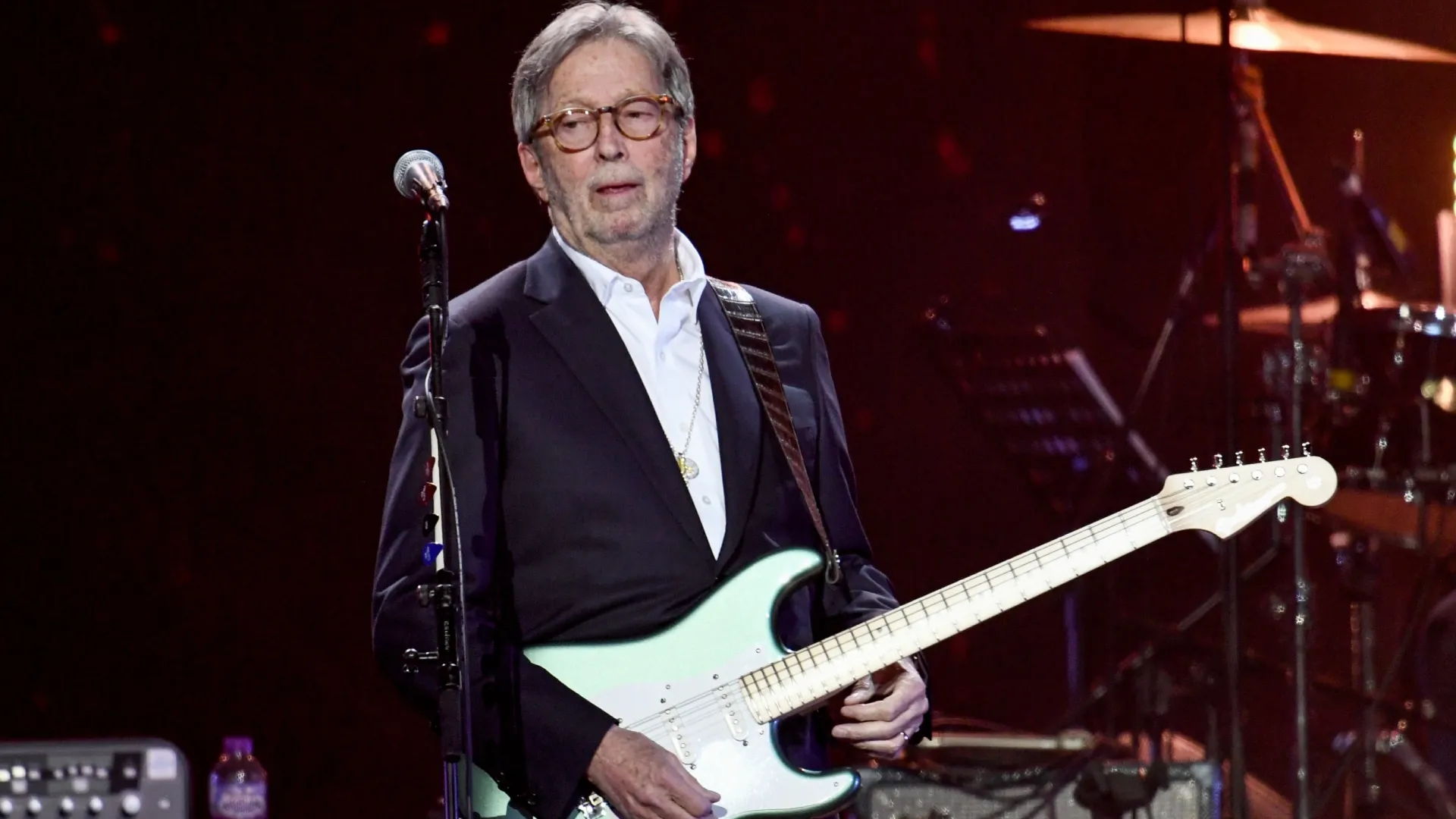
Eric Clapton performs on stage during Music For The Marsden 2020 (Source: Gareth Cattermole/Gareth Cattermole/Getty Images)
“Crossroads” (Cream, 1968)
Recorded live at the Winterland Ballroom, this reimagining of Robert Johnson’s “Cross Road Blues” is often cited as the greatest live guitar performance ever captured on tape. Clapton’s solos are a blur of technical brilliance and emotional fire, effectively bridging the gap between the Delta blues of the 1930s and the stadium rock of the 1960s. It was the moment “Clapton is God” became more than just graffiti.
The sheer speed and accuracy of his playing on this track set a new standard for rock virtuosity. He didn’t just cover the song; he electrified it, proving that the blues were a living, breathing entity that could evolve. For any aspiring guitarist, the live version of “Crossroads” remains the ultimate study in phrasing and improvisational stamina.
“I Shot the Sheriff” (1974)
By covering this Bob Marley track, Clapton played a pivotal role in bringing reggae to a mainstream American audience. His version replaced the sparse, dub-heavy original with a polished, soulful rock arrangement that topped the Billboard Hot 100. It signaled a new era for Clapton, one characterized by a global outlook and a willingness to experiment with genres outside of traditional blues.
The track’s success revitalized his career during a difficult personal period. By leaning into the groove and the rhythmic “skank” of reggae, he showed a versatility that many of his peers lacked. It remains a highlight of his 70s output, blending a catchy pop sensibility with a dark, narrative-driven lyricism.
“Bad Love” (1989)
Coming toward the end of the 1980s, “Bad Love” was a high-energy return to the “Power Blues” that had initially made him famous. Featuring a driving beat and a searing, wah-wah-soaked guitar solo, the song felt like a bridge between his classic 60s sound and the modern production of the late 80s. It earned him another Grammy and proved that he could still compete with the younger “guitar heroes” of the era.
The song is a masterclass in tension and release. Clapton’s vocals are gritty and determined, matched by a guitar tone that was much more aggressive than his mid-70s work. It remains a fan favorite for its energy and its reminder that, even in his 40s, Clapton could still burn through a fretboard with the best of them.
“Change the World” (1996)
Teaming up with producer Babyface, Clapton delivered this smooth, acoustic-led track for the Phenomenon soundtrack. It was a massive commercial success, winning Record of the Year and Song of the Year at the Grammys. The track highlighted his ability to blend his blues roots with contemporary R&B influences, resulting in a sophisticated, mid-tempo hit that dominated the airwaves.
The track’s charm lies in its effortless delivery. Clapton’s acoustic soloing is tasteful and melodic, showing a musician who is completely comfortable in his skin. It proved that he could remain relevant in a changing musical landscape by focusing on high-quality songwriting and his unmistakable, soulful touch.
“White Room” (Cream, 1968)
This psychedelic masterpiece features one of the most iconic uses of the wah-wah pedal in rock history. The opening rising chords, Jack Bruce’s haunting vocals, and Clapton’s blistering, feedback-laden solos create an atmosphere of surrealist dread. It was a song that pushed the limits of studio technology at the time, showcasing Clapton as a sonic experimentalist.
The song’s longevity is a testament to its unique structure and Clapton’s inventive playing. He used his guitar to mimic the human voice, crying and screaming through the solos in a way that felt both chaotic and perfectly controlled. It remains a cornerstone of the psychedelic era and a definitive example of the power of the “Slowhand” in his prime.