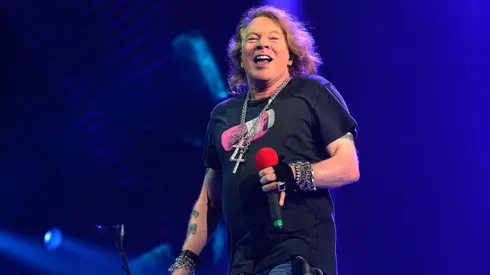
The Making of William Bailey
Long before he was Axl, he was William Bruce Rose Jr., born in 1962 in Indiana. His early life was a landscape of religious extremism and deep-seated trauma. Growing up in an oppressive Pentecostal household, he sang in the church choir from age five but lived under the thumb of a stepfather he believed was his biological father. It wasn’t until age 17 that he discovered insurance papers revealing his real father—a revelation that prompted him to drop his last name and eventually legalise the moniker W. Axl Rose.
His teenage years were a blur of rebellion and arrests, with Rose later admitting he was an “outcast” who found sanctuary only in piano keys and rock records. Faced with the threat of being charged as a habitual criminal in his hometown, he hopped a bus to Los Angeles in 1982, carrying nothing but a dream and a chip on his shoulder the size of a Gibson Les Paul.

Welcome to the Jungle: The G N’ R Era
The formation of Guns N’ Roses in 1985 was a lightning-strike moment for music. Merging members of L.A. Guns and Hollywood Rose, the “classic” lineup—Axl, Slash, Izzy Stradlin, Duff McKagan, and Steven Adler—became the “most dangerous band in the world.”
When Appetite for Destruction dropped in 1987, it didn’t just top charts; it decimated the polished “hair metal” of the era with raw, street-wise aggression. Axl’s unique five-octave vocal range—from a rich baritone to his signature “banshee” wail—made him an instant icon. However, with the fame came the “no-show” riots, public feuds, and a reputation for unpredictability that made every concert a high-stakes gamble.
The Reclusive Architect
Following the massive Use Your Illusion tour in 1993, the band fractured. As Slash and Duff departed, Axl retreated into a legendary period of reclusivity in his Malibu mansion. For over a decade, he became a “ghost” in the industry, spending millions of dollars and countless hours in studios working on the mythical album Chinese Democracy.
During this time, the narrative around Axl shifted from “rock god” to “reclusive genius.” When the album finally arrived in 2008, it showcased a different, more industrial side of Rose—a complex, layered work that proved his creative fire hadn’t been extinguished, even if it had been refined in isolation.
The Great Reunion and the 2026 World Tour
The “impossible” happened in 2016: the “Not in This Lifetime…” tour brought Axl, Slash, and Duff back together. It became one of the highest-grossing tours in history, silencing critics who thought the bridges were burned beyond repair.
Today, in 2026, Axl is as active as ever. Guns N’ Roses is currently midway through a massive World Tour, featuring a historic return to the Rose Bowl in Pasadena—their first time at the venue in over 30 years. Fans are also buzzing over the release of two new singles, “Nothin’” and “Atlas,” which dropped in late 2025. At 64, the “screaming 2-year-old” he once described himself as has found a rare kind of peace, standing tall as one of the last true, unfiltered rock stars of the modern age.