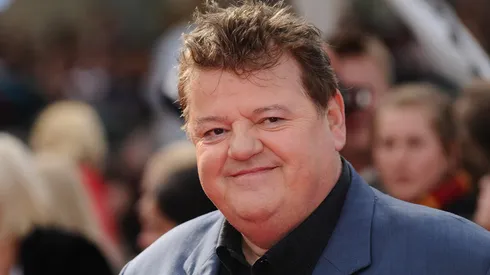
To the generation that grew up within the stone walls of Hogwarts, Robbie Coltrane was the gentle tectonic plate upon which a franchise rested—the bearded, bumbling heart of Rubeus Hagrid.
Yet, to pigeonhole the Scottish titan solely as a keeper of keys and grounds is to overlook a chameleonic career that stretched from the smoke-filled rooms of gritty British crime dramas to the high-stakes glitz of the James Bond universe.
He possessed a gravitational charisma; he was a man of immense physical stature who could pivot from menacing intellect to fragile vulnerability with the grace of a stage veteran, proving that his true magic lay far beyond a prosthetic beard and a giant’s coat.
Dr. Edward “Fitz” Fitzgerald in Cracker (1993–2006)
Before the “anti-hero” became a television staple, there was Fitz—a chain-smoking, gambling-addicted criminal psychologist who was as brilliant as he was self-destructive.
Coltrane didn’t just play the role; he inhabited the jagged edges of a man who could solve a grisly murder while his personal life collapsed in real-time. It was a performance fueled by a raw, intellectual ferocity, earning him three consecutive BAFTA Best Actor awards and setting a new high-water mark for British police procedurals.
The magic of this portrayal lived in the interrogation room. Coltrane used his massive presence not to intimidate, but to dismantle the psyche of his suspects with surgical verbal precision.
He turned the “box” into a theater of human frailty, showing the world that a hero doesn’t need to be likable to be absolutely mesmerizing. Even decades later, his work as Fitz remains a masterclass in how to portray a soul both tortured by its own vices and redeemed by its relentless pursuit of the truth.
Valentin Zukovsky in GoldenEye & The World Is Not Enough (1995, 1999)
Stepping into the high-stakes orbit of James Bond, Coltrane introduced the world to Valentin Zukovsky, an ex-KGB operative turned Russian Mafia kingpin with a permanent limp and a sharp tongue.
In an era of cartoonish villains, he brought a weary, lived-in cynicism to the 007 franchise, playing a man who survived the fall of the Soviet Union by trading in secrets and black-market caviar. He was the perfect, gritty mirror to Pierce Brosnan’s polished spy, offering a sense of history and weight to every scene.
What started as a wary rivalry in GoldenEye blossomed into a reluctant, humorous alliance by the time the late 90s rolled around. Coltrane’s Zukovsky felt like a character with an entire spin-off movie’s worth of backstories hidden behind his smirk.
He navigated the explosive world of international espionage with a dry wit and a dangerous charm, asserting himself as one of the few actors who could out-talk and out-charisma a secret agent without ever needing to draw a weapon.
Danny McGlone in Tutti Frutti (1987)
Long before global fame beckoned, Coltrane found his rhythm in this cult-classic BBC Scotland series as the lead singer of “The Majestics.” Playing Danny McGlone—the brother of the band’s original frontman—he captured the bittersweet spirit of the Scottish working class, caught between the mundanity of daily life and the fading neon lights of rock-and-roll ambition.
It was a role deeply rooted in his own heritage, blending a sharp Glaswegian tongue with a surprisingly tender vulnerability. The series acted as a springboard for both Coltrane and a young Emma Thompson, showcasing a “dramedy” chemistry that was decades ahead of its time.
Coltrane’s performance was rhythmic and soulful, proving he could carry the emotional weight of a leading man while delivering the comedic timing of a veteran. To look back at Tutti Frutti is to see the early embers of a star who was already too big for the small screen, radiating a charisma that felt entirely effortless.
Paul Finchley in National Treasure (2016)
In what is widely regarded as his final dramatic masterpiece, Coltrane took on the harrowing role of a beloved veteran comedian accused of historical sexual abuse. This was an uncomfortable, high-wire act of a performance; he had to play a man whose public face was a mask of grandfatherly warmth, while his private life was under the scorching heat of an investigation.
Coltrane leaned into the ambiguity, leaving the audience to struggle with their own perceptions of fame and the monsters that can hide in plain sight. The brilliance here was in the silence. Rather than relying on grand speeches, he used his aging, heavy frame to convey a man retreating into a shell of bewilderment and denial.
It was a searing interrogation of the “Operation Yewtree” era in the UK, and Coltrane’s willingness to inhabit such a polarizing character served as a final reminder that his artistic courage had never dimmed. He didn’t ask for the audience’s sympathy; he demanded their attention, delivering a performance of quiet, devastating power.
Charlie McManus in Nuns on the Run (1990)
Trading the darkness of the criminal mind for the absurdity of a convent, Coltrane teamed up with Eric Idle for this slapstick heist comedy. As Charlie McManus, a crook who flees his gang and disguises himself as a nun to hide in plain sight, he demonstrated a flawless gift for physical comedy.
Despite the ridiculous premise of a six-foot-plus man in a habit, Coltrane never let the character become a caricature; he played the panic and desperation straight, which only made the comedy hit harder.
The “odd couple” dynamic he shared with Idle was the engine that drove the film’s success. While the movie was packed with sight gags, Coltrane’s ability to ground the silliness in a relatable desire for a fresh start gave the story its heart.
He proved that he didn’t need a gritty script to dominate the frame; a panicked whisper or a skeptical glance from under a wimple was enough to cement his status as one of the most versatile comedic forces of his generation.
Falstaff in Henry V (1989)
When Kenneth Branagh sought to bring Shakespeare to a new cinematic generation, he looked to Coltrane to provide the emotional foundation of “Old England” through the character of Sir John Falstaff.
Though his screen time was concise, his impact was tectonic. He portrayed the boastful, tragic knight as a mountain of flesh and regret—a man whose youthful revelry with the King had curdled into the heartbreaking realization that he was no longer needed by the crown.
Coltrane navigated the complex Shakespearian meter with a naturalism that stripped away the “theater” and replaced it with raw humanity. His portrayal of the rejected Falstaff is one of the most moving moments in the film, proving that he possessed the classical chops to stand shoulder-to-shoulder with the finest stage actors. He brought a profound, terminal vulnerability to the role, turning a legendary literary figure into a living, breathing man of deep sorrow.
Samuel Johnson in Blackadder the Third (1987)
In a guest appearance that has since become the stuff of comedy legend, Coltrane breathed life into the pompous, lexicographical giant Dr. Samuel Johnson. Arriving at the royal court to present his newly finished dictionary, he was immediately thrust into a battle of wits with Rowan Atkinson’s Blackadder.
Coltrane played the doctor with an explosive, high-status energy, obsessively checking for missing words while trying to maintain his dignity in a room full of idiots. The performance was a whirlwind of intellectual arrogance and rapid-fire dialogue.
His ability to deliver dense, wordy rants with such aggressive comedic timing made the character an instant standout in a series already famous for its brilliance. Even decades later, his interactions with Atkinson are cited as a highlight of British sitcom history, proving that Coltrane could dominate the room with nothing more than a leather-bound book and a look of sheer, vocabulary-driven disdain.
The Pope in The Pope Must Die (1991)
Taking on a title that courted international controversy and even bans, Coltrane played a low-ranking, kind-hearted priest who accidentally ascends to the papacy due to a clerical error and a Mafia scheme.
While the film was a biting satire of Vatican corruption, Coltrane provided the moral center as the “Accidental Pope.” He portrayed the character as an everyman trying to do the right thing in a world of wolves, using his natural warmth to make the absurd premise feel surprisingly sincere.
Amidst the chaos of the script, he remained the anchor. He successfully navigated the transition from a simple priest who loves cars and rock music to the bewildered leader of the Catholic Church with a charm that disarmed the film’s critics.
His performance was a testament to his innate relatability; even when wearing the papal tiara in ridiculous situations, Coltrane maintained a shred of dignity that made the character—and the movie’s message—actually land.
Sergeant Peter Godley in From Hell (2001)
Descending into the fog-shrouded, visceral world of Victorian Whitechapel, Coltrane played the pragmatic Sergeant Peter Godley in this reimagining of the Jack the Ripper murders.
Acting as the grounded partner to Johnny Depp’s opium-addicted Inspector Abberline, he provided the structural integrity for the film’s grim atmosphere. He was the sturdy, reliable copper who navigated the filth of the East End with a sense of duty that felt deeply authentic to the period.
This role saw a return to his roots in the crime genre, but with a Gothic, atmospheric twist. Coltrane’s Godley felt like he belonged in the 19th century; he brought a lived-in authority to the part that helped sell the film’s dark reality.
His presence offered a much-needed sense of human grit in a narrative swirling with conspiracy and madness, reminding audiences that Coltrane was often the “glue” that held high-concept productions together.
The Ghost of Christmas Present in A Christmas Carol (1999)
For this star-studded adaptation of the Dickens classic, Coltrane was the definitive choice to play the Ghost of Christmas Present. Cloaked in emerald robes and surrounded by a feast of epic proportions, he was the embodiment of festive abundance. However, he didn’t stop at being “jolly.”
He infused the spirit with a booming, commanding authority and a touch of melancholy, using his stature to remind Patrick Stewart’s Scrooge of the harsh, cold realities facing the poor outside his door.
His performance captured the duality of the character—the warmth of the hearth and the biting truth of the streets. Using his voice to fill the frame, he guided the viewer through a visual feast of 19th-century London, acting as the emotional bridge between Scrooge’s isolation and the world’s shared humanity.
It remains a beloved holiday performance, showcasing Coltrane’s unique ability to take a larger-than-life supernatural figure and make him feel as tangible and resonant as a neighbor.