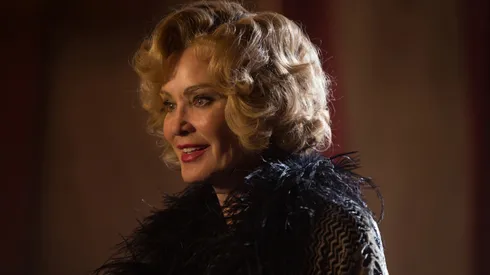
At 77, Jessica Lange remains one of the defining forces behind the early cultural impact of American Horror Story, a series that reimagined anthology television through a lens of theatrical excess and emotional precision.
Her arrival in Ryan Murphy’s universe in 2011 did more than elevate the show’s prestige—it helped establish its tone, where glamour and decay, performance and vulnerability, exist in constant collision.
Each appearance carried a distinct emotional architecture: grief disguised as control, power edged with collapse and charisma that often masked something far more fractured underneath.
“Return to Murder House” – Season 8, Episode 6 (Apocalypse)
This episode functions as one of the most significant crossovers within the American Horror Story universe, as it directly connects the narrative of Apocalypse with the origins of Murder House. The return of Constance Langdon, portrayed by Jessica Lange, reopens one of the most iconic storylines from the first season, particularly in relation to Michael Langdon and the legacy of the Antichrist.
The construction of the episode relies heavily on the viewer’s emotional memory, and this is where Lange asserts her interpretive weight. Constance appears as a figure who already understands how the story ends, moving between irony and a nearly spiritual resignation. Each of her scenes reinforces the idea that her character has always been aware of the tragic cycle surrounding the house.
“Apocalypse Then” – Season 8, Episode 10 (Apocalypse)
The finale of Apocalypse brings together multiple narrative threads developed throughout the season, resolving the central conflict between the witches, the Antichrist, and the forces of hell. Constance Langdon reappears at a key moment in the resolution, functioning as a figure who observes and defines Michael Langdon’s fate.
Jessica Lange plays this conclusion with a calmness that contrasts with the intensity of the overall plot. Constance no longer acts as an active participant in the conflict, but rather as someone who understands its inevitable outcome. Her presence adds an almost elegiac tone to the episode, reinforcing the idea that some characters endure more as memory than as action.
“Head” – Season 3, Episode 7 (Coven)
This episode marks a turning point in Fiona Goode’s gradual downfall within the American Horror Story coven. As her power begins to weaken, the narrative explores the physical and emotional consequences of a figure who has lived obsessed with immortality.
Jessica Lange crafts a more fragile Fiona, whose authority no longer holds with the same strength as in previous episodes. The character begins to show more visible emotional cracks, especially in her relationship with time and the loss of control over her own body. It’s an episode where power ceases to be abstract and becomes inevitably personal.
“The Dead” – Season 3, Episode 7 (Coven)
Parallel to the main coven storyline, this episode delves deeper into Fiona Goode’s relationship with the Axeman, expanding a more intimate and psychological dimension of the character. The narrative moves between the romantic, the manipulative, and the obsessive, building a dynamic charged with emotional tension.
Lange uses this narrative space to portray a Fiona who not only seeks magical power, but also emotional validation. The relationship exposes her need for control even in emotional contexts, revealing a character who cannot separate desire from dominance. The episode thus becomes an exploration of the loneliness behind authority.
“The Replacements” – Season 3, Episode 3 (Coven)
This episode focuses on Fiona’s strategic positioning within the coven, particularly in her interactions with Madison as a potential successor. The story explores how power is not only exercised, but also negotiated through emotional manipulation.
Jessica Lange presents a Fiona who oscillates between mentor and constant threat. Each conversation with the young witches functions as a silent survival assessment, where control is not always explicit. The episode reinforces the idea that Fiona is not simply trying to lead, but to ensure that no one can easily replace her.
“The Magical Delights of Stevie Nicks” – Season 3, Episode 10 (Coven)
This episode of Coven introduces an unusual element within the series’ universe: the appearance of Stevie Nicks as an almost mythical figure within the coven. At the same time, Fiona Goode continues her physical decline while trying to maintain her status as Supreme, at a point where her power is already showing clear signs of deterioration.
Jessica Lange builds a Fiona here who oscillates between an obsession with immortality and a growing melancholy. The episode uses the contrast between pop culture and ritual to reinforce the idea of a witch beginning to confront her own irrelevance within the cycle of magical power.
“The Seven Wonders” – Season 3, Episode 13 (Coven)
The Coven season finale determines the succession of the coven through a series of trials known as the “Seven Wonders,” which decide who will become the new Supreme. The episode serves as the structural conclusion to the season’s central arc, resolving the tensions that have built up among the witches.
In this context, Fiona Goode faces her fate as a figure of power. Jessica Lange plays this final stretch with a mixture of pride and emotional exhaustion, revealing that absolute control always had a time limit. Her presence in the final episode cements Fiona as one of the most influential performances in the entire series.
“Bitchcraft” – Season 3, Episode 1 (Coven)
The opening episode of Coven introduces Fiona Goode as the new Supreme of the coven, marking Jessica Lange’s return to the series in a completely commanding role. From the start, the narrative establishes the generational conflict between the younger witches and the authority figure embodied by Fiona.
Lange crafts an entrance that immediately defines the hierarchy of the narrative universe. Fiona needs no lengthy introduction: her presence, style, and body language establish the tone of the season. She is a character who combines glamour, menace, and decay from her very first scene.
“Boy Parts” – Season 3, Episode 2 (Coven)
In this episode, Fiona begins actively observing the young witches in the coven, especially Madison, in whom she sees the potential for succession. The story explores the internal logic of power within the witch academy, where survival depends as much on talent as on manipulation.
Jessica Lange portrays Fiona as a figure who dominates effortlessly. Every interaction functions as a silent evaluation of power, where authority is not imposed through direct violence, but through presence and psychological control.