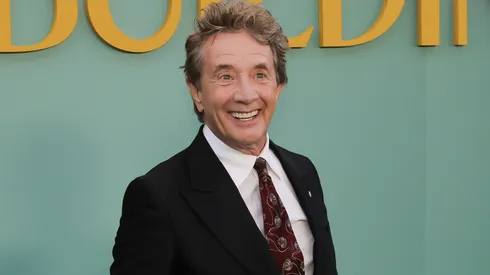
In Hollywood’s long memory of comedy, few performers have sustained the kind of restless inventiveness associated with Martin Short, whose work has moved fluidly between television satire, studio comedies and stage performance for more than four decades.
Emerging through SCTV and quickly translating that momentum into film, his screen identity was never built around a single persona, but around a shifting gallery of characters that felt fully inhabited rather than sketched.
That sense of reinvention is what gives his filmography its peculiar coherence. From the exuberant chaos of Three Amigos to the sharpened eccentricity of Father of the Bride and the more recent layered irony of Only Murders in the Building, his roles often balance exaggeration with unexpected control.
The result is a body of work that reads less like a career trajectory and more like a curated archive of comic alter egos, each anchored by precise timing and an instinct for disruption within the scene.
Three Amigos (1986)
Released in the mid-1980s, Three Amigos positioned Martin Short alongside Steve Martin and Chevy Chase in a Western satire that leaned heavily on silent-film-inspired physical comedy. Short’s Ned Nederlander is written as the most earnest of the trio, a former screen actor whose heroic identity is based more on illusion than experience.
The role allowed Short to translate his sketch-comedy precision into film language, using timing and exaggerated physical reactions rather than dialogue-heavy punchlines. While the film itself plays with parody, his performance becomes a study in innocence colliding with chaos, grounding the absurdity around him.
Father of the Bride (1991–1995)
In Father of the Bride and its sequel, Short appears as Franck Eggelhoffer, a flamboyant and meticulously detailed wedding planner whose entrances often reset the tone of every scene. The character is constructed as a heightened personality, balancing elegance with comedic excess.
What distinguishes Franck is the control behind the flamboyance: every gesture and cadence is tightly calibrated, giving the character a theatrical precision rather than pure improvisational chaos. Across both films, Short turns what could have been a supporting gag into a memorable comedic pillar of the story.
Innerspace (1987)
Innerspace casts Short as Jack Putter, a hypochondriac supermarket clerk suddenly caught in a science-fiction experiment gone wrong. The premise allows the performance to oscillate between panic, confusion and escalating physical comedy.
Rather than relying on spectacle alone, Short anchors the role in nervous realism, making the character’s anxiety the emotional engine of the story. The contrast between grounded performance and high-concept sci-fi makes his work in the film unusually textured for a genre comedy of its time.
Clifford (1994)
In Clifford, Short takes on one of his most divisive roles as a grown man behaving with childlike unpredictability within a dark domestic comedy framework. The character constantly disrupts tone, shifting between innocence and unsettling intensity.
The performance is notable for its commitment to discomfort as a comedic device. Rather than softening the edges, Short leans into them, creating a role that challenges audience expectations of what mainstream comedy could tolerate in the mid-1990s.

Mars Attacks! (1996)
Tim Burton’s ensemble satire features Short as Jerry Ross, a press secretary whose interactions with global crisis situations are filtered through vanity and denial. Though not a central character, his presence amplifies the film’s critique of institutional panic.
The performance works through exaggeration rather than realism, aligning with the film’s comic-book logic. Short uses sharp vocal rhythm and facial exaggeration to make even brief appearances feel sharply defined within the ensemble chaos.
Jungle 2 Jungle (1997)
In this cross-cultural comedy, Short plays Richard Kempster, a Wall Street figure navigating the arrival of an unexpected family dynamic between urban and Amazonian worlds. The role relies heavily on reaction-based humor and escalating situational conflict.
What emerges is a performance structured around disruption: Short functions as both participant and amplifier of the film’s misunderstandings. His comedic timing helps maintain coherence even as the premise leans into increasingly improbable situations.
The Santa Clause 3: The Escape Clause (2006)
As Jack Frost, Short steps into a stylized antagonist role within a family fantasy franchise. The character blends ambition, insecurity and theatrical villainy in a way that mirrors animated archetypes more than grounded realism.
Within the structure of the film, Frost becomes a catalyst for narrative escalation, and Short’s performance embraces exaggerated physicality and vocal modulation. It’s a role designed to disrupt holiday familiarity with controlled chaos.
The Pebble and the Penguin (1995)
In this animated feature, Short voices Hubie, a timid penguin whose personality is built around insecurity and romantic idealism. The performance relies entirely on vocal expression, without physical presence to support it.
Short uses tonal variation to create emotional range within animation constraints, giving the character both fragility and determination. It reflects his broader ability to translate theatricality into voice work without losing comedic clarity.
Treasure Planet (2002)
As B.E.N., the eccentric robotic character in Disney’s Treasure Planet, Short delivers a performance defined by improvisational energy and fragmented logic. The character serves as both comic relief and narrative guide within the film’s sci-fi reinterpretation of a classic story.
The voice work leans into unpredictability, with shifting emotional beats and rapid tonal changes. It stands as one of Short’s most recognizable animated roles due to its manic yet carefully structured delivery.
Jiminy Glick in Lalawood (2004)
In this project, Short fully inhabits his alter ego Jiminy Glick, a grotesquely exaggerated celebrity interviewer who satirizes entertainment media itself. The film extends a character originally developed for television into a full narrative environment.
The performance blurs boundaries between interview parody and character study, creating a layered comedic format where guests and host become part of the same absurd system. It remains one of Short’s most meta and structurally unconventional works.