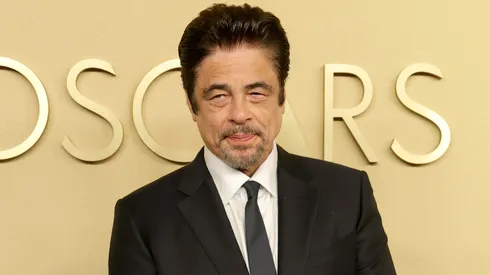
Benicio Del Toro’s trajectory has been anything but ordinary, shaped by roles that range from enigmatic antiheroes to morally complex figures whose presence lingers long after the film ends. He first broke into wider public awareness with a distinctive turn as Fenster in The Usual Suspects.
The breakthrough that redefined his career came in 2000 with Steven Soderbergh’s Traffic, where he portrayed a role that earned him the Academy Award for Best Supporting Actor and cemented his place among Hollywood’s most compelling character actors.
Whether anchoring gritty crime dramas or redefining genre expectations, his performances have consistently blended emotional nuance with unexpected intensity, making him one of the most distinctive actors of his generation.
Fear and Loathing in Las Vegas (1998)

In Terry Gilliam’s surreal adaptation of Hunter S. Thompson’s cult classic, Del Toro inhabits Dr. Gonzo, the volatile lawyer and chaotic partner to Johnny Depp’s Raoul Duke. Del Toro’s physical and psychological commitment brings a bizarre authenticity to the film’s drug-fueled journey through excess and disillusionment.
This role marked one of his earliest major performances in mainstream cinema, showcasing his ability to fully transform even in films driven by stylistic chaos rather than conventional narrative.
It wasn’t a traditional breakout, but Fear and Loathing confirmed Del Toro’s range and fearlessness — qualities that would define his later work. Playing Gonzo, he proved he could match the intensity of larger-than-life collaborators and navigate material that demanded both comedic impact and unsettling realism.
The Usual Suspects (1995)
In the now-classic crime thriller directed by Bryan Singer, Del Toro’s role as Fred Fenster is small but indelible. His idiosyncratic delivery and off-beat charisma help distinguish a character within one of the most talked-about ensemble casts in 1990s cinema. Despite limited screen time, Del Toro stood out among big names — evidence of his innate screen magnetism.
The performance earned him the Independent Spirit Award for Best Supporting Actor and immediately marked him as an actor to watch. It showed early on that he didn’t need traditional leads to leave an impression — a sign of an artist comfortable making every moment count.
Snatch (2000)
In Guy Ritchie’s frenetic crime comedy, Del Toro brings swagger and wit to Franky “Four-Fingers”, a jewel thief whose misadventures tie together several plot threads. His presence adds a humorous unpredictability to the film’s rapid cuts and eclectic character mix.
While not as celebrated as some dramatic turns, this role underlined Del Toro’s versatility — able to handle intense dramatic material and also bring comedic timing to stylized ensemble pieces. It broadened his appeal and reminded audiences of his dynamic range.
The French Dispatch (2021)
Dir. Wes Anderson tapped Del Toro for The French Dispatch, where he plays Moses Rosenthaler, a prisoner-artist whose emotionally volatile creativity becomes central to one of the anthology’s most vivid segments. The role allowed Del Toro to combine raw emotionality with satire, anchoring a surreal chapter in an already whimsical film.
This performance showcased his ability to adapt to highly stylized, auteur-driven work while still grounding his character in profound emotional truth — a reminder that even in a hyper-designed cinematic world, he brings weight and nuance.
21 Grams (2003)
In Alejandro G. Iñárritu’s nonlinear study of grief and loss, Del Toro portrays Jack Jordan, a man wrestling with guilt after a tragic accident reshapes multiple lives. His performance is raw and human, delving deep into remorse and the search for redemption in a narrative that demands emotional commitment at every turn.
This role earned Del Toro an Academy Award nomination and confirmed his ability to carry weighty, psychologically complex parts — showing that his talents extend far beyond genre or ensemble work into the core of human experience on screen.
Che (2008)
In the biographical epic by Steven Soderbergh, Del Toro takes on the formidable task of portraying Ernesto “Che” Guevara with depth and nuance across two films. The performance demanded immersive research, physical transformation, and a balance of charisma and ideological conflict.
His work in Che earned him Best Actor at the Cannes Film Festival and marked one of his most ambitious career achievements, proving he could lead long-form, demanding historical narratives with intellectual and emotional precision.
Traffic (2000)
Del Toro’s portrayal of Javier Rodriguez, a Mexican police officer navigating corruption and moral ambiguity in the U.S.–Mexico dr*g war, stands as the pinnacle of his career. Directed by Steven Soderbergh, Traffic examines complex social issues with interwoven stories, and Del Toro’s central role brings humanity to the film’s moral center.
The performance garnered him the Academy Award for Best Supporting Actor, along with Golden Globe and BAFTA honors, solidifying his reputation as one of cinema’s most impactful character actors. It remains not only his most acclaimed role but also the one most associated with his legacy.
Sicario (2015)
In Denis Villeneuve’s gripping thriller about the border drug war, Del Toro’s Alejandro Gillick is a figure of quiet menace and moral contradiction, walking the line between justice and revenge. His minimal dialogue and intense presence speak volumes, making Alejandro one of modern cinema’s most memorable antiheroes.
The role earned widespread critical praise and a BAFTA nomination, reinforcing Del Toro’s mastery of complex, layered characters — figures who drift between shadow and motive in ways that are both compelling and unsettling.
The Wolfman (2010)
In The Wolfman, Del Toro steps into a classic horror reinterpretation as the legendary creature himself, combining physical intensity with emotional depth. While the film received mixed reviews, Del Toro’s performance anchored the narrative with genuine gravitas and brooding complexity.
This role expanded his presence in mainstream blockbusters while still affirming his dedication to character detail, proving he could inhabit genre fare without losing the subtlety that defines his dramatic work.
One Battle After Another (2025)
Del Toro’s recent role as Sensei Sergio St. Carlos in One Battle After Another adds a new chapter to his legacy, blending humor, heart, and understated leadership. Though not as widely known yet as some earlier films, the role earned him Best Supporting Actor recognition and showcases his evolution into roles that balance emotional nuance with clear narrative impact.
Here, Del Toro plays a community figure whose calm strength and small moments of levity — like the now-quoted line about “a few small beers” — underscore a matured screen persona that continues to resonate with audiences and critics alike.