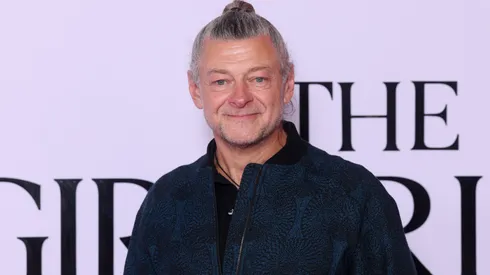
On his 62nd birthday, Andy Serkis stands as one of the most transformative figures in modern cinema, an artist whose career has repeatedly redrawn the boundaries between performance and technology.
From motion capture experiments that once felt experimental to fully realized characters that reshaped blockbuster storytelling, his work has quietly redefined what acting can look like in the digital age…
He is set to return to the franchise in the upcoming The Lord of the Rings: The Hunt for Gollum, a project that revisits the world that helped define his career while expanding its mythology once again.
The Lord of the Rings trilogy (2001–2003) – Gollum
The role of Gollum in The Lord of the Rings marked a turning point in modern cinema, with Andy Serkis delivering a performance that fused physical acting, voice work, and pioneering motion capture.
Rather than treating Gollum as a purely digital creation, Serkis performed the character on set alongside other actors, shaping his movements and emotional rhythm in real time. This approach became foundational for how CGI characters would later be developed in Hollywood.
What made the performance resonate was not just the technology, but the duality Serkis injected into Gollum and Sméagol. The internal conflict between innocence and corruption became a living presence on screen, turning what could have been a supporting creature into one of the saga’s emotional anchors.
The Hobbit trilogy (2012–2014) – Gollum
Returning to Middle-earth in The Hobbit: An Unexpected Journey, Serkis revisited Gollum with a more refined and technically advanced performance. By this stage, motion capture had evolved significantly, allowing for subtler facial detail and more expressive physical nuance.
His work in the riddle scene with Bilbo Baggins became one of the trilogy’s standout moments, built almost entirely on performance tension rather than spectacle. Unlike the earlier films, this version of Gollum leaned more heavily into psychological fragmentation.
Serkis emphasized vulnerability beneath the character’s instability, making him feel less like a monster and more like a tragic figure trapped by his own obsession. The performance reinforced how deeply Serkis had become intertwined with Tolkien’s world, almost functioning as its emotional memory.
King Kong (2005) – Kong / Lumpy
In Peter Jackson’s King Kong, Serkis expanded his motion-capture range beyond humanoid characters, embodying the giant ape Kong with surprising emotional depth. The performance was built through physical reference acting on set, often reacting to nothing but imagined environments and stand-ins.
This allowed animators to translate his gestures into a fully realized creature performance. What distinguished this portrayal was its emotional framing: Kong was not a monster but a displaced force of nature.
Serkis gave the character a sense of loneliness and instinctive tenderness, particularly in his interactions with Naomi Watts’ character. The result was a blockbuster creature film that felt unexpectedly intimate at its core.
Rise of the Planet of the Apes (2011) – Caesar
The introduction of Caesar in Rise of the Planet of the Apes became one of Serkis’ most influential roles, establishing him as the central figure in a new era of performance capture. The character’s evolution from intelligent experiment to revolutionary leader was grounded entirely in physical acting layered with digital enhancement.
What set Caesar apart was restraint. Serkis avoided exaggeration, instead building emotion through stillness, eye movement, and controlled physicality. The performance proved that motion capture could carry complex narrative arcs without relying on dialogue-heavy exposition.
Avengers: Age of Ultron (2015) – Ulysses Klaue
As Ulysses Klaue in Avengers: Age of Ultron, Serkis stepped into the Marvel universe with a sharply different energy. The character is chaotic, volatile, and deliberately theatrical, offering a break from the franchise’s more controlled villains.
Klaue’s presence also connects directly to Wakanda’s mythology, positioning him as a recurring outsider threat. Serkis plays him with a mix of humor and menace, turning limited screen time into a memorable antagonist role.
Breathe (2017) – Robin Cavendish
In Breathe, Serkis moves away from motion capture entirely, portraying Robin Cavendish, a man diagnosed with polio who becomes an advocate for disability rights. The performance is grounded, physical, and emotionally restrained, relying on subtle facial expression rather than transformation through CGI.
This role highlights Serkis’ range beyond digital innovation. The film’s emotional impact comes from stillness and vulnerability, showing that his strength as an actor is not dependent on technology but on precision and control.
Mowgli: Legend of the Jungle (2018) – Baloo
In Mowgli: Legend of the Jungle, Serkis not only performs Baloo but also directs the project, taking full creative control of its darker reinterpretation of Kipling’s world. The film uses motion capture extensively, allowing him to merge performance and direction simultaneously.
His version of Baloo is less comedic than previous adaptations, leaning instead into a protective, almost weary presence. The dual role reflects Serkis’ evolution from performer to filmmaker, expanding his influence over how motion capture storytelling is constructed.
The Batman (2022) – Alfred Pennyworth
In The Batman, Andy Serkis steps into one of the most iconic supporting roles in the Batman mythology as Alfred Pennyworth, Bruce Wayne’s loyal but emotionally distant guardian.
Unlike previous portrayals of the character as purely composed and paternal, Serkis’ version introduces a sharper edge—an Alfred shaped by years of isolation, grief, and unresolved tension with Bruce. What stands out is the emotional restraint he brings to the role.
Rather than overplaying sentimentality, Serkis leans into understatement, making Alfred feel more grounded and human within Gotham’s noir-heavy atmosphere. His scenes with Robert Pattinson’s Batman become quiet confrontations rather than traditional mentorship moments, reflecting a fractured version of their bond.
The Sandman (2022) – Matthew the Raven (voice)
In The Sandman, Serkis lends his voice to Matthew the Raven, one of the most emotionally grounded supporting characters in Dream’s realm. Though entirely voice-acted, the performance carries his signature physicality, translating subtle rhythm and tone into personality.
Matthew serves as both companion and conscience within the story, often balancing dark mythological themes with moments of unexpected humor. Serkis’ vocal work helps anchor the surreal tone of the series, giving shape to a character that exists between tragedy and levity.
Luther: The Fallen Sun (2023) – David Robey
In Luther: The Fallen Sun, Serkis plays David Robey, a chilling antagonist who operates from the shadows of digital manipulation and psychological control. The character stands as a modern evolution of villainy, rooted less in physical confrontation and more in surveillance, blackmail, and engineered chaos.
Serkis delivers a controlled, unsettling performance that contrasts sharply with Idris Elba’s John Luther. Instead of overt aggression, Robey’s menace lies in precision and detachment, making him one of Serkis’ most quietly disturbing roles in recent years.
Venom: Let There Be Carnage (2021) – Knull (voice)
While not physically present on screen, Serkis’ connection to the Venom: Let There Be Carnage universe extends through his performance-related involvement in the broader symbiote mythology, including his role as director of the film. His influence helped shape the tonal balance between chaos and humor that defines the franchise.
Although Knull’s presence is more closely associated with the larger Marvel symbiote lore, Serkis’ creative involvement behind the camera played a part in expanding the darker mythological elements that future installments continue to explore.
Andor (2022–2025) – Kino Loy
In Andor, Serkis delivers one of his most grounded live-action performances as Kino Loy, a prisoner whose arc becomes central to one of the series’ most intense storylines. Stripped of digital effects, the role relies entirely on physical presence and emotional escalation.
Kino Loy’s transformation—from reluctant enforcer to reluctant leader—becomes one of the show’s defining emotional beats. Serkis uses minimalistic expression and controlled intensity to portray a man breaking free from systemic control, making it one of his most human performances in a career often defined by transformation.