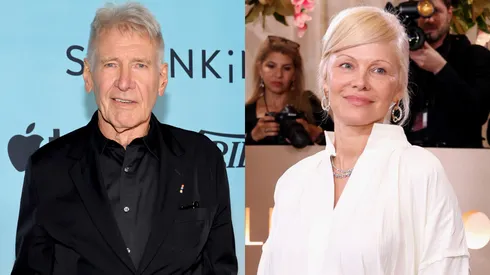
Fame rarely announces itself in advance. In several well-documented cases, it has arrived mid-shift, mid-argument or in the middle of an entirely different life. Charlize Theron was discovered during a heated exchange at a Los Angeles bank, while Danny Trejo stepped onto a film set not as an actor, but as a boxing counselor—only to be pulled in front of the camera.
Accidental stardom isn’t about bypassing effort, but about timing intersecting with visibility in ways that can’t be replicated. What begins as coincidence is later reframed as destiny, though at the moment it happens, it often looks like anything but.
Harrison Ford
Harrison Ford’s path to stardom was anything but linear. After struggling to land meaningful acting roles in the 1960s, he turned to carpentry to support his family, working on homes and studios around Los Angeles. Acting became secondary—something he pursued on the side rather than a reliable career.
That practical decision ended up placing him in the exact rooms that would change his life. While doing carpentry work for industry figures like George Lucas, Ford was invited to read lines during auditions and eventually landed roles in American Graffiti and, most notably, Star Wars. Being physically present—not strategically positioned—became the turning point.
Pamela Anderson
Pamela Anderson’s rise began in one of the most public—and unexpected—settings possible: a sports stadium. While attending a Canadian football game, she appeared on the jumbotron, drawing attention from the crowd and, crucially, from marketing executives who saw immediate potential.
That spontaneous moment quickly translated into modeling opportunities, including a high-profile beer campaign that launched her into wider visibility. From there, television followed, eventually leading to Baywatch. What began as a fleeting appearance in a crowd became the foundation of a global career.
Marilyn Monroe
Long before becoming a Hollywood icon, Marilyn Monroe—then Norma Jeane—was working in a World War II munitions factory, far removed from the entertainment world. Her life at the time was defined by routine labor, not ambition for stardom.
Everything changed when a military photographer captured her image for a magazine feature. That single photograph revealed a natural camera presence, leading to modeling opportunities and eventually film roles. Her discovery remains one of the clearest examples of fame emerging from an entirely unrelated environment.
Channing Tatum
Channing Tatum’s early life included a series of jobs far removed from acting, including construction work and dancing. His entry into the public eye wasn’t driven by a long-term artistic plan, but by opportunity and circumstance.
After being spotted by a talent scout, he began working in campaigns and music videos, which gradually opened the door to film roles. His transition highlights how industries often overlap—modeling visibility becoming a gateway into acting rather than a planned destination.
Charlize Theron
Charlize Theron’s discovery is one of Hollywood’s most well-known chance encounters. After moving to the U.S. with limited resources, she found herself in a bank arguing with a teller over a check she desperately needed to cash.
That moment—charged with frustration—caught the attention of a talent agent standing nearby, who saw potential in her presence and offered representation. Within months, she had her first acting roles. What seemed like a setback became the exact moment her career began.
Jennifer Lawrence
Jennifer Lawrence’s entry into acting began during a family trip to New York City, where she was spotted by a talent scout at just 14 years old. At the time, she had no formal training and no established plan to pursue acting professionally.
That encounter led to auditions and, shortly after, representation. Her rapid progression through early roles demonstrated how quickly the industry can respond to instinctive talent. In her case, a vacation became the starting point of an Oscar-winning career.
Chris Pratt
Before acting became a career, Chris Pratt was navigating an unstable lifestyle, working various jobs and spending time living out of a van. The entertainment industry was not a structured goal, but rather a distant possibility.
His turning point came while working at a restaurant in Hawaii, where he was noticed by actress-director Rae Dawn Chong. She cast him in a project, giving him his first step into acting. That chance encounter laid the groundwork for a career that would later include major franchises.
Charlize Theron
Charlize Theron’s discovery has become one of Hollywood’s most well-known origin stories. While attempting to cash a check sent from abroad, she became involved in a heated argument with a bank teller—an incident driven by financial necessity.
A talent agent witnessing the exchange recognized her presence and approached her afterward, offering representation. That spontaneous moment—far from any audition or casting call—led directly to her first roles and, eventually, an Oscar-winning career.
Danny Trejo
Danny Trejo’s path into acting began in a completely different environment. Working as a counselor helping individuals with addiction, he visited a film set not as a performer, but to support someone else.
While there, his appearance and real-life background caught the attention of filmmakers, who offered him a role. That initial casting grew into a steady career, demonstrating how authenticity and lived experience can become unexpected entry points into Hollywood.
Ashton Kutcher
Ashton Kutcher initially pursued biochemical engineering, with no intention of entering entertainment. Financial pressures led him to enter a modeling competition, not as a career move, but as a practical way to earn money.
Winning that competition shifted his trajectory almost immediately, bringing him into the fashion industry and soon after into television. The transition from student to actor was less about long-term ambition and more about momentum created by a single opportunity.
Chloe Sevigny
Chloe Sevigny’s rise began in New York’s downtown scene, where her distinctive style and presence drew attention from a fashion editor. There was no audition process—just a moment of recognition within a specific cultural environment.
That exposure led to modeling and eventually independent film roles, where her unconventional appeal stood out. Her career reflects a different kind of discovery, shaped less by mainstream casting and more by subcultural visibility and timing.