If you were to spin a globe and look for the absolute epicenter of modern blockbuster history, your finger would land directly on today’s date.
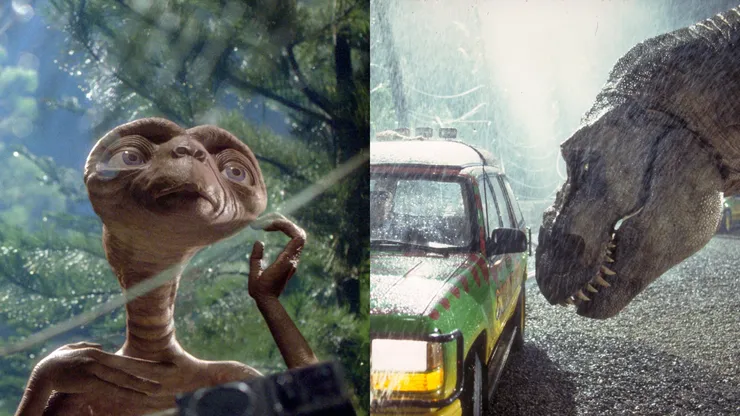
June 11 is not just an ordinary day on the calendar; it is the holy grail of cinematic milestones. By an almost unbelievable twist of distribution scheduling, today marks the twin anniversaries of two of the most influential, highest-grossing, and beloved movies ever projected onto a silver screen: Steven Spielberg’s E.T. the Extra-Terrestrial (released 44 years ago today, in 1982) and Jurassic Park (released 33 years ago today, in 1993).
Think about the sheer creative flex required for one director to own a single calendar date with two generational masterpieces. What makes the coincidence even more poetic is their historical box-office relationship: E.T. shattered records to become the highest-grossing film of all time in 1982, holding onto that crown for eleven years until it was finally dethroned in 1993 by… Spielberg’s own Jurassic Park.
To celebrate this legendary double feature, we are breaking down how both films changed the DNA of movies forever.
44 Years Ago: ‘E.T.’ and the Birth of Modern Cinematic Empathy
Before the summer of 1982, science fiction cinema had spent decades treating alien visitation as a looming, cold-war metaphor for global destruction. Aliens were supposed to blow up the White House or abduct citizens in rural towns.
Spielberg turned that entire paradigm inside out by scaling the cosmic down to the suburban. Written by Melissa Mathison, E.T. the Extra-Terrestrial traded weaponized spaceships for a glowing finger, a Speak & Spell, a basket of Reese’s Pieces, and a lonely boy named Elliott navigating his parents’ divorce.
Why It Changed Movies
- The Magic of Puppetry: Built by special effects wizard Carlo Rambaldi for just $1.5 million, the animatronic and puppet versions of E.T. were marvels of emotional expression. Spielberg shot the entire film from a child’s eye level, forcing adults into the background and making the audience form an intense, immediate, and tear-filled empathetic bond with a wrinkled brown animatronic creature.
- The Power of the Amblin Aesthetic: E.T. solidified what the world now recognizes as the “Amblin style”—suburban kids on bicycles facing supernatural wonders, a visual shorthand that modern pop culture hits like Stranger Things are still mimicking decades later.
“Phone home.” — A two-word piece of dialogue that reduced global audiences to tears and transformed a puppet into an immortal icon.
33 Years Ago: ‘Jurassic Park’ and the Dawn of the Digital Era
Exactly eleven years after Elliott and E.T. flew past the moon, Spielberg returned to June 11 to unleash an entirely different kind of prehistoric magic. If E.T. proved Hollywood had a heart, Jurassic Park proved it had the technology to build the future.
Jurassic Park represents the literal boundary line between traditional, old-school filmmaking and the modern digital age. Before 1993, putting full-scale, fast-moving dinosaurs on screen was deemed an impossibility. Spielberg’s team at Industrial Light & Magic (ILM) changed that by rendering a fully digital Brachiosaurus and a Tyrannosaurus Rex, dragging cinema out of the stop-motion era and birthing the modern CGI revolution.
Why It Changed Movies
- The Formula of Restraint: Despite its massive reputation as a digital pioneer, the 127-minute film features only 14 minutes of actual dinosaur footage. Only six minutes of that footage utilized CGI. By perfectly blending Stan Winston’s massive, hyper-realistic physical animatronics with ILM’s computer graphics, Spielberg created a tangible reality that modern blockbusters frequently fail to replicate.
- The Audio Revolution: Spielberg used the film to launch DTS (Digital Theater Systems) sound, storing high-definition audio on separate CD-ROM discs synchronized to the projector. It fundamentally upgraded the acoustic experience of movie theaters worldwide, making the T-Rex roar a literal, chest-thumping reality.
One Director, One Date, Total Immortality
It is easy to get lost in the metrics of budgets, box office numbers, and technological breakthroughs, but the true magic of June 11 belongs entirely to Steven Spielberg’s understanding of human wonder.
Whether it is a young boy looking up at a spaceship ascending into the starry night sky, or a paleontologist falling to his knees as a prehistoric giant walks past, Spielberg mastered the art of capturing the collective imagination of humanity. Forty-four years later, thirty-three years later, and long into the future, the world will still be looking up at the screen on June 11 in absolute, breathless awe.