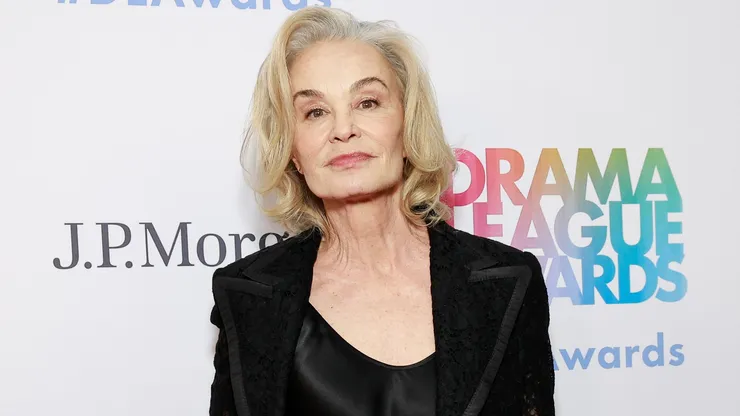
Across film, television and stage, Jessica Lange has built one of the most decorated and wide-ranging careers in modern acting. Her work became associated with emotionally complex women, often caught between vulnerability and control, a duality that would define much of her legacy on screen.
Rather than following a linear Hollywood trajectory, her career has unfolded in distinct creative phases—Oscar-winning film roles, acclaimed dramatic turns in American Horror Story, and award-winning stage work that solidified her status as a rare Triple Crown performer.
King Kong (1976) – Dwan
Jessica Lange made her film debut in King Kong, playing Dwan, a role that catapulted her from model to international star. At the time, the film was a large-scale blockbuster production, and her involvement marked an unexpected entry into Hollywood for an actress with no prior film experience.
Lange even won the Golden Globe for New Star of the Year for this role. Although the film divided critics, her on-screen presence made an immediate impression. Lange brought a mix of vulnerability and magnetism that turned Dwan into more than just a classic “damsel in distress,” placing her career on the industry’s radar from the very beginning.
Tootsie (1982) – Julie Nichols
In Tootsie, Lange played Julie Nichols, a soap opera actress involved in a complex emotional dynamic with Dustin Hoffman’s character. Her performance earned her the Academy Award for Best Supporting Actress, solidifying her status in Hollywood.
Beyond the comedic tone, her portrayal added emotional sensitivity and internal conflict, especially in shaping a woman caught between attraction and identity confusion. It became one of the performances that defined her early career versatility.
Frances (1982) – Frances Farmer
In Frances, Lange portrayed actress Frances Farmer in a raw and devastating performance still regarded as one of the most intense of her career. The film depicts the rise and fall of a Hollywood figure marked by mental illness and the studio system.
Her performance was widely praised for its physical and emotional commitment, presenting a harrowing vision of fame and loss of control. Although she did not win the Oscar that year, the role remains a benchmark in dramatic biographical performances.
Country (1984) – Jewell Ivy
In Country, Lange played Jewell Ivy, a Midwestern woman facing the agricultural crisis in the United States. The role earned her another Academy Award nomination, this time for Best Actress.
The film stood out for its emotional realism and for showcasing a more grounded side of Lange, far removed from typical Hollywood arcs. Her performance balanced resilience and fragility within a harsh, quiet social context.
Blue Sky (1994) – Carly Marshall
In Blue Sky, Jessica Lange delivers one of the most acclaimed performances of her career as Carly Marshall, a woman caught between emotional instability and the rigid structure of the 1960s military system.
The film was shot years before its release but ultimately became the role that earned her a second Academy Award for Best Actress. The delay only amplified the critical impact of her performance.
Lange’s work is built on a constant tension between outward charm and inner collapse. Carly moves between social brightness and deeply contained fragility, and Lange sustains both layers without slipping into caricature. Her performance is frequently cited as one of the most complex portrayals of female emotional instability in 1990s American cinema.
Crimes of the Heart (1986) – Meg Magrath
In Crimes of the Heart, Lange plays Meg Magrath, the eldest sister in a trio marked by family trauma and unresolved secrets. Adapted from Beth Henley’s stage play, the film blends drama and dark comedy within a Southern setting rich in emotional symbolism.
Lange starred alongside Sissy Spacek and Diane Keaton in an all-female ensemble that drew significant attention at the time. Her performance stands out for a lighter, more accessible tone within her filmography, without losing emotional depth.
Meg is a woman attempting to rebuild herself after personal failure, and Lange brings humanity that balances the film’s uneven tonal shifts. The role earned her yet another Oscar nomination, reinforcing her consistent awards-season presence throughout the 1980s.
The Postman Always Rings Twice (1981) – Cora Smith
In this adaptation of the classic noir, Lange plays Cora Smith, a woman trapped in a loveless marriage who enters a dangerous relationship with Jack Nicholson’s character. Directed by Bob Rafelson, the film fits into the 1980s erotic thriller tradition, defined by tension and fatalism.
Lange’s performance was key in redefining the modern femme fatale archetype. Cora is not simply seductive; she is strategic, vulnerable, and emotionally contradictory.
Her dynamic with Nicholson creates a spiral of desire and destruction that anchors the film’s narrative core, making it one of the most memorable titles of that phase in her career.
Big Fish (2003) – Sandra Bloom
In Big Fish, directed by Tim Burton, Lange plays Sandra Bloom, the emotional anchor between reality and fantasy within the protagonist’s storytelling. Although the film is dominated by imaginative and exaggerated tales, her character represents emotional stability and human connection.
Lange’s performance is defined by restraint. Rather than competing with the film’s visual extravagance, she provides emotional balance, especially in scenes exploring memory, love, and storytelling. It is a supporting role in screen time but essential in emotional structure.
American Horror Story (2011–2014) – Constance Langdon / Fiona Goode, and More
Lange’s arrival in American Horror Story marked a new phase in her career, introducing her to a younger television audience. In the first season, she plays Constance Langdon, a neighbor in the infamous Murder House, a character blending manipulation, grief, and charisma.
Later, in Coven, she transforms into Fiona Goode, the powerful Supreme of a coven of witches. Both roles earned her multiple Emmy Awards and renewed critical attention in contemporary television.
Ryan Murphy designed these characters specifically to highlight her ability to shift between extreme theatricality and moments of vulnerability, turning her into one of the series’ most iconic figures.
Grey Gardens (2009) – Big Edie Beale
In Grey Gardens, Lange portrays Edith “Big Edie” Beale in a physical and emotional transformation that earned her an Emmy Award for Best Actress. The film depicts the lives of a mother and daughter living in social and physical decay, based on the famous documentary of the same name.
Her performance focuses on constructing a figure trapped between nostalgia and extreme isolation. Lange avoids overt dramatization, instead delivering a restrained interpretation that communicates emotional decline through subtle gestures, pauses, and silence. It remains one of the most praised works of her television career.