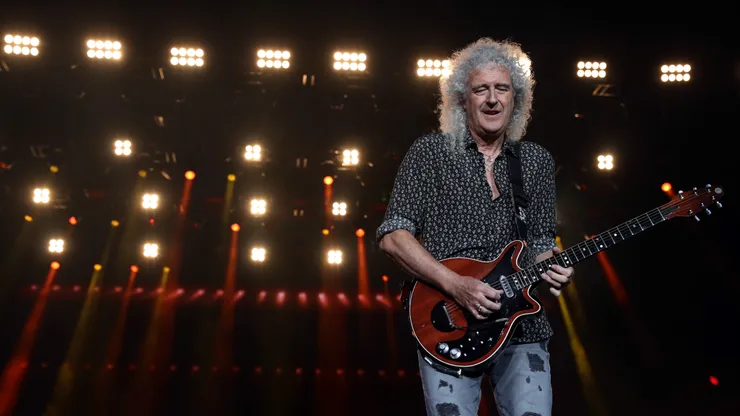
When we think of Queen, our minds immediately fly to the theatrical, world-conquering presence of Freddie Mercury. But behind the operatic high notes and the yellow leather jackets sat the band’s quiet genius. Brian May didn’t just play the guitar; he redefined what a guitar could do. By layering multiple tracks to sound like a string orchestra and injecting an unmatched sense of melodic drama, May gave Queen the heavy, majestic foundation that allowed them to conquer stadiums worldwide.
To celebrate his 79th birthday today, we are shining a spotlight on his three-fold genius as Queen’s guitarist, songwriter, and vocalist.
The Secret of the Red Special and the Sixpence
You cannot discuss the sonic identity of Queen without talking about the instrument that helped build it. Unlike his peers who bought off-the-shelf Fenders or Gibsons, May played a guitar he built himself alongside his father, Harold, in 1963.
- The Fireplace Wood: Built from the mahogany of an 18th-century fireplace mantel, oak, knitting needles, and motorcycle valve springs.
- The Sixpence Coin: Instead of a plastic pick, May famously used a British sixpence coin, giving his guitar its trademark sharp, bright, and highly tactile metallic bite.
This home-brewed setup, nicknamed “The Red Special” (or “Old Lady”), became an extension of May’s soul. From the blistering solos of “Bohemian Rhapsody” to the heavy riffs of “Stone Cold Crazy,” his tone is instantly recognizable to anyone with working ears.
The Pen of a Master: Writing Queen’s Greatest Anthems
While Freddie Mercury penned many of the band’s operatic numbers, Brian May was the master of the unifying, heavy-hitting stadium anthem. He had an uncanny ability to write songs that forced audiences to participate.
The Essential Brian May Songbook
- “We Will Rock You”: A stroke of pure interactive genius. May wanted to write a song that the audience could perform with the band, utilizing stomps and claps instead of instruments. It became the most recognizable sporting and stadium anthem in human history.
- “The Show Must Go On”: Written as Freddie Mercury’s health was rapidly declining. May presented the incredibly demanding vocal melody to Freddie, worried it might be too physically taxing. Freddie allegedly downed a shot of vodka, said, “I’ll fucking do it, darling,” and delivered a flawless, definitive performance.
- “Fat Bottomed Girls”: A gloriously heavy, blues-influenced hard-rock tribute that remains a staple of classic rock radio.
- “Who Wants to Live Forever”: A sweeping, heartbreaking power ballad written for the Highlander soundtrack, showcasing May’s ability to blend classical orchestration with rock power.
The Secret Vocal Weapon
One of the most criminally overlooked aspects of May’s Queen career was his voice. While Mercury took the lead, Queen’s signature, wall-of-sound harmonies were built on a three-part vocal engine consisting of Freddie, drummer Roger Taylor, and Brian. May provided the warm, rich lower-register harmonies that glued the high-flying vocals together.
He also stepped up to the microphone to sing lead vocals on several of the band’s most beautiful, acoustic-driven tracks. In songs like the sci-fi folk journey “’39”, the romantic ballad “Sail Away Sweet Sister”, and the dreamlike “Some Day One Day”, May’s soft, melancholic voice showed a gentle, vulnerable side to Queen’s stadium-sized sound.