There are grand slams, there are Super Bowl halftime shows, and then there is the FIFA World Cup—the single most-watched sporting spectacle on planet Earth. While players train their entire lives for a chance to lift that iconic golden trophy, one global pop icon has managed to conquer the tournament without ever kicking a ball.
The tournament officially gets underway in Mexico City, launching an unprecedented trilogy of opening ceremonies across North America. Headlining the spectacular curtain-raiser at the Estadio Azteca is none other than the High Priestess of Football herself: Shakira.
Alongside Nigerian sensation Burna Boy, the Colombian superstar is taking the stage today to debut “Dai Dai,” the official anthem of the 2026 tournament. In a beautiful twist of cosmic irony, today’s opening match features a face-off between Mexico and South Africa—a direct throwback to the 2010 opening match that birthed Shakira’s most legendary World Cup chapter.
To mark the kickoff of the 2026 games, let’s chart the extraordinary, four-act history of how Shakira became the undisputed, eternal Queen of the World Cup.
Act I: The Berlin Breakthrough (Germany, 2006)
Shakira’s love affair with the beautiful game didn’t start with an official anthem; it started with a hostile takeover of a closing ceremony. In the summer of 2006, her global smash hit “Hips Don’t Lie” was dominating the radio waves. Recognizing a cultural phenomenon, FIFA brought her to Berlin ahead of the Italy vs. France final to perform a specially commissioned “Bamboo Remix” of the track.
Draped in a flowing red skirt and flanked by a stadium full of dancers, Shakira injected a heavy dose of rhythmic, cross-cultural energy into a historically rigid ceremony. The performance proved to executives that pop music and international soccer were a match made in heaven, forever shifting how the tournament approached its musical entertainment.
Act II: The Gold Standard of Anthems (South Africa, 2010)
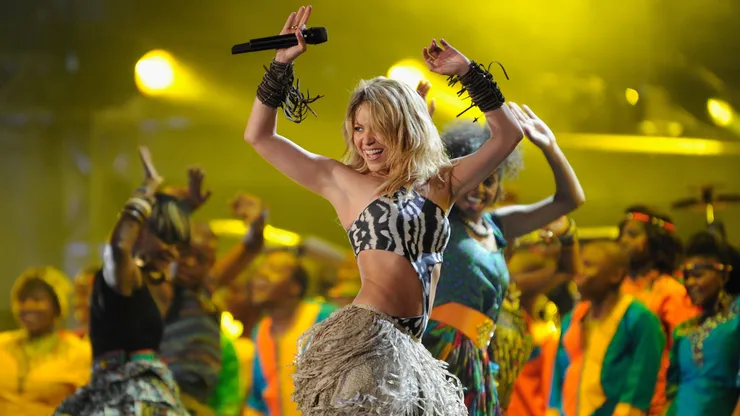
If 2006 was an introduction, 2010 was the coronation. Tasked with creating the official song for the first-ever World Cup held on African soil, Shakira collaborated with South African band Freshlyground to deliver “Waka Waka (This Time for Africa).” The track didn’t just succeed; it became a permanent cultural monument. Driven by an infectious Afro-Colombian rhythm and a celebratory, stadium-shaking choreography, the song topped the charts in dozens of countries and its music video went on to log billions of views. Sixteen years later, it remains the gold standard against which every single sports anthem is measured.
Act III: The Rio Hijacking (Brazil, 2014)
By the time the 2014 tournament rolled around in Brazil, FIFA opted to go in a different direction for its official anthem, selecting a track by Pitbull and Jennifer Lopez. The internet, however, had other plans.
Sensing that the fans wanted that distinct Shakira flavor, she released “La La La (Brazil 2014)”—a reworked version of her track “Dare”—featuring Brazilian musician Carlinhos Brown. The music video, which featured cameos from global soccer royalty like Lionel Messi and Neymar Jr., completely eclipsed the tournament’s official song in views and popularity. Yielding to public demand, FIFA brought her back to headline the Closing Ceremony at the Maracanã Stadium in Rio de Janeiro, completing her World Cup performance trilogy.
Act IV: The Ultimate Crown (North America, 2026)
After sitting out the tournaments in Russia and Qatar, Shakira has made her triumphant return today for the 2026 expansion, and she is claiming more real estate than ever before.
Her performance of “Dai Dai” at the Estadio Azteca today is just the opening salvo of her 2026 reign. In an unprecedented move, FIFA has announced that the July 19 Final at the New York New Jersey Stadium will feature a massive, Super Bowl-style halftime show—and Shakira is locked in to co-headline the historic broadcast alongside pop royalty Madonna and K-pop icons BTS. Proceeds from the performance are actively funding the FIFA Global Citizen Education Fund, proving her legacy extends far beyond pure pop spectacle.