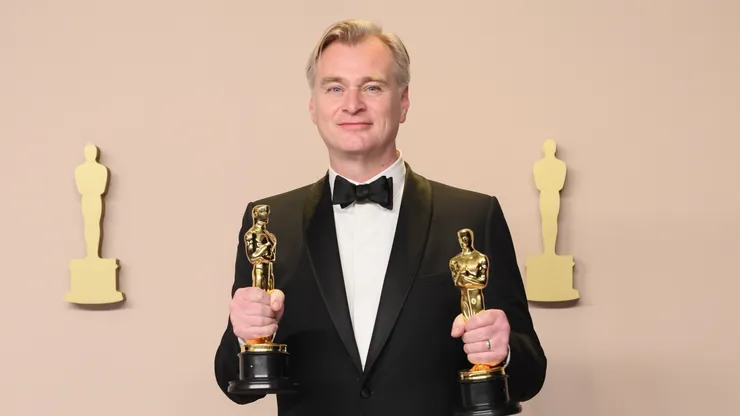
Fresh off sweeping the Academy Awards for Oppenheimer and continuing to smash box office records with The Odyssey, Nolan has spent nearly three decades proving that audiences are hungrier than ever for uncompromising, large-format cinema. To celebrate his milestone birthday, here is a look at what makes him one of the greatest directors in history, along with the essential films that defined his career.
Why Christopher Nolan Is One of the Greatest Directors in History
Calling a modern director “one of the best in film history” is a bold claim, but Nolan’s impact on 21st-century cinema is indisputable. He bridges the gap between artistic prestige and mass appeal in a way few filmmakers have achieved since Steven Spielberg or Alfred Hitchcock.
The Savior of the Theatrical Experience
Nolan is cinema’s most vocal and effective guardian. He doesn’t just make movies for theaters; he builds custom experiences meant to be witnessed on massive IMAX 70mm screens. By pushing camera manufacturers to push technology forward and continuously fighting to preserve physical film stock, Nolan has single-handedly kept the high-end theatrical format alive in the digital age.
A Commitment to Realism
Where other directors rely heavily on green screens and digital post-production, Nolan insists on physical reality. He flipped a real 18-wheeler semi-truck in the middle of Chicago for The Dark Knight, blew up real physical sets for Inception, constructed full-scale working aircraft for Dunkirk, and recreated nuclear reactions using practical effects for Oppenheimer. This tactile approach gives his films a visceral, grounded weight that digital effects simply cannot replicate.
Mastering the Non-Linear Puzzle
Few directors respect their audience’s intelligence as much as Nolan. His films are famously obsessed with time—its elasticity, its weight, and its tragic irreversibility. From backward-running revenge plots to gravitational time dilation, he turns complex scientific and psychological concepts into high-octane visual thrillers without losing the emotional thread.
Redefining the Modern Blockbuster
Before Nolan’s Batman Begins in 2005, comic book movies were largely treated as campy, lighthearted fare. Nolan reinvented the genre by treating superheroes with serious dramatic integrity, paving the way for the modern landscape of cinematic storytelling.
Christopher Nolan’s 6 Defining Masterpieces
With 13 feature films under his belt, narrowing down Nolan’s filmography is a formidable task, but these six films best capture his mastery of the medium.
1. Oppenheimer (2023)
The crowning achievement of his career, Oppenheimer earned Nolan his long-overdue Academy Awards for Best Director and Best Picture. Turning a three-hour biographical drama centered around physics conversations and security clearance hearings into a $950 million global blockbuster is nothing short of a miracle. Nolan turned human guilt, scientific ambition, and political paranoia into the ultimate suspense thriller.
2. The Dark Knight (2008)
Widely considered the definitive comic book adaptation, The Dark Knight elevated a summer superhero film into a gritty, neo-noir crime saga. Anchored by Heath Ledger’s legendary, posthumous Oscar-winning turn as the Joker, Nolan crafted an airtight exploration of chaos, morality, and post-9/11 anxiety that fundamentally altered Hollywood history.
3. Inception (2010)
A film about heist artists invading subconscious dreamscapes sounds like an impossible sell for a mid-summer blockbuster, yet Nolan turned Inception into a original cultural phenomenon. Featuring iconic practical gravity-defying hallway fights and Hans Zimmer’s brass-heavy score, it showcased Nolan’s ability to build complex, multi-layered narrative worlds without breaking a sweat.
4. Interstellar (2014)
Nolan took his obsession with time to the edge of the universe in this emotionally charged sci-fi epic. Blending real astrophysics with a deeply personal story about the bond between a father and daughter, Interstellar remains one of his most visually breathtaking and heart-wrenching achievements.
5. Memento (2000)
The film that put Nolan on the map. Telling the story of a man with short-term memory loss trying to find his wife’s killer, the entire narrative is told in reverse. It wasn’t just a gimmick—it forced the audience to experience the exact same disorientation as the protagonist, announcing the arrival of a major storytelling talent.
6. Dunkirk (2017)
Stripping away heavy dialogue in favor of pure visual cinema, Dunkirk is a 106-minute exercise in unrelenting tension. By weaving together three distinct timelines—land (one week), sea (one day), and air (one hour)—Nolan transformed a historical evacuation into a ticking-clock survival thriller that redefined war cinema.
7. The Odyssey (2026)
Taking on Homer’s 2,700-year-old Greek poem, The Odyssey has instantly cemented itself as one of Nolan’s most astounding technical and narrative feats. Shot entirely on custom IMAX 70mm film and starring Matt Damon alongside Tom Holland, Anne Hathaway, Zendaya, and Robert Pattinson, Nolan eschewed digital tricks in favor of practical sea voyages, storm systems, and visceral action sequences. Crossing the $700 million mark worldwide in record time, it stands as proof that ancient myth, told with uncompromising cinematic realism, can still captivate global audiences.
As Sir Christopher Nolan steps into another year at the absolute zenith of his powers, he continues to remind us why we go to the movies in the first place. He has built a career on trusting that audiences want to be challenged, dazzled, and moved—all at the exact same time. Happy 56th Birthday to one of cinema’s true visionaries!