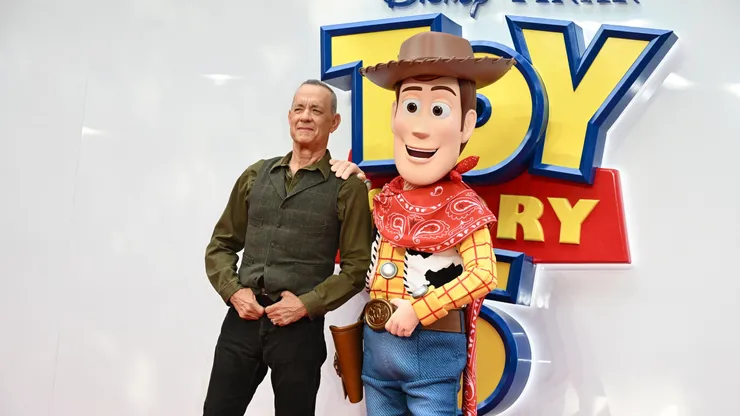
Reaching his eighth decade, Hanks stands in a territory of reverence reserved for only the absolute finest to ever grace the silver screen.
While the world routinely reflects on his back-to-back Oscar wins or his harrowing historical epics, his current 2026 footprint points to a completely different type of cultural dominance. Right now, Pixar’s highly anticipated blockbuster Toy Story 5 is completely dominating global box offices after its June 19 release. Watching a new generation of children flock to theaters to watch Sheriff Woody protect his playroom from the disruptive tech of an advanced tablet device (voiced flawlessly by Greta Lee) is a stark reminder of a beautiful truth: for over thirty years, Tom Hanks has been the beating, emotional heart of American animation.
From Cynical Jerk to the Ultimate Faithful Friend
When Pixar was a tiny, unproven tech company attempting to build the world’s very first feature-length, computer-animated movie in the early 1990s, the original script for Toy Story was shockingly dark. In early drafts drafted by Disney and Pixar executives, Sheriff Woody wasn’t a lovable, protective leader; he was a bitter, tyrannical bully who intentionally threw Buzz Lightyear out of a window out of pure, calculated jealousy.
Director John Lasseter and the creative team quickly realized the film was collapsing because the main character was entirely unlikable. Enter Tom Hanks. Fresh off his groundbreaking work in Big, Hanks brought a frantic, hyper-expressive vulnerability to the recording booth that forced an immediate, complete overhaul of the character’s DNA.
Hanks took a plastic toy and injected him with complex, deeply human anxieties:
- The Fear of Replacement: He made Woody’s jealousy over Buzz feel completely relatable—anchored in the fear of losing your purpose in the eyes of someone you love.
- The Unyielding Moral Compass: He replaced the cynical edge with a fierce, absolute loyalty to his kid, Andy, establishing a thematic blueprint that would carry five films across four separate decades.
The Pure Physicality of the Recording Booth
A common misconception among casual moviegoers is that voice acting is “easy work”—simply walking into a carpeted room, reading lines from a binder, and collecting a paycheck. Hanks systematically shattered that illusion, treating the voiceover booth with the exact same intense, exhausting physical discipline he applied to Cast Away or Saving Private Ryan.
Because Woody is an energetic, high-strung cowboy puppet whose string is constantly being pulled, Hanks spent hours leaping, waving his arms, and sprinting in place to capture the authentic breathlessness of a toy in a state of perpetual panic. He famously recounted recording voice tracks for Toy Story sessions until his throat literally bled, requiring days of vocal rest afterward.
The Secret Ingredient: Unmatched Chemistry with Tim Allen
Animation voice tracks are typically recorded in total isolation, with actors reading lines to a wall while a director guides them through headphones. However, recognizing the complex, buddy-cop friction required to make Toy Story work, Hanks explicitly requested to record select, pivotal sequences in the exact same room alongside his co-star, Tim Allen.
The resulting magic is the literal bedrock of the entire franchise. The rapid-fire, improvisational banter between Woody’s frantic, high-pitched logic and Buzz Lightyear’s deadpan, deluded space ranger stoicism wasn’t just manufactured by clever computer editors; it was forged in real-time through the genuine, deep-seated mutual respect and comedic timing of two master performers.