Writing about writers has always carried a strange kind of irony: the closer cinema gets to the act of creation, the more fragile and fractured that process tends to look on screen. Across decades of film history, stories about authors have often moved away from romanticized genius and toward something more unsettled.
From psychological studies to literary biopics, some films tend to orbit the same tension: inspiration versus exhaustion, clarity versus collapse. Whether set in cramped apartments, publishing houses or isolated retreats, they reveal how stories are rarely born in moments of ease.
Almost Famous
Cameron Crowe’s semi-autobiographical film follows William Miller, a teenage writer covering a rock band for Rolling Stone. His journey places him inside the world he is meant to observe, forcing him to constantly negotiate distance and involvement.
Writing becomes an act of filtering experience into narrative form. The emotional reality of what he witnesses often resists the structure required for publication, highlighting the tension between lived moments and written interpretation.
Sideways
Alexander Payne’s film follows Miles, a failed novelist whose unpublished manuscript becomes a constant reminder of stalled ambition. The story never treats writing as a heroic act, but as something unfinished that defines his identity more than his actual achievements.
The book he carries represents a life suspended between intention and execution. Writing, in this context, is not a breakthrough but a quiet accumulation of doubt, where creative work exists mostly in potential rather than completion.
Before Sunset
Richard Linklater’s film unfolds in real time as Jesse, now a writer, reunites with Celine in Paris after years apart. The entire narrative is built on conversation, turning dialogue itself into the primary form of storytelling.
Writing emerges through reflection and reinterpretation of lived experience. Jesse’s identity as an author is inseparable from memory, suggesting that stories are constructed not in the moment they happen, but in the act of revisiting them later.
Sunset Boulevard
Billy Wilder’s film is narrated by Joe Gillis, a screenwriter whose involvement with a fading silent film star leads him into a world of control, illusion, and decay. The narration structure immediately frames writing as both testimony and consequence.
Hollywood is depicted as a space where writers are shaped by compromise and survival. Joe’s voice guides the story from beyond his own fate, turning writing into something inseparable from manipulation and loss of control.
All the President’s Men
Alan J. Pakula’s film reconstructs the investigative reporting of The Washington Post journalists Bob Woodward and Carl Bernstein during the Watergate scandal. While not about novelists or screenwriters, it offers one of the clearest cinematic depictions of writing as investigative labor, where narrative is built through documentation, interviews, and verification of facts.
The film emphasizes process over inspiration: writing emerges from persistence, cross-checking sources, and assembling fragmented information into a coherent political narrative. Its newsroom setting turns the act of writing into a form of institutional pressure, where every published line carries legal and historical consequences.
Following
Christopher Nolan’s debut feature centers on a young unemployed writer in London who begins following strangers to find material for his stories. What begins as creative curiosity gradually evolves into entanglement with a burglar who introduces him to a criminal underworld.
The film presents writing as dependence on observation, but also as a dangerous erosion of identity. The protagonist’s attempt to “find stories” outside himself ultimately removes him from authorship altogether, blurring the line between storyteller and subject in a tightly constructed noir narrative.
Barton Fink
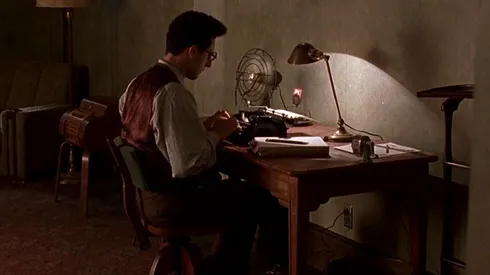
Set in 1941 Hollywood, the film follows Barton Fink, a New York playwright hired to write commercial screenplays for a wrestling movie studio. As he struggles with severe writer’s block, he becomes increasingly isolated in a decaying hotel filled with unsettling characters.
The film, directed by the Coen Brothers, uses surreal and symbolic elements to represent creative paralysis. Writing is portrayed not as inspiration, but as psychological pressure intensified by commercial expectations, isolation, and internal contradiction between artistic ideals and industry demands.
Misery
Based on the novel by Stephen King, the story follows writer Paul Sheldon, who is rescued from a car accident by his “number one fan,” Annie Wilkes. He soon discovers she is dangerously unstable and forces him to rewrite his latest novel under captivity.
The act of writing becomes physical coercion: manuscripts are controlled, pages are destroyed, and creative output is dictated by survival. The film transforms authorship into imprisonment, where narrative control shifts violently from writer to audience.
Adaptation
Directed by Spike Jonze and written by Charlie Kaufman, the film follows a fictionalized version of Kaufman struggling to adapt Susan Orlean’s nonfiction book The Orchid Thief. As he battles writer’s block, the film increasingly folds into a self-referential narrative structure.
It is widely regarded as a metafictional exploration of screenwriting itself, where the process of adaptation becomes the subject. The film examines themes of insecurity, originality, and the impossibility of fully separating the writer from the work being written.
Certified Copy
Directed by Abbas Kiarostami, the film follows a British writer promoting his book in Italy, where he meets a woman who challenges the boundaries between authenticity and performance. What begins as a philosophical discussion about art and originality gradually shifts into something more ambiguous and emotionally unstable.
Writing here is not shown as production, but as interpretation. The film constantly questions whether identity itself can be “authored,” blurring the line between literary theory and lived experience. The writer figure becomes a vessel for contradiction rather than authority.
The Wild Pear Tree
Nuri Bilge Ceylan’s film centers on Sinan, a young aspiring writer who returns to his rural hometown after graduating. He carries a manuscript he hopes to publish, but faces indifference from publishers and emotional distance from his family.
The film treats writing as both ambition and burden, showing how artistic aspiration collides with economic reality. Sinan’s essays and conversations reveal a tension between intellectual ambition and social disconnection, making the writing process inseparable from personal identity and frustration.
Midnight in Paris
Woody Allen’s film follows a screenwriter who travels back in time each night to 1920s Paris, encountering literary figures such as Ernest Hemingway and F. Scott Fitzgerald. The story plays with nostalgia and the romanticization of artistic “golden ages.”
Writing is framed as longing for an idealized past rather than engagement with the present. The protagonist’s journey reveals how creative dissatisfaction often stems from comparison, and how writers project inspiration onto imagined eras instead of confronting their own.
Her
Directed by Spike Jonze, the film follows Theodore, a professional letter writer who forms a relationship with an artificial intelligence operating system. His job itself is rooted in writing emotional correspondence for others, crafting intimacy through language.
The film explores writing as emotional substitution. Theodore’s profession highlights how language can simulate human connection, while his personal arc reflects isolation in a technologically mediated world where words are both authentic and manufactured.
The Hours
Stephen Daldry’s film interweaves three storylines connected by Virginia Woolf’s novel Mrs. Dalloway. One narrative follows Woolf herself as she struggles with mental illness while beginning the book, while the others show women in different eras influenced by her writing.
Writing is portrayed as both creation and inheritance. Woolf’s act of writing ripples across time, affecting lives she never directly encounters. The film presents literature as continuity, where a single book becomes a psychological and emotional thread across generations.