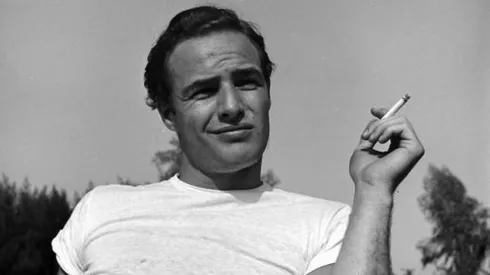
Some actors perform; Marlon Brando rewrote the language of acting itself. Emerging in the late 1940s from the Actors Studio, he carried the raw, interior intensity of Method acting into a Hollywood still shaped by theatrical formality.
By the time he stepped into roles like Terry Malloy in On the Waterfront, he had already begun to shift the center of gravity in American cinema, making vulnerability feel as powerful as bravado.
The transformation didn’t stop there. Across decades, his choices traced a restless trajectory—from rebellious icons to mythic figures. His career moved in unpredictable rhythms, marked by brilliance, absence and reinvention.
A Streetcar Named Desire | Stanley Kowalski
There’s a before and after this performance. As Stanley Kowalski, Marlon Brando introduced a raw, animalistic energy that shattered the polished acting style dominant at the time. His physicality—sweat, tension, unpredictability—felt almost intrusive, as if the screen could barely contain him.
The role became a cultural flashpoint. Brando didn’t just play Stanley; he inhabited him with a psychological depth that made vulnerability and aggression coexist uneasily. It marked the arrival of Method acting in mainstream cinema, influencing generations who would chase that same authenticity.
On the Waterfront | Terry Malloy
“I coulda been a contender” remains one of cinema’s most quoted lines, yet it’s the quiet devastation behind it that defines the performance. As Terry Malloy, Brando strips away bravado, revealing a man trapped between guilt and survival.
His work earned him an Academy Award and redefined masculinity on screen—not as dominance, but as conflict. The performance feels internal, almost hesitant, creating a character whose strength lies in what he cannot fully express.
The Godfather | Vito Corleone
With a softened voice and minimal movement, Brando crafted one of the most iconic figures in film history. Don Vito Corleone isn’t loud or explosive; he commands through stillness, turning silence into power.
The performance reshaped the gangster genre entirely. Rather than caricature, Brando offered complexity—a patriarch balancing brutality with tenderness. It earned him another Oscar, though his refusal to accept it became as legendary as the role itself.
Last Tango in Paris | Paul
Few performances feel as exposed as this one. In a film defined by emotional and physical vulnerability, Brando delivers a portrayal that blurs the line between character and personal confession.
The result is unsettling, intimate, and deeply controversial. His improvisational approach adds a layer of unpredictability, making the film as much an exploration of grief and identity as it is of relationships.
Apocalypse Now | Colonel Kurtz
Brando appears late, almost like a shadow materializing. As Colonel Kurtz, he embodies madness not through chaos, but through eerie calm. His voice—measured, hypnotic—becomes the film’s moral abyss.
Despite a famously troubled production, the performance lingers as one of cinema’s most haunting. Kurtz isn’t just a character; he’s an idea, a descent into the darkness of war and the human psyche.
The Men (Ken Wilcheck)
Before the legend fully took shape, Marlon Brando made his film debut in a role that demanded restraint rather than spectacle. As a paralyzed war veteran struggling to rebuild his life, he immersed himself in real veterans’ hospitals to understand the physical and emotional weight of the character.
The result is a performance grounded in observation—quiet, internal, and deeply human. Instead of leaning on dramatics, Brando allows frustration and dignity to coexist in subtle ways.
The film doesn’t rush its emotions; it sits with them, reflecting post-war trauma through a lens that feels intimate rather than grand. It’s an early indication of the realism he would later bring to Hollywood on a much larger scale.

One-Eyed Jacks (Rio)
The only film Brando ever directed carries his signature intensity both in front of and behind the camera. As Rio, an outlaw driven by betrayal and revenge, he shapes a Western that feels less about gunfights and more about psychological tension.
The landscapes are wide, but the emotions remain tightly wound. Unlike traditional Western heroes, Rio is conflicted—caught between vengeance and vulnerability.
Brando lingers in those contradictions, stretching moments, letting silence speak where dialogue might have dominated. The film stands as an anomaly within the genre, reflecting his instinct to challenge expectations even at the height of his fame.
Julius Caesar | Mark Antony
Skepticism surrounded Brando’s casting in Shakespeare, yet he answered with precision. His Mark Antony speech—controlled, deliberate, and quietly persuasive—demonstrated a discipline that critics hadn’t expected.
Rather than overpowering the text, he shapes it, proving his range extended far beyond raw intensity. It remains one of the clearest examples of his technical command as an actor.
The Wild One | Johnny Strabler
Leather jacket, motorcycle, defiance—Brando’s Johnny Strabler became the blueprint for cinematic rebellion. The performance captures a restless energy that would define youth culture for decades.
When asked what he’s rebelling against, the answer—“What’ve you got?”—lands like a manifesto. The role turned Brando into a symbol, not just a star, embodying a generational shift in attitude and identity.
Guys and Dolls | Sky Masterson
A surprising turn into musical territory reveals a different side of Brando. As Sky Masterson, he trades intensity for charm, navigating romance and humor with understated confidence.
While not a traditional singer, his performance works through presence rather than perfection. It’s a reminder that his appeal wasn’t confined to drama—it could adapt, soften, and entertain.
Mutiny on the Bounty | Fletcher Christian
Lavish, troubled, and ambitious, this production became infamous behind the scenes. Yet Brando’s portrayal of Fletcher Christian offers a nuanced take on authority and rebellion within a rigid system.
The performance reflects a shifting phase in his career—less explosive, more measured. Even amid production chaos, his ability to anchor a character remains evident.
Reflections in a Golden Eye | Major Weldon Penderton
Quietly unsettling, this role reveals Brando at his most restrained. As a repressed army officer, he builds tension through stillness and subtle gestures rather than overt emotion.
The film itself moves in shadows—psychological, intimate, uneasy—and Brando meets it there. It’s a performance that doesn’t seek attention, yet lingers long after, precisely because of what it withholds.