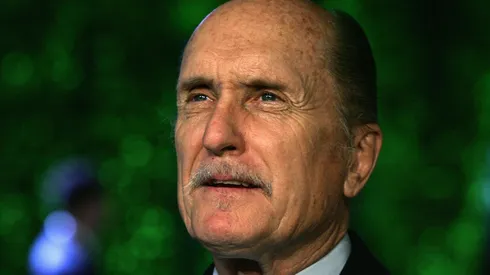
Robert Duvall, the Academy Award-winning powerhouse whose career spanned seven decades and defined the era of New Hollywood, passed away peacefully at his home in Virginia on February 15, 2026, at the age of 95.
A Legacy of Truth and Tenacity
Robert Selden Duvall was born on January 5, 1931, in San Diego, the son of a Navy Rear Admiral. That military discipline and observational keenness became the bedrock of his acting style. While his peers like Al Pacino or Marlon Brando were often celebrated for their explosive, high-theatricality turns, Duvall was the master of the “quietly explosive.” He famously preferred characters who worked for a living, imbuing lawmen, outlaws, and blue-collar dreamers with a realism that made them feel like people you’d meet at a roadside diner.
His wife, Luciana Duvall, confirmed his passing on Monday, noting that he died surrounded by family. The outpouring of tributes has been immediate, with Francis Ford Coppola calling him “an essential part of American cinema” and long-time friends like Al Pacino praising his “phenomenal gift for the truth.” As we say goodbye to “the actor’s actor,” we look back at the ten projects that cement his status as a permanent titan of the silver screen.
The 10 Roles That Defined a Legend
1. To Kill a Mockingbird (1962)

In his film debut, Duvall achieved immortality without saying a single word. As the reclusive Arthur “Boo” Radley, he provided the emotional climax of the film, appearing in the shadows of a bedroom to save the Finch children. It was a masterclass in physical acting, using only his pale features and a hesitant stance to convey a lifetime of isolation and sudden, protective love.
2. The Godfather & The Godfather Part II (1972–1974)
As Tom Hagen, the Irish-German consigliere to the Corleone family, Duvall provided the calm, tactical center for the family’s violent storms. Surrounded by the simmering intensity of Pacino and the gravitas of Brando, Duvall’s steady, objective performance earned him his first Oscar nomination. His departure from Part III over a salary dispute remains one of cinema’s great “what ifs,” as fans and critics alike felt the void of his missing presence.
3. Apocalypse Now (1979)
“I love the smell of napalm in the morning.” With a single line delivered in a cowboy hat amidst a rain of mortar fire, Duvall created the definitive portrait of wartime madness. As Lt. Col. Bill Kilgore, he was both terrifying and absurd—a man more concerned with finding good surfing waves than the chaos of the Vietnam War around him. The role earned him a BAFTA and another Oscar nod, becoming perhaps his most quoted character.
4. The Great Santini (1979)
Duvall drew on his own upbringing as the son of a high-ranking Navy officer to play Bull Meechum, a domineering Marine fighter pilot who treats his family like a military squadron. It is a punishing, often uncomfortable performance that showcases Duvall’s ability to find the humanity within a “hard” man, earning him a Best Actor nomination for his complex portrayal of a father who loves through discipline.
5. Tender Mercies (1983)
The role that finally brought him the Best Actor Oscar. Playing Mac Sledge, a washed-up, alcoholic country singer seeking redemption in rural Texas, Duvall did his own singing and drove 600 miles through the state to master the local rhythm. It is a tender, stripped-back performance that relies on silence and subtle gestures, proving that he was a leading man of immense depth.
6. Lonesome Dove (1989)
Though it was a television miniseries, Duvall often cited Augustus “Gus” McCrae as his favorite role of all time. Alongside Tommy Lee Jones, he brought a wit and a weary wisdom to the aging Texas Ranger. The project was so successful it was dubbed the “Godfather of Westerns,” and Duvall’s Gus became the archetype for the modern, soulful cowboy.
7. Network (1976)
In a film filled with iconic rants, Duvall played the cold, corporate counterpoint. As Frank Hackett, the ruthless executive focused solely on ratings and bottom lines, he represented the “soulless” machinery of the media. It was a shark-like performance that highlighted his versatility—moving effortlessly from the moors of a Western to the sterile boardrooms of Manhattan.
8. The Apostle (1997)
Duvall spent 12 years and $5 million of his own money to bring this passion project to life. Not only did he star as “Sonny” Dewey, a charismatic but flawed Pentecostal preacher on the run, but he also wrote and directed the film. The result was a powerhouse performance that earned him yet another Oscar nomination and highlighted his deep respect for the complexities of faith and regional culture.
9. Sling Blade (1996)
In a brief but haunting supporting turn, Duvall played the estranged, dying father of Billy Bob Thornton’s Karl Childers. In just one scene, sitting in a dark, dilapidated house, he conveyed a lifetime of bitterness and neglect. It was a “scene-stealing” moment that reminded audiences that Duvall could command a film with just a few minutes of screen time.
10. The Judge (2014)
At the age of 83, Duvall received his final Oscar nomination for playing Judge Joseph Palmer. Starring opposite Robert Downey Jr., he portrayed a respected small-town judge whose mind and body are failing him as he faces a murder charge. The film showcased that even in his eighties, Duvall had lost none of his fire, delivering a vulnerable performance that bridged the gap between his legendary past and the contemporary era.