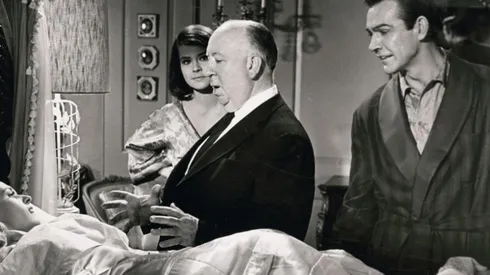
Sir Alfred Hitchcock, universally crowned the “Master of Suspense,” directed over fifty feature films across six decades, pioneering techniques that still serve as the fundamental blueprint for psychological thrillers and blockbuster filmmaking today.
From silent title designer to Hollywood royalty, Hitchcock understood the human psyche—specifically our deepest fears, voyeuristic tendencies, and fascination with the unknown—better than almost any artist in history.
Psycho (1960)
Few movies in history have reshaped the landscape of cinema quite like Psycho. Following a secretary on the run who stumbles upon a secluded motel run by a polite yet deeply troubled young man, the film broke every established rule in the Hollywood playbook. By shockingly eliminating his top-billed star, Janet Leigh, in the iconic shower scene accompanied by Bernard Herrmann’s screeching violins, Hitchcock proved to audiences that no one was safe. In doing so, he fundamentally birthed the modern slasher genre and proved that psychological terror could be a massive box-office phenomenon.
Vertigo (1958)
Frequently cited by film critics as one of the single greatest movies ever made, Vertigo is Hitchcock’s most haunting and personal study of obsession, grief, and illusion. The story follows an acrophobic former police detective hired to trail a friend’s wife, sending him into a dizzying romantic spiral. Technically revolutionary, the film introduced the world to the “dolly zoom,” simultaneously zooming in while dollying back to visually convey the sensation of vertigo. Beyond its visual brilliance, the film stands as an unmatched masterpiece of psychological vulnerability.
Rear Window (1954)
A masterclass in spatial storytelling and human curiosity, Rear Window turns the movie audience into active accomplices. Starring James Stewart as a wheelchair-bound photographer recovering from a broken leg, the narrative unfolds as he spends his days spying on his neighbors out his apartment window, eventually becoming convinced that one of them has committed murder. Co-starring Grace Kelly, Hitchcock used this tightly confined setting to explore our innate voyeuristic tendencies, questioning why human beings find watching the private lives of others so deeply intoxicating.
North by Northwest (1959)
Serving as the definitive prototype for the modern spy thriller, North by Northwest set the gold standard for action-thriller set pieces. The film stars Cary Grant as an innocent Manhattan advertising executive mistaken for a government spy and pursued across the country by a ruthless covert organization. Featuring legendary sequences like Grant fleeing a crop-duster plane in a desolate cornfield and a climactic fight atop Mount Rushmore, the film directly influenced future cinematic titans like the James Bond and Mission: Impossible franchises.
The Birds (1963)
Without ever providing a neat or convenient explanation for why the local avian population turns violently aggressive, Hitchcock crafted an apocalyptic creature-feature steeped in pure existential dread. Following a wealthy socialite who pursues a potential suitor to a small Northern California coastal town, The Birds relied on pioneering visual effects and groundbreaking electronic sound design. By transforming everyday, harmless creatures into a relentless force of terror, Hitchcock proved that fear could lurk in the most ordinary places.
Rebecca (1940)
Marking Hitchcock’s grand Hollywood debut, Rebecca won the Academy Award for Best Picture and established his reputation in American cinema. The film tells the story of a naive young woman who marries a wealthy widower, only to find herself living in the shadow of his deceased, enigmatic first wife. Blending gothic romance with razor-sharp suspense, the picture is anchored by an unforgettable, chilling performance from Judith Anderson as the sinister housekeeper, Mrs. Danvers.
Strangers on a Train (1951)
Driven by a brilliantly sinister premise, Strangers on a Train examines one of Hitchcock’s favorite thematic motifs: the innocent man trapped in a waking nightmare. When two strangers meet on a train, one proposes a hypothetical scenario where they “swap murders” so neither gets caught, only for the darker stranger to take the proposition deadly seriously. The film culminates in an iconic, chaotic amusement park carousel climax that remains one of the tensest sequences ever captured on film.
The Anatomy of Hitchcockian Suspense
What set Hitchcock apart from his peers was his surgical ability to engineer human emotion. He famously drew a clear distinction between simple surprise and true suspense. If a bomb under a table suddenly explodes, the audience experiences a brief ten-second shock; however, if the audience sees the bomb under the table and knows it will detonate in five minutes while the characters casually chat, the audience suffers through five minutes of unbearable agony. He also popularized the concept of the “MacGuffin”—a plot device or object that drives the characters’ motivations, even if the object itself is ultimately secondary to the deeper human drama.
Although Hitchcock was nominated five times for the Academy Award for Best Director, he famously never won in the competitive category, an omission widely regarded as one of the greatest oversights in Oscar history. However, his true reward was permanent immortality. Over a century after his birth on August 13, 1899, every shadowy hallway, rising musical score, and sudden camera tilt in contemporary filmmaking continues to pay homage to the undisputed Master of Suspense.