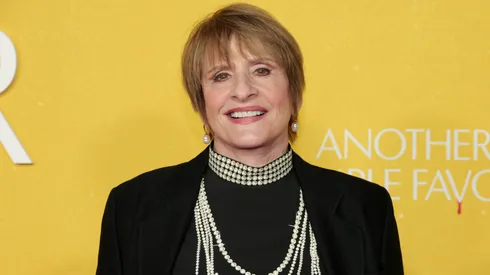
At 77, Patti LuPone stands as one of the last true bridges between classical Broadway discipline and modern stage spectacle. Born in 1949 and trained at Juilliard, she built her foundation in the early 1970s with The Acting Company before making her Broadway debut in 1973.
Over more than five decades, her career has expanded far beyond the stage, weaving through film, television and concert performances while maintaining a firm identity rooted in live theater.
A multi–Tony Award winner with additional honors including Olivier and Grammy recognition, she has remained a constant figure in an industry defined by turnover, moving between mediums without diluting her artistic imprint.
Patti LuPone’s most unforgettable onstage roles
Eva Peron — Evita
Patti LuPone didn’t just play Eva Perón in Evita—she defined it. Originating the role on Broadway, her performance earned her a Tony Award and instantly positioned her as one of the most commanding voices of her generation. The production itself became a cultural phenomenon, and LuPone’s interpretation—fierce, ambitious, and vocally explosive—helped cement its legacy.
Beyond the accolades, what made her Eva endure was its volatility. LuPone leaned into the contradictions of the Argentine leader, balancing charisma with calculation, vulnerability with steel. It was not a softened portrayal, but a charged one—setting a tone that later performers would inevitably be measured against, even decades later.
Mama Rose — Gypsy
If Evita made her a star, Gypsy reaffirmed her as a force of nature. Her portrayal of Mama Rose earned her a second Tony Award, and critics widely hailed it as one of the definitive interpretations of the role—a character already considered one of the most demanding in musical theater.
Rather than playing Rose as purely domineering, LuPone injected a raw emotional current into the performance. Her version felt less like a caricature of ambition and more like a slow-burning unraveling, where maternal obsession and personal failure collided in real time. The result was a performance that felt almost confrontational in its intensity.
Fantine — Les Miserables
In the original London cast of Les Miserables, LuPone originated the role of Fantine, earning an Olivier Award and expanding her reputation beyond the United States. The production would go on to become one of the longest-running musicals in history, and her early involvement placed her at the heart of its formative identity.
Her interpretation of Fantine leaned heavily into emotional realism, particularly in moments of quiet despair. Rather than relying solely on vocal power, she grounded the character in something more fragile—allowing the tragedy to unfold with restraint, which made its impact feel sharper and more immediate.
Norma Desmond — Sunset Boulevard
LuPone originated the role of Norma Desmond in the West End production of Sunset Boulevard, a part that quickly became as famous for its behind-the-scenes drama as for the performance itself. Her portrayal earned critical recognition and an Olivier nomination.
There was something almost meta about her take on Norma—a fading star clinging to relevance—played by an actress at the height of her powers. LuPone approached the role with theatrical grandeur, but also with a sharp edge that resisted turning Norma into mere spectacle, keeping her unsettlingly human.
Mrs. Lovett — Sweeney Todd
In the 2005 Broadway revival of Sweeney Todd: The Demon Barber of Fleet Street, LuPone took on Mrs. Lovett in a stripped-down production where actors doubled as musicians onstage. Her performance earned a Tony nomination and highlighted her technical versatility.
What stood out was her ability to navigate tone—balancing grotesque humor with emotional undercurrents. Playing the tuba while performing added a layer of physicality that turned the role into something almost kinetic, reinforcing her reputation as a performer who thrives under pressure rather than avoids it.
Joanne — Company
Decades into her career, LuPone found a late-career peak with Joanne in Company, a role that earned her a third Tony Award. The revival reimagined the story’s gender dynamics, giving her character renewed resonance.
Her performance of “The Ladies Who Lunch” became an event in itself—delivered with biting clarity rather than nostalgia. It wasn’t just a reprise of a classic song, but a reinterpretation that reflected both the character’s cynicism and LuPone’s own lived experience within the industry.
Patti LuPone’s most notable film and TV roles
Libby Thatcher — Life Goes On
LuPone reached a broader audience with the ABC series Life Goes On, where she played Libby Thatcher, the mother in a groundbreaking family drama. The show was one of the first to feature a main character with Down syndrome, giving it a distinct cultural impact.
Her performance brought a grounded, everyday realism that contrasted with her larger-than-life stage work. Over multiple seasons, she developed the character with subtle shifts rather than theatrical flourishes, showing a different side of her range—quieter, but no less controlled.
Frederica Norman — Pose
In Pose, Patti LuPone appeared in the second season as Frederica Norman, a wealthy and influential real estate developer whose ambitions place her in direct conflict with the ballroom community. The FX series, created by Ryan Murphy, is set in late-1980s and early-1990s New York and explores the rise of ball culture alongside the social and economic pressures faced by LGBTQ+ communities.
LuPone’s character operates as a symbol of institutional power, representing the forces of gentrification threatening to displace the very spaces where the show’s central characters find identity and belonging.
Rather than softening the role, she leans into its rigidity—portraying Norman with a composed, almost immovable authority. The performance is deliberately restrained, allowing the character’s influence to emerge through quiet decisions rather than overt confrontation, reinforcing the broader tension between visibility and erasure that defines the series.
Kathy Pizazz — American Horror Story: NYC
Patti LuPone’s involvement in American Horror Story is often remembered as brief, but it spans more than one chapter of the anthology. In the 2022 season NYC, she played Kathy Pizazz, a cabaret singer and business owner embedded in the city’s underground queer nightlife during the early 1980s.
The season itself leaned into a darker, more grounded narrative—intertwining serial crime with the emerging AIDS crisis—and LuPone’s character existed at the intersection of performance, community, and quiet decay.
Rather than dominating the storyline, her performance operated in a more atmospheric register. Kathy Pizazz moves through smoky interiors and bathhouse stages, singing to audiences even as the world around her begins to fracture.
LuPone brings a sense of theatrical history into the role—a former stage performer now rooted in a fading scene—adding texture without overwhelming the ensemble. It’s a contained performance, but one that lingers, shaped less by screen time and more by tone, presence, and the slow unraveling of the world her character inhabits.
Dr. Seward — Penny Dreadful
In Penny Dreadful, Patti LuPone took on a more substantial screen role in its third season, playing Dr. Florence Seward, an American “alienist”—an early form of psychotherapist—tasked with treating Vanessa Ives, portrayed by Eva Green. The character is a reimagined version of Dr. Seward from Bram Stoker’s Dracula, adapted into the show’s dense, literary-inspired universe.
What makes LuPone’s presence particularly compelling is the duality behind it. She had already appeared in the previous season as Joan Clayton, a powerful witch, and returns here as Seward—revealed to be a descendant of that same character, creating a subtle narrative echo.
Her performance shifts away from theatrical intensity into something more controlled and observational, grounding Vanessa’s psychological unraveling with a calm, methodical approach. In a series driven by gothic excess and supernatural chaos, Seward becomes a stabilizing force—though never entirely free from the darkness that defines the show’s world.
Lilia Calderu — Agatha All Along
In Agatha All Along, Patti LuPone stepped into the Marvel Cinematic Universe with a role that felt both unexpected and strangely fitting. She plays Lilia Calderu, a centuries-old Sicilian witch with the ability to perceive time non-linearly, joining a coven led by Kathryn Hahn’s Agatha Harkness.
The series, released in 2024 on Disney+, blends dark comedy, fantasy, and character-driven storytelling—an unusual tonal mix that gives LuPone space to explore something more abstract than her previous screen roles.
Rather than relying on sheer presence, her performance leans into fragmentation—Lilia exists slightly out of sync with reality, and LuPone mirrors that disorientation with precision.
Critics singled out her central episode as one of the emotional high points of the series, where the character’s arc moves from eccentric mysticism to something far more tragic and grounded.
The role also earned her major award nominations, reinforcing how seamlessly she can transition from the structure of theater to the unpredictability of modern television storytelling.