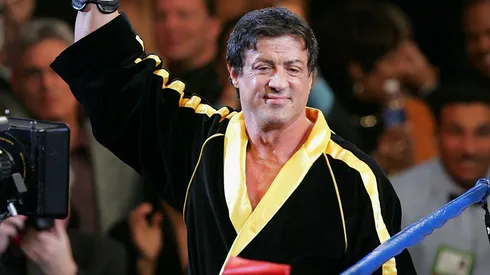
On this momentous day we are breaking down exactly how a penniless, unknown actor systematically built a boxing story into the most enduring, emotional, and multi-generational sports franchise in movie history.
Eighty years ago, Sylvester Stallone entered a world that didn’t favor the underdog. Today, on his 80th birthday, he stands as the architect of a cultural myth. As fans worldwide blast Bill Conti’s “Gonna Fly Now” to celebrate Sly’s big day, the industry’s eyes are locked on the horizon. This November 2026 marks the 50th anniversary of the original Rocky, a milestone being commemorated by Fathom Events’ remastered 4K theatrical re-release and the highly anticipated Amazon MGM biopic I Play Rocky (directed by Peter Farrelly and starring Anthony Ippolito).
But how did a script written in three days by a man with $106 in his bank account become a multi-billion-dollar cinematic empire spanning nine films and five decades? Stallone didn’t just stumble into a hit; he structurally engineered the sports movie genre to transcend the sports world entirely.
The Great Gamble: The Actor Contract Ultimatum
The franchise exists because Stallone understood that the character of Rocky was his intellectual property. In 1975, when producers Irwin Winkler and Robert Chartoff offered him a then-massive $330,000 for the script to Rocky, they wanted a bankable star like Robert Redford, Burt Reynolds, or James Caan in the ring. Stallone, completely broke and having just sold his dog Butkus to afford groceries, refused to sell unless he played the Italian Stallion himself. By forcing Hollywood to accept him as the physical embodiment of his words, Stallone ensured that the audience’s emotional investment in Rocky would mirror their real-life investment in Stallone’s own survival. It was a meta-narrative that modern cinematic universes still try to replicate today.
Subverting the Win: Shifting the Goalposts of Victory
Before Rocky, sports movies were traditionally obsessed with the clean, triumphant narrative of winning a trophy. Stallone made a radical choice in his original 1976 script: Rocky loses the final split decision to Apollo Creed. “I just want to go the distance. Nobody’s ever gone the distance with Creed.” — Rocky Balboa
By shifting the goalposts of the narrative from a gold belt to a personal victory of self-worth and survival, Stallone turned a boxing film into a universal human parable. It meant the franchise was never trapped by the limitations of a sports record. The audience didn’t care about the statistics of the fight; they cared that a lonely debt collector proved he wasn’t “just another bum from the neighborhood.”
The Serialized Life Cycle: The Sports Soap Opera
Stallone’s genius lay in recognizing that a sports franchise shouldn’t just repeat the big game; it should follow the tragic, messy reality of an athlete’s life cycle. Across Rocky II through Rocky Balboa (2006), Stallone handled the franchise like a prestige, long-form soap opera. We watched Rocky deal with sudden, overwhelming wealth, the crippling grief of losing his trainer Mickey, the Cold War trauma of losing his best friend Apollo, and eventual financial ruin and physical decline. By allowing the character to age in real-time alongside his audience, the fights ceased to be about standard boxing and became visceral physical manifestations of Rocky’s internal emotional struggles.
Weaponizing the Training Montage
You cannot discuss the sports movie genre without acknowledging that Stallone practically invented the modern training montage. Working alongside director John G. Avildsen, Stallone used the rhythm of editing and music to turn physical conditioning into a spiritual awakening. Running up the steps of the Philadelphia Museum of Art, punching slabs of raw meat, and carrying logs through the Siberian snow weren’t just filler sequences; they became cultural shorthand for human work ethic. Stallone realized that the preparation for the fight was infinitely more dramatic than the fight itself, giving audiences a blueprint for how to tackle their own real-life struggles.
The Ultimate Act of Deconstruction: Passing the Torch to ‘Creed’
The final stroke of genius that solidified Rocky as Hollywood’s greatest sports franchise was Stallone’s willingness to step out of the spotlight when the time was right. When Ryan Coogler pitched the concept of Creed (2015), Stallone didn’t let ego block the evolution of his universe. By allowing Rocky to step into the corner as a battle-weary, cancer-stricken trainer to Apollo’s son, Adonis (Michael B. Jordan), Stallone successfully passed the torch to a new generation. His devastating, deeply vulnerable performance earned him a Golden Globe and proved that the franchise’s core philosophy—resilience in the face of absolute loss—could adapt to the 21st century without ever losing its soul.
As Sylvester Stallone turns 80 today, the concrete steps in Philadelphia remain a monument to his unyielding imagination. He took a brutal, bloody sport and used it as a canvas to paint a masterpiece about family, love, and the simple beauty of getting back up when life throws its hardest punch. The Rocky franchise didn’t just dominate the box office; it became the definitive blueprint for how a story about an athlete can live forever.